

In The '40s, The US Military Detonated The World's First Nuke, Then Something Went Very Wrong
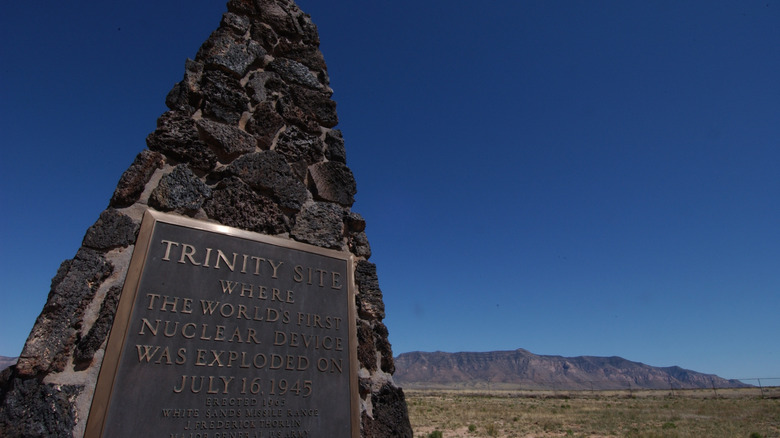
Today Ruidoso, New Mexico, is a quiet town full of vacationers and retirees. Many people visit during one of the yearly windows when the Trinity atomic bomb test site is open to the public. But Ruidoso was a dangerous place to be on the morning of July 16, 1945, when things went very wrong during the world's first nuclear fission bomb detonation, leading to unnecessary deaths.
Later that day, when something resembling snow began to fall, young girls camping near a creek in Ruidoso excitedly ran outside to play with the substance. What they did not know (and the U.S. Army deliberately had not warned them about) was that the substance was dangerous nuclear fallout. The explosion was not acknowledged as a nuclear bomb until after nuclear weapons had been dropped on Japan.
Unfortunately, this was only the first in a long line of nuclear tests conducted on unwitting military and civilian personnel. The awesome power of the bomb detonated in rural New Mexico spread more than just nuclear fallout — it began the Cold War.
Disastrous Trinity Test miscalculations
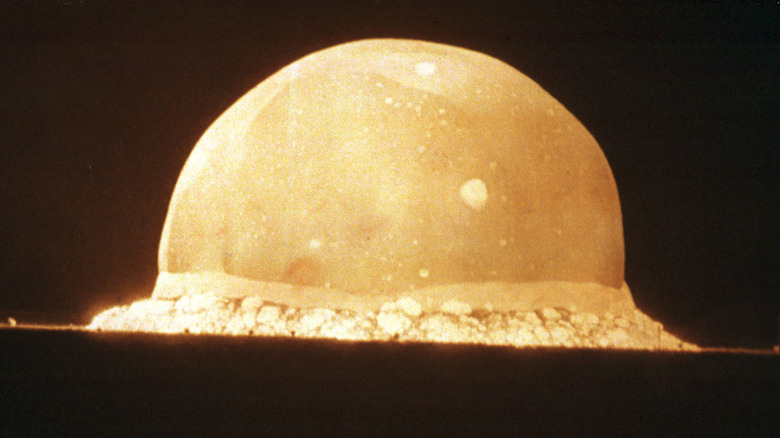
The top-secret nature of the U.S. military's nuclear bomb development program precluded warnings to New Mexico's residents about the impending blast, despite urging from the scientists involved. Afterward, the locals were told only that a large ammunition depot had exploded.
The expected yield of the Trinity test had been equal to about 7,500 tons of TNT (dynamite) but was later calculated as closer to 21,000 tons of TNT. This had spread the effects of the blast over a much greater distance than expected, which made the cover story less plausible. The force of the blast broke windows 120 miles away. The flash of light from the detonation was seen 280 miles from the test site.
A family living 45 miles from the test site, where radioactive ash settled thickly on the property, soon noted the mysterious deaths of all their chickens and the family dog. In the months after the Trinity test, infant mortality rates spiked downwind of the blast. Despite the concerns of New Mexico healthcare providers, the U.S. Army denied that there was any danger to public safety and health.
The test was acknowledged as a nuclear detonation on August 6, 1945 when President Truman announced the bombing of Hiroshima. However, despite this recognition, the families affected by the Trinity fallout were not compensated until 2025 when the Radiation Exposure Compensation Act was reauthorized and expanded.
Postwar nuclear developments
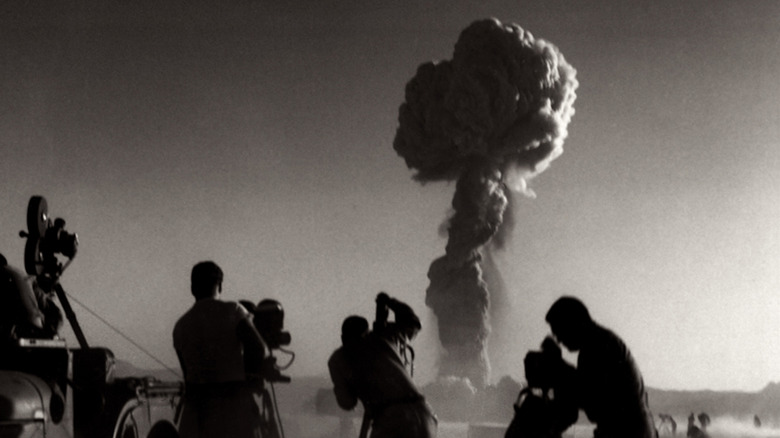
Prior to the Trinity test, the U.S. had developed weapon designs with both uranium and plutonium cores. As neither design had ever been tried before, the scientists were unsure which would work better (i.e., be more destructive). Both uranium enrichment and plutonium production were completely new processes.
The Trinity test, with a plutonium core, was considered a success by the military commanders, scientists, and engineers who witnessed it. The bomb dropped successfully on the Japanese city of Hiroshima on August 6 had a uranium core. It was followed two days later by the bombing of Nagasaki using another plutonium device. Emperor Hirohito of Japan formally surrendered a week later on August 15, 1945.
Although the role of the bombs in hastening the end of the war remains debatable, they did usher in the nuclear age. Four years after the end of World War II, the Soviet Union tested its own nuclear weapon. The weapons programs resulted in the development of nuclear energy, which is an abundant energy source when managed properly.
Throughout the 1950s and 1960s, the U.S. rapidly developed and tested various nuclear bomb designs on land, over the ocean, underground (where they caused earthquakes), and even in space. Since 1963, a Limited Test Ban Treaty has prohibited nuclear testing in the atmosphere, outer space, and underwater. A Comprehensive Test Ban Treaty was written in 1996 but has not yet been ratified by all 44 acknowledged nuclear-capable governments.