

In The '50s, The US Military Exposed Soldiers To Nuclear Blasts And The Result Was Horrifying
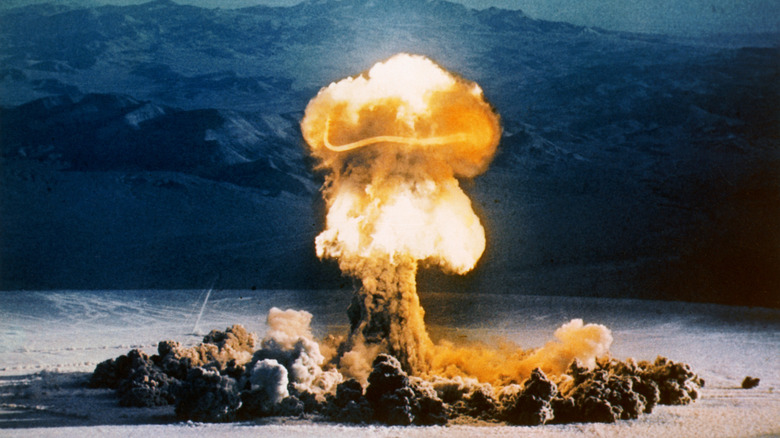
During the Cold War, U.S. weapons testing bordered on the inhumane. During the Starfish Prime test, for example, nukes were launched into space, but not before several failures left radioactive debris raining down over Pacific islands. The Castle Bravo test was even more destructive, leaving a legacy of cancer and birth defects on nearby atolls. But perhaps the most wanton disregard for human life was Operation Plumbbob, which intended to study the effects of a nuclear bomb on pigs — while thousands of human service members became test subjects, too.
Operation Plumbbob was a series of nuclear tests conducted in 1957 in the Nevada desert, roughly 65 miles north of Las Vegas. The unpopulated area provided the ideal testing ground for studying the effects of nuclear bombs on fauna, and over 1,200 pigs were placed in varying distances and degrees of exposure. Some pigs were fitted with armor to test protective materials, others were placed in shielded containers, and others were placed aside glass panes to test debris damage. Over the course of four months, 29 nuclear bombs were detonated during Operation Plumbbob. Allegedly, most pigs survived with horrific burns covering up to 80% of their bodies.
Military officials sought to take advantage of the mushroom clouds on the horizon, since the landscape simulated that of a nuclear battlefield. Over 16,000 service members participated in exercise maneuvers called Desert Rock VII and VIII in the Nevada Test Site near the nuclear tests. The most damaging was the "Smoky" bomb, a 44-kiloton nuke that was detonated just a few miles from a group of over 3,000 soldiers. While the mushroom cloud was still forming, the soldiers were ordered to charge towards it in helicopters.
The Smoky nuke explosion and its legacy of cancer
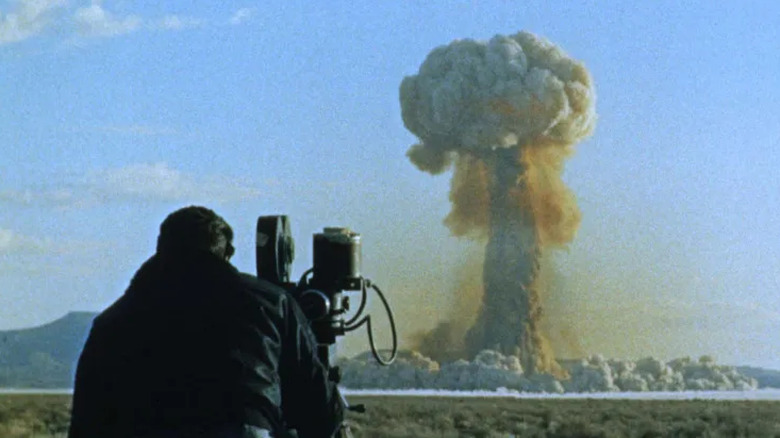
On August 31, 1957, around 3,000 soldiers from the U.S. Army assigned to "Task Force WARRIOR" were instructed to wait in an observation zone called News Nob and prepare to approach the scheduled "Smoky" bomb a few miles away. Immediately after the bomb's detonation, the soldiers were loaded into helicopters and dropped off within three miles of ground zero. Overall, the exercise was seemingly successful, with few immediate injuries reported. It wasn't until 1979 that the Centers for Disease Control reported that participants exposed to the nuclear test had more than twice the normal leukemia rate.
Officially, the "Shot Smoky" test was never intended to study the effects of radiation on the service members, even though military leaders and scientists were well-aware of the dangers. However, they either underestimated the power of the long-term effects or intentionally minimized them. If it's true that the long-term effects of radiation exposure were swept under the rug, then the soldiers who participated were right to later claim that they were used as guinea pigs. Very few follow-up or long-term medical studies were conducted.
Only a few years earlier, the military dropped vaporized zinc cadmium sulfide from planes onto a low-income African-American neighborhood in St. Louis in a secretive study on the spread of hypothetical biological weapons. Although the compounds were considered non-toxic at their concentrations, affected residents still sought compensation for the area's elevated cancer rates in the ensuing decades. And in 1977, the Army declassified a total of 239 biological warfare tests on civilian populations in the '50s and '60s. Clearly, the willingness of the U.S. government to use its own citizens as non-consenting human test subjects isn't new.
The science behind radiation exposure

High-energy radiation, such as that emitted by an atomic bomb, can damage DNA and lead to various cancers. Leukemia is often the first cancer to appear after exposure. Cancers of the blood have a short latency period, since blood–forming cells replicate quickly and travel through the entire body. From the initial mutation event, such as a short-but-intense exposure to the flood of gamma rays and free-flying neutrons produced by an atomic bomb, leukemia usually takes only 5 to 10 years to develop into its symptomatic stages.
The second reason so many victims of the "Smoky" bomb developed leukemia is because of the damage to their bone marrow. The bomb was a nuclear chain-reaction weapon, whose initial trigger was the fission of plutonium-239, followed by the "boosting" fusion of deuterium and tritium isotopes. The reaction produces strontium-90, which attached itself to the desert dust and entered the lungs of the nearby service members. Unfortunately, strontium-90 can mimic calcium in the body, which uses the imposter element to reinforce its bones. Once embedded in the soldiers' skeletons, strontium-90 continued to decay and irradiate their already-damaged bone marrow, leading to a greater risk of blood cancers.
To what degree the participants of Operation Plumbbob were "guinea pigs" is debated, but it's certain that the risks of radiation exposure from nuclear bombs shouldn't be tested on uninformed, sentient subjects.