

The Evolutionary Quirk That Keeps Making Species Look Like Crabs
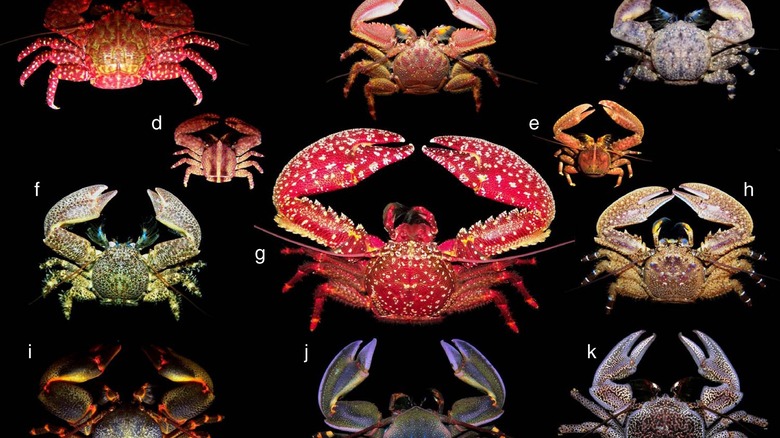
There's a popular science meme that "everything evolves into crabs," and its origins may go back as far as H.G. Wells' 1895 novel "The Time Machine," in which the far-distant future is inhabited by giant, crab-like creatures. The meme plays on a long-recognized pattern of convergent evolution called carcinization. First scientifically described in 1916, carcinization is the tendency for many non-crab crustaceans to evolve crab-like bodies, even those distantly related. For example, hermit crabs, king crabs, and porcelain crabs aren't crabs at all. Instead, the recent common ancestor of "false crabs" and "true crabs" diverged around 250 million years ago.
The meme over-exaggerates the scope of the pattern, since carcinization only refers to non-crab crustaceans. However, the genetic distance between false crabs and true crabs is vast; the most distantly related "false crab" is the hairy stone crab, which is about as closely related to a true crab as humans are to platypuses. Yet, humans and platypuses have extremely different body plans, since our evolutionary lines split during the Jurassic period. Why, then, does the hairy stone crab look so much like a crab if it's not a crab?
First, consider what scientists mean by "crab-like body plan." Carcinization doesn't describe a creature's genetics. Instead, it refers to the external features of the creature. Some of those features include a broad, flat carapace across the main body segment; a shortened, hidden abdomen; specialized front claws; legs on the sides that can move sideways; and eyes that can be tucked away or retracted into the body. With so many shared features, it's hard to distinguish a false crab from a true crab. However, the give-away is in the legs: True crabs (Brachyura) have four pairs of walking legs, while false crabs (Anomura) only have three.
The differences between true crabs and false crabs
Although convention labels the infraorder Brachyura as "true crabs" and Anomura as "false crabs," they both look like crabs. Their recent common ancestor was likely a small, shrimp- or lobster-like creature, which split into the two lineages around 250 million years ago when Earth had just one mega-ocean. (Our current oceans are set to change, too.)
The most distinguishing features between Brachyura and Anomura are how they use their legs; Anomura, or false crabs, only dedicated three of their five pairs of limbs to walking, while Brachyura devoted four. Anomura's other two pairs are the front claws and the back limbs. Unlike Brachyura, the back pair shrank and became specialized limbs for specialized tasks, depending on the species.
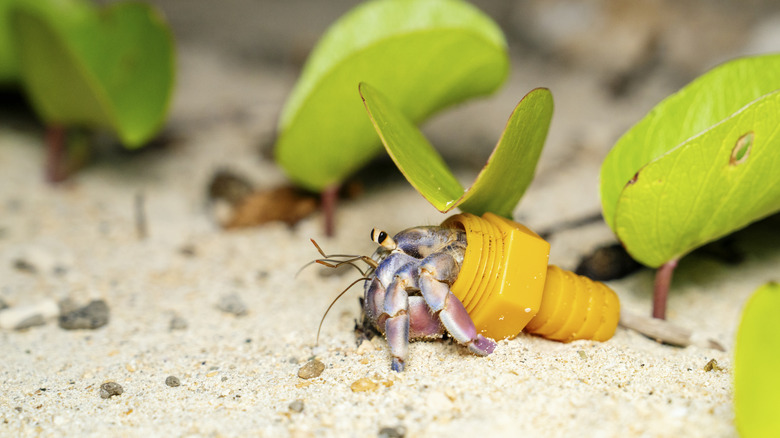
Hermit crabs are false crabs. Rather than adding a fourth pair of legs for walking, their hind limbs are used to grip the inside of their shell. This is where hermit crabs lack a feature of the crab-body plan. Rather than evolving a broad, armored carapace, hermit crabs and juvenile coconut crabs adapted their hind quarters to commandeer empty shells and husks on the beach.
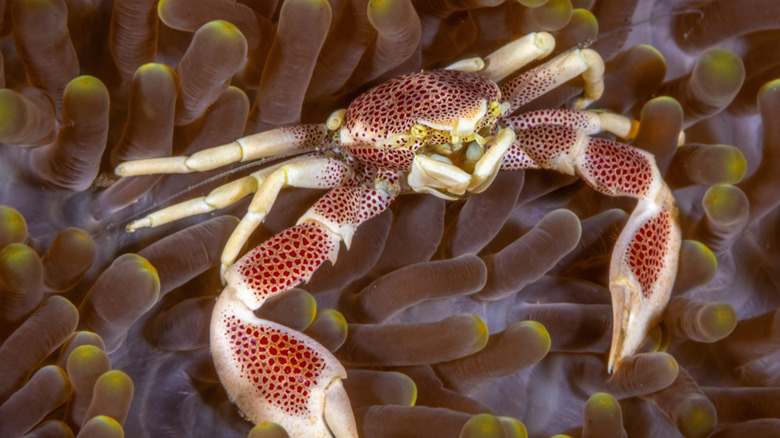
Porcelain crabs are also Anomuran. Their rear limbs are specialized for life under rocks and sand, where they filter feed. Because their gills are constantly under assault from silt, sand, and other debris, the porcelain crab can slip its rear limbs into the inner compartments of its carapace to gently brush away irritants. Yet, despite one fewer pair of legs for walking, Anomuras adapted to the crab lifestyle perfectly. They may not have the dexterous, agile side-winding locomotion of four-legged true crabs, but their scuttling lives in the intertidal zones are just as successful.
False crabs aren't imposters, and there's nothing false about them
Calling creatures that evolved through carcinization "false crabs" is something of a disservice, since there's nothing "false" about them beyond our human instinct to label them as crabs. After all, these creatures evolved alongside "true crabs" for hundreds of millions of years, and the phenomenon isn't the result of animal mimicry. The skin patterns of a false coral snake, for example, mimic those of the venomous coral snake to trick predators into thinking that it too is deadly. And the Australian orb weaver spider mimics bird poop to hide in plain sight. "False crabs," however, are not imposters — their crab-like morphology arose through the same evolutionary pressures that shaped so-called "true crabs."
Mimicry doesn't work when everyone is doing it, and it certainly doesn't explain carcinization among crustaceans. The infraorder Anomura contains 2,500 species, and many more distantly-related animals have "crab" in their name, such as the horseshoe crab (which is part of an entirely different infraorder and more closely related to spiders). Clearly, there's an evolutionary advantage in the body plan of a crab.
The most widely-accepted theory on the convergent evolution between non-crab crustaceans and crabs mostly boils down to their environment. By the numbers, crabs and crab-like crustaceans flourish along the seafloor and intertidal pools, and their body plans are adapted to scuttling across rocks, coral, and sand while the shifting tides and constant predators threaten to sweep them away. Every aspect of their environment demands speed, efficiency, fast reproduction cycles, and sharp, armored protection. Perhaps the meme is better said, "Many mid-sized crustaceans tend to turn into crabs in seafloor and intertidal environments." Unfortunately, the truth isn't as meme-worthy.