

The Smell Of This Body Part Could Help Scientists Detect Parkinson's
The diagnosis of Parkinson's disease requires a lengthy process of reviewing medical records and symptoms while conducting various blood tests and imaging scans. On top of that, it can be particularly difficult to diagnose the condition early on since it can take months to years for obvious symptoms to develop. Scientists have been looking for improved diagnostic methods that make it easier and more cost-effective to detect the disease. They may have found the answer in the odor compounds in the belly button, the unexpected body part that can start "leaking" at any moment.
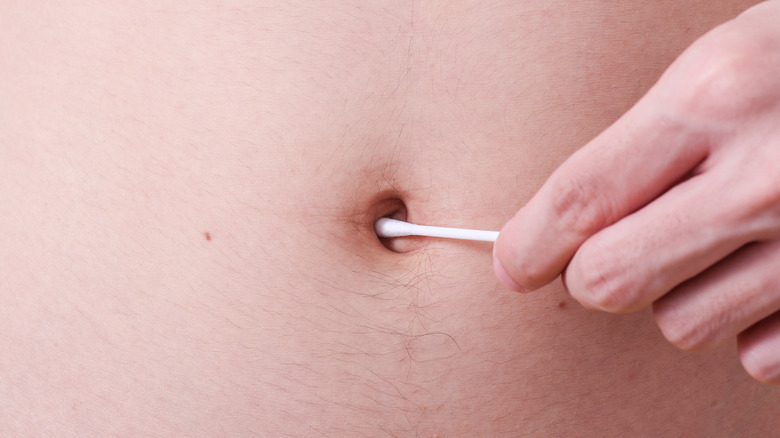
Researchers at Germany's Technical University of Dresden and Fraunhofer Institute for Integrated Circuits IIS conducted a proof-of-conduct study to investigate how body odor changes when people develop diseases. Publishing their research in Scientific Reports, they explain how they used laser-based photoacoustic spectroscopy to analyze volatile organic compounds (VOCs), compounds that are released as gases from various areas of the body. They took odor samples from the belly buttons, ears, and noses of patients who are healthy and diagnosed with COVID-19, mild cognitive impairment, and Parkinson's disease.
After the cotton swab samples were placed into a special holder, purified synthetic air was blown onto them so that the VOCs were directed into the laser-based photoacoustic spectrometer. The VOCs then absorbed the infrared light, which heated and caused the surrounding gas to heat, expand, and generate sound. Using principal component analysis, a statistical technique, the belly button samples provided the most distinct patterns.
This isn't the first time smell has been related to detecting Parkinson's
Detecting diseases with smell is a relatively new concept. After all, even there's even the "old people smell" phenomenon that's easily explained by science. There was also a study published in Psychological Science in 2014 that found "experimental evidence that disease smells" and that humans have the ability to develop such a superhuman smelling ability that could actually save lives.
In fact, that evidence was somewhat substantiated by former nurse Joy Milne. She noticed that everyone she met and who had been diagnosed with Parkinson's had the same musky scent as her husband, who also has the disease. When she mentioned it to a University of Edinburgh researcher, they conducted an experiment smelling T-shirts. She correctly identified every participant with Parkinson's, including one who hadn't been diagnosed yet.
Other research into odors being used to diagnose diseases has been published as well. Published in ACS Central Science in 2019, a study identified distinct VOCs in people with Parkinson's disease after testing VOCs in sebum, the oils produced by the skin, from the upper backs of 64 people. Another was published in Nature Communications in 2021, providing more evidence that sebum can be used to detect VOCs associated with the disease. The hope is that this and other research can be used to develop an ideal method for testing VOCs in a clinical setting to make diagnosing Parkinson's easier and faster.