

Scientists Reexamined A 45-Million-Year-Old Crocodile Fossil. They Noted A Bizarre Connection
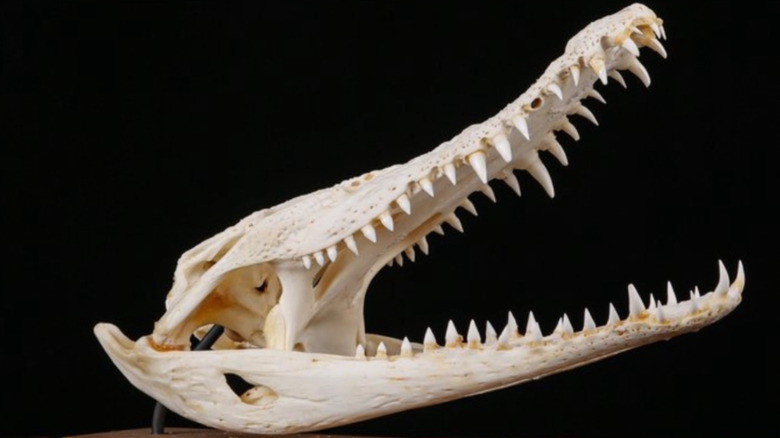
Identifying fossils isn't easy because many species have similarities. As a result, a lot of fossils have either been unidentified or misidentified. Such was the case with an almost fully intact skull, found in Egypt's Mokattam Formation during the 1920s. It was misidentified as a Tomistoma species, a genus that belongs to the family Gavialidae. After scientists took another look, they discovered it was a new extinct species of crocodile with a bizarre connection to a monument in the area: a missing nose.
Located in Northern Egypt, the Mokattam Formation is a 45-million year-old thick layer of limestone, the same stone used to make monuments like the Great Sphinx, Great Pyramid of Giza, and other archaeological sites and structures in Greater Cairo. That outcrop has preserved a lot of prehistoric fish, shark, and whale fossils, and researchers recovered a skull and other fossils from the area that were classified in 1927 as belonging to Tomistoma. Knowing that the fossils were distinct, scientists decided to take a better look using CT scanning.
Finding several distinguishable features from Tomistoma and describing them in Royal Society Open Science, the researchers have named the new extinct crocodile species Herugavialis cairensis. The name pays homage to Heru, the ancient Egyptian god that may have been the inspiration for the Great Sphinx. That's because, like the monument, the prehistoric croc is missing the tip of its nose.
A description of Herugavialis cairensis beyond the missing nose
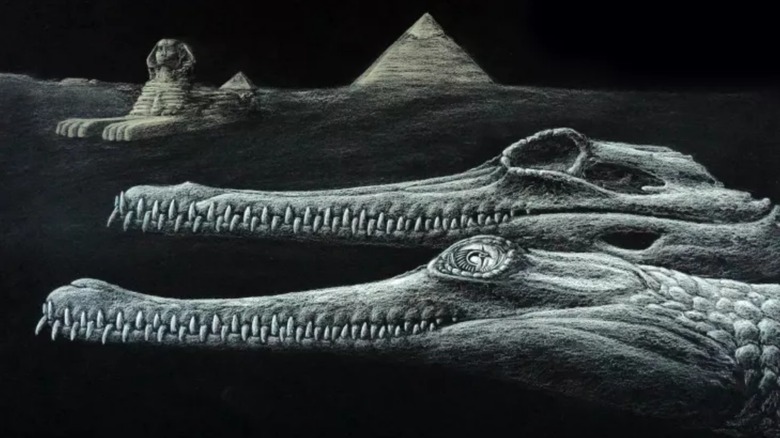
In the paper re-identifying the fossils from the Mokattam Formation, the authors provide a detailed description of the newly named Herugavialis cairensis, a semiaquatic predator. It includes a long, narrow snout and teeth, the latter of which are razor sharp. Like the Indian gharial (Gavialis gangeticus), a related species, the prehistoric croc's eye sockets were raised, indicating that its eyes protruded from its head. These characteristics were likely adapted for capturing cartilaginous and bony fish, whose fossils could be preserved in the Mokattam Formation as well.
H. cairensis is one of only six gharial species that are known to have roamed the Mediterranean from 66 to 23 million years ago, millions of years before the Great Sphinx was built about 4,500 years ago. It probably wasn't anything compared to Sarcosuchus imperator, the largest prehistoric crocodile ever discovered, however, the discovery of H. cairensis adds another piece of the puzzle to the gharial group's complicated evolution and gives scientists a better picture of how ancient crocodilians influenced ecosystems during the Eocene epoch.
Today, there are no crocodilians in the Mediterranean, and only two gharial species are known to be living — the gharial in South Asia and the false gharial (Tomistoma schlegelii) in Southeast Asia. Both of them are critically endangered and can live up to 60 years and 80 years, respectively. That's a far cry from the crocodile that's lived longer than most people probably ever will — 125-year-old Henry who lives at the Crocworld Conservation Centre in Scottburgh, South Africa.