

The 7 Scariest Creatures From The Oceans' Depths
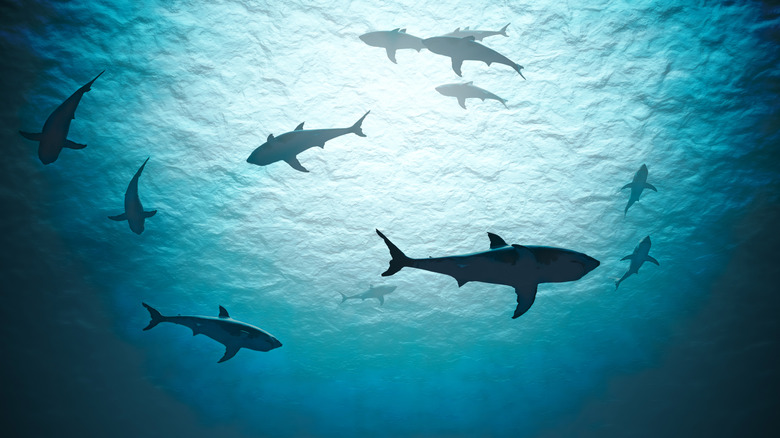
The ocean is really, really, really big. That may sound obvious, but let's put it into perspective. The National Ocean Service estimates that the global ocean holds a mind-boggling, 352,670,000,000,000,000,000 gallons of water. That's enough zeroes to make Elon Musk's bank account blush. By covering nearly three-quarters of the globe, the ocean also holds far more life than we share on land, but we hardly know the start of what's down there. Less than one percent of the deep ocean seafloor has been actually observed by researchers, which leaves massive gaps in our knowledge. The deep sea is almost as mysterious as outer space, and it turns out the lifeforms there are creepier than anything in science fiction.
Living in the deepest parts of the ocean isn't for the faint of heart, and it requires very special evolutionary adaptations to do so. These adaptations make sense in nature, but to our human eyes, they often look flat-out frightening. The deep sea is home to more nightmares than even the deadliest animals on land. With that in mind, here are seven creepy deep sea dwellers that you wouldn't want to come across on a swim.
Anglerfish
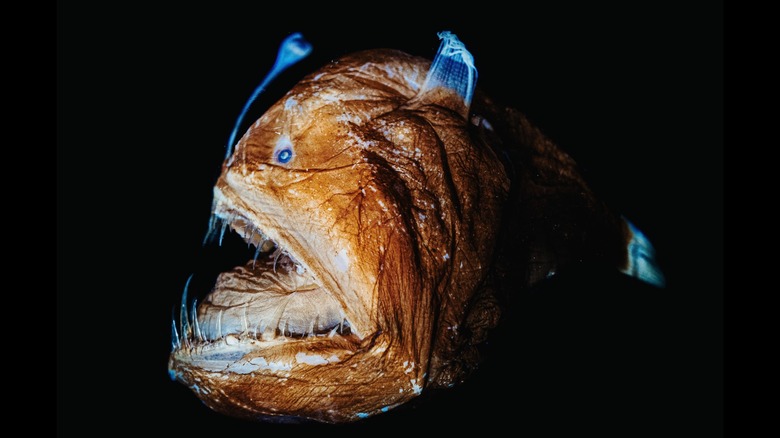
The order Lophiiformes, commonly known as anglerfish, comprises more than 200 species of ghoulish bottom-dwelling predators. They are named for the distinctive "lure" that hangs in front of their face to attract prey. This is called an esca, and it's actually an extension of their dorsal fin that evolved over millennia to serve this particular purpose. In deep-sea anglerfish, such as the infamous humpback anglerfish, the esca is capped by a bioluminescent bulb that casts an eerie glow, putting it among the list of animals that emit their own light. Anglerfish that live in shallower environments often have different adaptations, such as the frogfish, whose esca is shaped like a little shrimp.
Goblin shark
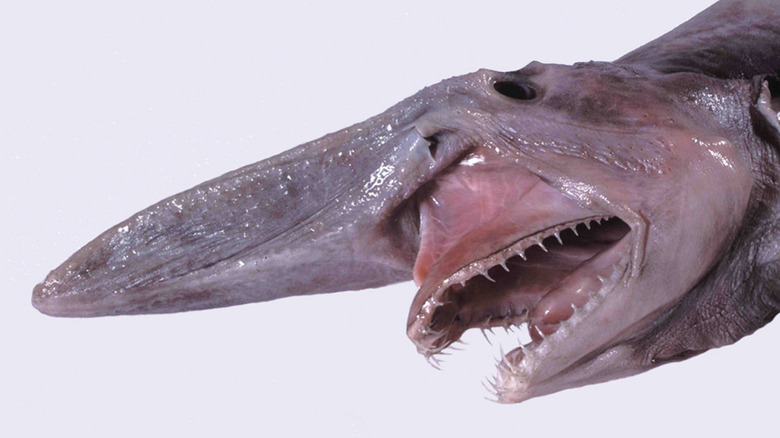
The depths of the ocean is where Mother Nature really whipped out the ugly stick, and the goblin shark (Mitsukurina owstoni), is truly a case for the books. Those jaws have a particularly terrifying adaptation for catching prey. They are protrusible, meaning the jaws extend forward to reach the shark's prey. They can extend to around nine percent of the shark's total length, and do so at such speed that it creates a suction force, pulling victims straight in. With this tool, goblin sharks act as vicious ambush predators, their sharp teeth bursting forth to decimate the fish, crustaceans, and cephalopods it feeds upon.
Viperfish
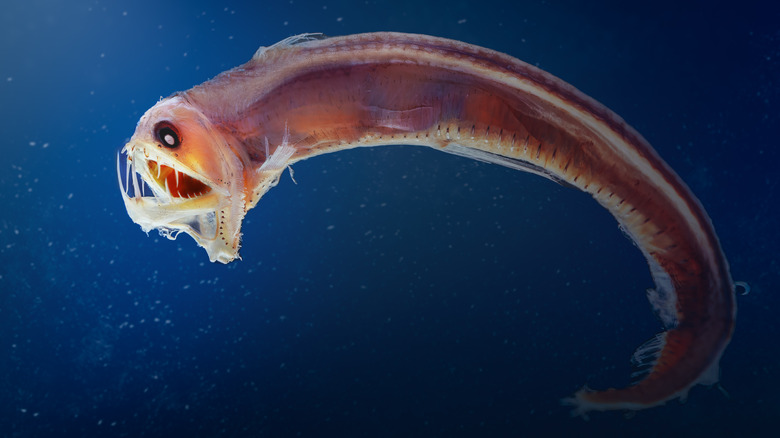
There are nine species in the genus Chauliodus, and their formidable sets of fangs have earned them the colloquial title of viperfish. Among these, Sloan's viperfish (Chauliodus sloani) is a particular standout, having the largest tooth-to-skull size of any known fish. In fact, it can dislocate its jaws and use its long teeth like a cage, allowing the fish to trap prey even larger than its mouth can accommodate. This way, the viperfish is able to consume fish up to two thirds its own size, eating meals big enough to sustain it for two weeks at a time.
Giant isopod
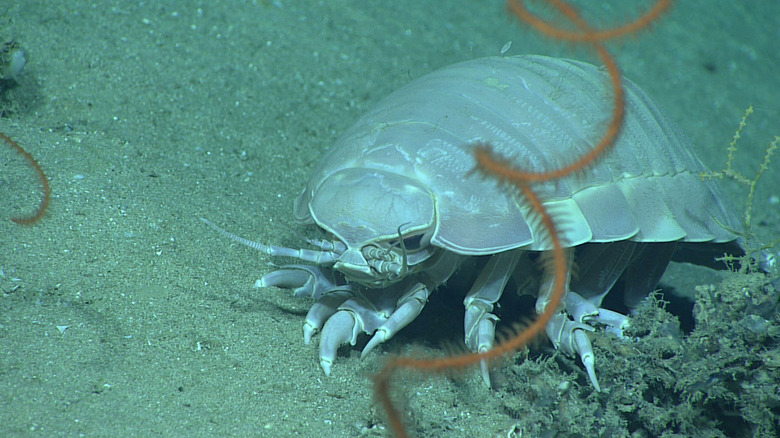
At up to 16 inches in length, the giant isopod (Bathynomus giganteus) is by far the largest isopod species, an example of a phenomenon called deep-sea gigantism. Although they look disturbing, they are quite docile when compared to most of the other species on this list. They are scavengers that feed on marine snow, a term used to encompass all the detritus — dead animals, plants, and fecal matter — that trickles down to the bottom of the ocean. Since marine snow is an unpredictable source of nutrients, giant isopods have evolved to have very slow metabolisms. They can reportedly survive for years without eating if no food is available.
Bobbit worm
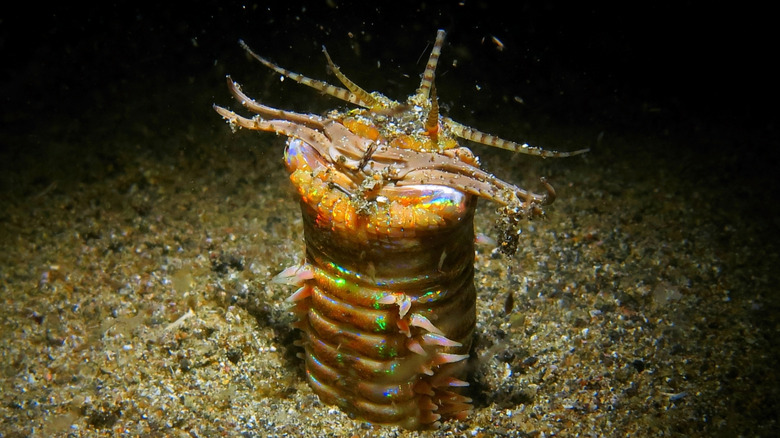
The bobbit worm (Eunice aphroditois) gets its common name from the infamous tale of Lorena Bobbitt, an American woman who, in 1993, cut off her abusive husband's genitals, and let's just say you don't want to go skinny-dipping near this creature. The worm has incredibly sharp teeth, essentially turning its jaw into a set of scissors. It buries itself beneath the seafloor sand, with only its sensitive antennae poking out. If any passing prey brushes against those antennae, the worm bursts forth from its hiding place, snatching the unfortunate victim. Its jaws are so sharp that they sometimes slice fish in half with their bite.
Frilled shark
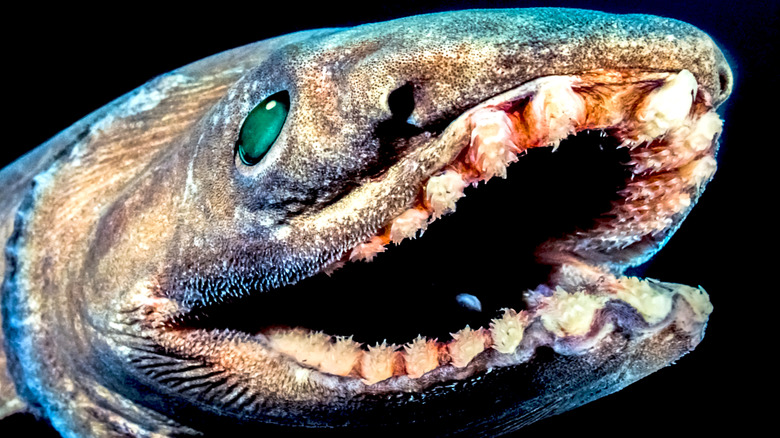
The frilled shark (Chlamydoselachus anguineus) is thought to have first emerged around 80 million years ago, during the Cretaceous period. This was the last of the three periods in which the dinosaurs lived, which means frilled sharks once shared Earth with Tyrannosaurus rex! Frilled sharks have an absolutely terrifying set of 300 trident-like teeth, layered into 25 different rows. All of the teeth point in towards the shark's mouth, so fish that swim in cannot back out without tearing themselves to shreds. The frilled shark hunts like a snake, lunging at its prey with jaws wide enough to gulp down victims almost as large as they are.
Lamprey
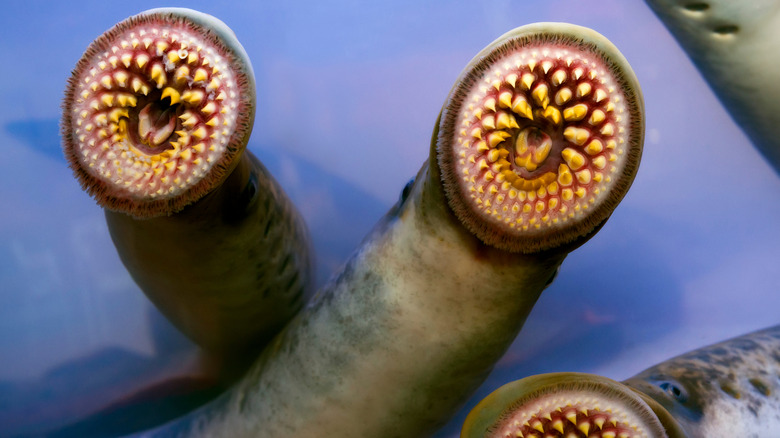
There are about 40 species of lamprey, comprising the family Petromyzonidae. They are one of the oldest animal species on the planet, older even than the first dinosaurs. They have existed in their present form for at least 340 million years, and have survived multiple mass extinction events. Lampreys have a truly disturbing way of feeding, latching onto prey with their sharp teeth, boring a hole in it with their tongue, then sucking out the bodily fluids like a leech. Each lamprey, which only weighs a pound on average, can kill 40 pounds of fish each year. This is one reason they are considered one of the most destructive invasive species in the world.