

A US Military Scientist Discovered This Material Twice Before Patenting It, But He Didn't Expect What Happened Next
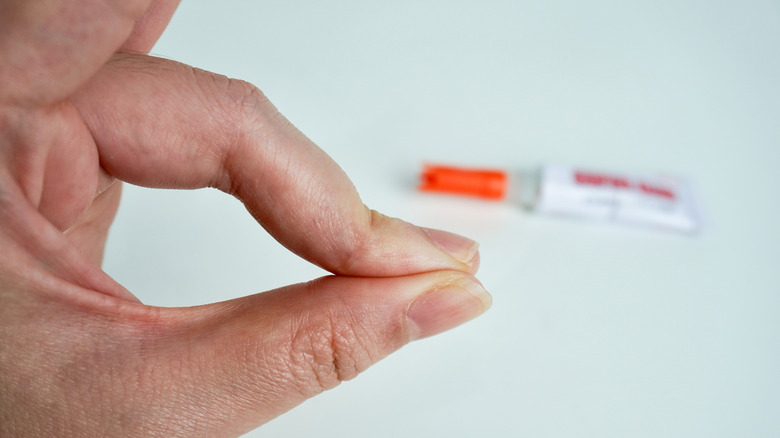
Many amazing scientific discoveries have been made by accident, from Alexander Fleming's moldy petri dish and the creation of penicillin to Percy Spencer accidentally melting the chocolate bar in his pocket while working with microwaves. Harry Coover made a significant accidental discovery not once, but twice, after abandoning his work with cyanoacrylates because they were sticking to absolutely everything, rendering them unusable. It wasn't until he encountered them again almost a decade later that he realized their incredible power — in the form of superglue.
Coover was an American chemist working for Eastman Kodak during World War II, as part of a research team attempting to make a transparent plastic to be used as a gunsight. A group of compounds known as cyanoacrylates were considered, but they were impossible to work with due to their intense stickiness. The research team's brief was to create a clear, shatterproof polymer for soldiers to look through in the challenging conditions of the front line to improve their aim. This meant that a substance that stuck to everything it came into contact with, assuming there was any moisture present, was never going to be of any use.
Reflecting on the discovery, Coover told Adhesives and Sealant Industry, "Cyanoacrylates worked great in reproducing the mold for the gunsights. The problem was, everything I was working with stuck to everything else. It was just a big pain." The extreme time pressure the team was under meant that the super-adhesive substance was discarded, without any thought of how its incredible properties could be exploited. It would take another nine years before a second frustrating encounter with the substance gave Coover an insight into what he had discovered.
A second accidental discovery changed everything
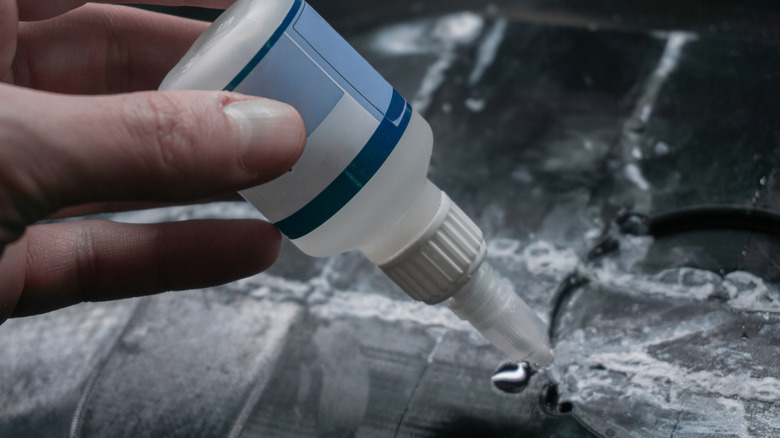
By 1951, the war was over and Coover's work at Eastman Kodak involved developing a heat-resistant polymer that could be used in jet planes. Cyanoacrylate was again considered, and his colleague Fred Joyner prepared to test the compound using refractometer prisms. After applying the liquid to the prisms, he found they had stuck together and could not be separated. Coover was intrigued by an adhesive that could stick so solidly without heat or pressure, and began to investigate its unique properties.
When exposed to a small amount of moisture, cyanoacrylates form long molecules during the process of polymerization, creating extremely strong bonds. This happens almost instantly, leading Coover to the realization that he had an incredibly unique adhesive on his hands. He got a patent for his glue in 1956, and in 1958 it was released commercially as Eastman 910. The success of the product was helped along by a television appearance, when he joined host Garry Moore on game show I've Got a Secret. He revealed the potency of his superglue to the nation by suspending himself and the host from metal bars using just one drop of the substance, introducing a wide audience to the potential of what is now a household essential. "Dr. Coover's secret is that the only thing between my 150 pounds and that wire, will be one drop of glue," host Moore said.
By the 1970s Coover's superglue had become a phenomenal commercial success and was sold on seven continents. However, its value extended far beyond its ability to stick wood or plastic together, and had potentially life-saving uses that Coover could never have imagined.
From laboratory adhesive to battlefield lifesaver
While the initial discovery of superglue happened during World War II, it was to take on a new use in a different conflict — the Vietnam War. Medical personnel discovered that the adhesive could be used to seal wounds and prevent bleeding temporarily, until the soldiers could receive proper medical treatment. The glue was sprayed onto battlefield injuries by field doctors, acting as an effective emergency treatment in the absence of any other method of preventing the soldiers from bleeding out.
Versions of cyanoacrylates have since been approved by the FDA for medical use, though this doesn't apply to a regular tube of glue from your local hardware store, in case you were thinking of doing some at-home surgery. It is used in certain cases in place of stitches, but is not generally used in serious wounds any longer.
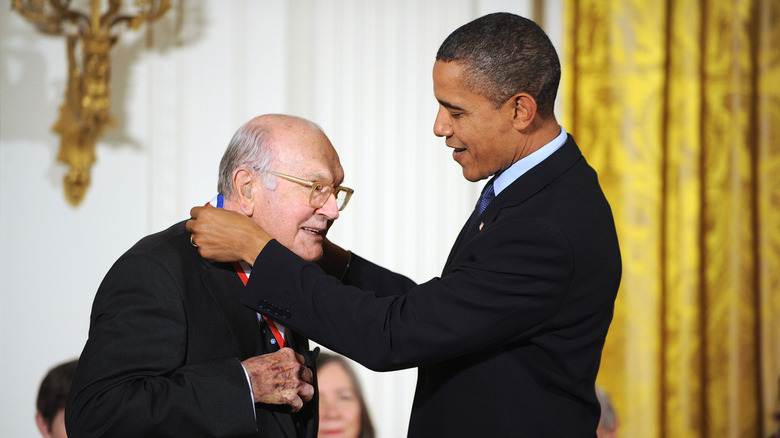
Superglue was certainly not Coover's only contribution to science, with 460 patents granted to him across his career. However, it was undoubtedly his biggest success, and in 2010 he was presented with a National Medal of Technology and Innovation, given to him by Barack Obama. "Serendipity gave me a second chance," Coover said after receiving the award, acknowledging the extraordinary circumstances that eventually led to his discovery. What started in the 1940s as a failed military project has gone on to become a stalwart of the multi-billion dollar adhesives industry and an indispensable DIY product in homes around the world.