

The Pantry Staple That Still Contains Radioactive Fallout From Cold War Nuclear Testing

In the early years of the Cold War, the world saw hundreds of atmospheric nuclear weapons tests in the South Pacific, the Russian Arctic, and the American Southwest states of New Mexico and Nevada. The Nuclear Test Ban Treaty of 1963 put strict limits on nuclear tests, but the environmental effects of these explosions lingers on decades later. In a 2021 study, researchers found evidence of radioactive fallout in an unexpected place: fresh honey.
Scientists found traces of radioactive cesium-137 in 68 of 122 samples of honey from the Eastern United States. Although not at a level considered hazardous to humans, the concentrations of cesium-137 found were roughly 100 times greater than what is normally seen in other foods. Cesium-137 has been spread throughout the atmosphere by nuclear tests and by nuclear plant accidents like the disasters in Chernobyl in 1986 and Fukushima, Japan, in 2011. However, studying the levels of radioactive decay shows that the vast majority of the cesium-137 found in the study came from atmospheric nuclear tests.
What goes up must come down
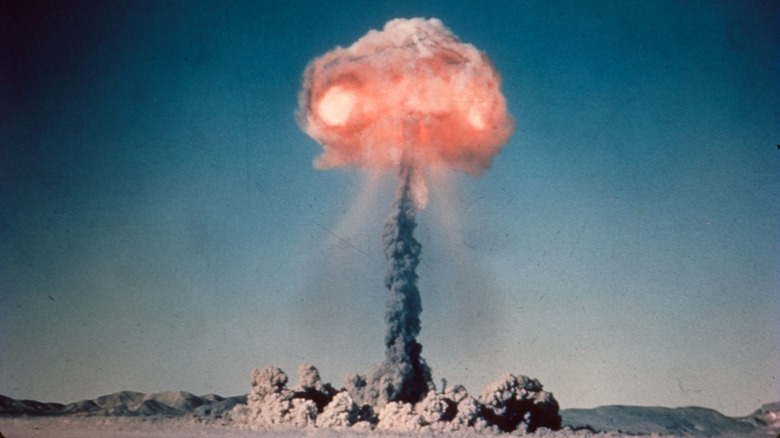
Fallout consists of radioactive dust that is kicked into the stratosphere during a nuclear explosion. While atmospheric nuclear tests of the early Cold War were carried out in remote locations, wind currents carried fallout long distances for up to a year before those radioactive particles returned to the surface through rainfall. Prevailing winds in the United States tend to blow from west to east, which drove fallout from test sites in Nevada eastward toward populated areas. This led to relatively large amounts of cesium-137 reaching the ground in the eastern part of the country.
However, the areas where honey had the highest concentration of cesium-137 weren't always the regions with the greatest contamination. Weather patterns led to higher cesium-137 levels in soils in the northeastern U.S.; however, more radioactive honey came from Florida and other parts of the southeastern U.S.. A likely reason for this is soil chemistry. Cesium and potassium, which is an essential mineral in soil that plants need to grow, have similar ionic charges and radius. This means that plants can absorb cesium-137 through the same mechanisms they use to get potassium from the soil. Plants growing in areas where soil was low in potassium took up more cesium-137 from the soil. The researchers found that honey made by bees in these potassium-poor soil areas had the highest levels of cesium-137.
Monitoring food for radioactivity

These findings confirm decades-old predictions that cesium-137 could find its way into soils, plants, and then humans. These predictions spurred the creation of programs to test milk for radioactive elements between the late 1950s and 1980s. During the early part of this time span, researchers found milk contaminated with iodine-131 from nuclear tests. Scientists also observed elevated cesium-137 levels in European honey after the Chernobyl accident. However, this is the first study on the presence of cesium-137 in the U.S. food supply or eastern U.S. plants since the late 1980s.
The widespread effects of atmospheric nuclear tests are becoming more understood. This ranges from steel made after 1945 having higher levels of background radioactivity to increased risks of thyroid cancer among people who drank large volumes of milk containing iodine-131. However, there are still uncertainties around the ways that radioactive elements move through the environment. Additionally, while the amount of cesium-137 found in honey is below the health risk threshold, there are questions about how much people were at risk in years past considering the roughly 30-year half-life of this element. Atmospheric nuclear tests may be a thing of the past, but scientists are still working to understand how the effects of those tests linger.