

The Once-Viral Optical Illusion That Stumped Millions Is Easily Explained By Science
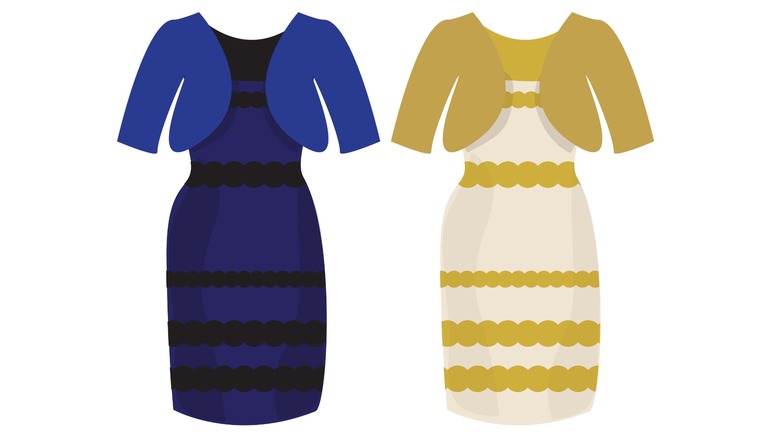
A lot of interesting optical illusions can trick the brain and how it processes and interprets what the eyes see. For instance, they're responsible for why a straw looks like it's broken in water and for the Troxler effect, the bizarre phenomenon that can happen if you stare into mirrors too long. In early 2015, "the dress" photo optical illusion went viral because millions of people couldn't agree on its color. As it turns out, scientists have found that color constancy and illumination interpretation are behind the debate.
One of the first papers investigating "the dress" photo illusion was published in Current Biology in June 2015. The researchers identified that most individuals saw two color combinations: black and blue or white and gold. During their study, they found that those who saw black and blue were interpreting a warm illumination, while those who saw white and gold were interpreting a cool illumination. Those results made the scientists hypothesize that illumination interpretation affects color perception.
In February 2017, a study was published in the Journal of Vision, providing experimental support for that hypothesis. The researchers also found that how the brain interprets what it sees in a photo has to do with color constancy, which involves perceiving and recognizing colors separately from illumination. By manipulating what the 31 participants expected before seeing the photo, the scientists were able to influence their color perception. Another study published in June 2017 involved an online survey of about 13,000 participants and largely confirmed that assumptions about the photo's illumination strongly affected the color combinations that the observers saw.
Other variables may influence the colors that people perceive in the dress photo optical illusion
While color constancy and illumination interpretation scientifically explain how people see different color combinations in "the dress" photo, it doesn't fully explain why people's assumptions differ. Numerous studies have looked into the possibilities, with one published in Cortex in December 2015 assessing neurological activity. Using functional magnetic resonance imaging, researchers observed that people who saw a black and blue dress had less activation in the frontal and parietal parts of the brain than those who saw a white and gold dress. The latter suggests higher-level cognitive processing, but it doesn't establish whether the extra brain activity causes or results from that perception.
In another study published in PLOS One in 2016, scientists examined the neural and retinal characteristics of 39 participants. Those who saw a white and gold dress color combo had a longer visual evoked potential (electrical activity in the visual pathways) than those who saw a black and blue dress. Additionally, the same participants had higher macular pigment optical density (MPOD, the amount of yellow pigment in the macular region or center of the retina), which is associated with healthy eyes. The greater MPOD is the result of the macular pigment absorbing more blue light. Although the sample was small, these findings suggest that some individuals might be predisposed to interpret some colors over others.
A third study example surveyed the responses of 413 kids ages 2 to 10 to see if age and food preferences affected the color combination they see. Published in the Journal of Vision in 2024, the researchers found that the older the children were, the more likely they were to identify a white and gold dress. The same was true of kids who preferred leafy greens.