

In The '60s, Scientists Launched The First Animals On A Mission Around The Moon And Back
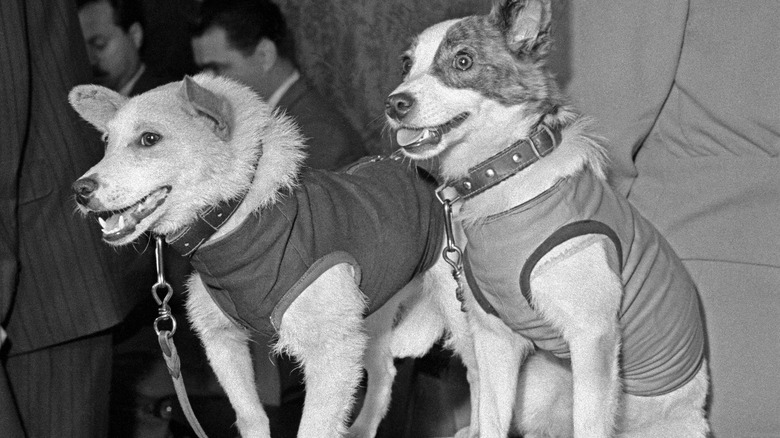
Yuri Gagarin became the first person to go to space in 1961, completing an orbit of Earth in under two hours. Eight years later, Neil Armstrong became the first person to set foot on the moon when he served as mission commander of Apollo 11. To date, even though there have been hundreds of humans in space, there have been thousands of animals. Before the Apollo 11 mission, Soviet scientists sent multi-animal missions into orbit around the moon with varied success.
Turtles, plants, bacteria, mealworms, and wine flies all successfully orbited the moon in September 1968 on the mission Zond 5. The unlikely team of space pioneers returned to Earth six days after their initial launch, floating back down to the Indian Ocean on deployed parachutes. The capsule was successfully retrieved, but a failure of the reentry guidance system led to extremely high G forces: more than double of what even trained fighter pilots can withstand.
Less than two months later, the Soviets launched Zond 6 with a similar mix of species. Like its predecessor, it also successfully made it around the moon. However, a loss of a gasket on the flight home resulted in a loss of cabin pressure and destruction of the specimens on board. American scientists launched a series of missions with animals from 1966 to 1969 as well, containing insects, microorganisms, frog eggs, and plants. These missions didn't orbit the moon, but studied the effects of the space environment on biological processes. Like with the Soviet missions, many of these specimens weren't successfully retrieved.
A brief look at the original animal space pioneers
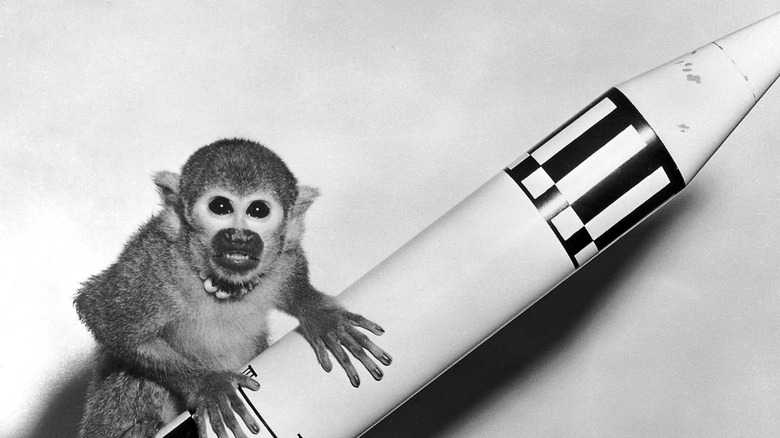
Yuri Gagarin will always be immortalized with the title of first human in space, but the original space pioneers made it beyond the Earth's atmosphere more than a decade before. Monkeys may have adapted to the jungles, but through the mid–1900s, they were destined to go to space. On June 11, 1948, a rhesus monkey named Albert I sacrificed himself in the name of science (admittedly not of his own choosing) on Blossom No. 3, flight 37, reaching an estimated 30 to 39 miles before an engine malfunction ended the mission prematurely.
Despite the technical problem in the first mission, Albert II was ready to step up for the next mission (again not entirely by his own choosing). Albert II reached 83 miles before dying on impact during the mission's descent. According to NASA, the next monkey flight in 1949 (which contained Albert IV) was successful and the monkey experienced no ill effects "until impact, when it died."
Throughout the 1940s and 1950s, dozens of monkeys were sent into space, with most of them not making it back alive. Eventually, scientists perfected the launch enough to keep a monkey alive in 1951 when Yorick made it home. Along with rhesus monkeys, researchers sent many other types of primates to space including spider monkeys (like Miss Baker in the photo above), chimpanzees, and macaques.
A look at dogs in space
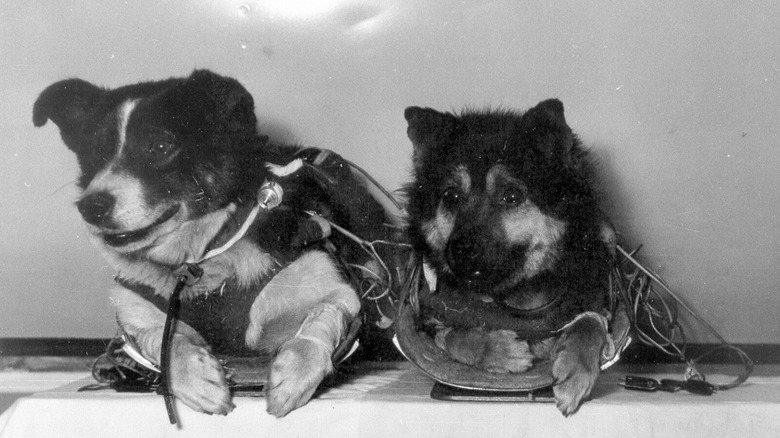
Dogs may be able to sense impending weather changes, but they probably can't sense when they're about to be sent on a rocket travelling 2,000 miles per hour. Unlike the Americans who preferred primates, the Soviets used to coax stray dogs onto spaceships with pieces of salami. Okay, that's probably not how they got them on the spacecraft, but they did send nine dogs to space between 1951 and 1952 after starting their experiments with mice, rats, and rabbits.
August 15, 1951, Dezik and Tsygan became the first dogs in space, and managed to return to Earth alive. Dezik would return to space a month later with Lisa, but unfortunately they wouldn't make it back. By all accounts, Soviet rocket pioneer Sergei Korolev, who led the mission, was devastated at the loss of the pair. Smelaya and Malyshka were scheduled to be launched shortly after, but Smelaya ran off, to the chagrin of crew who worried nearby wolves would eat her. She returned a day later and the test flight resumed successfully.
Perhaps getting the prelaunch jitters, the dog Bobik ran away before the next mission. Scientists found a replacement named ZIB outside a local canteen (ZIB is a Russian acronym for Substitute for Missing Dog Bobik). She succesfully completed the mission with a few hours of training. Perhaps the most famous dog in space was Laika, the first living creature to orbit the Earth. She unfortunately burned up upon reentry to Earth's atmosphere in 1957, but her mission helped prove living organisms could survive a rocket launch into orbit.