

A Scientist From The Early 2000s Predicted Humanity's Odds Of Surviving The 21st Century

We may receive a commission on purchases made from links.
There have been no shortage of doomsday predictions throughout modern human history. At the turn of the millennium ("Y2K"), some people thought the changing date could cause nuclear weapon malfunctions and catastrophic technological failures. Then in the early 2000s, a collective hysteria spread that the world would end in 2012, based on the belief that the Mayan calendar ended in that year. In 2003, Sir Martin Rees, a professor of cosmology and astrophysics at the University of Cambridge, wrote his book "Our Final Hour," in which he penned humanity's chances of surviving the next century as bleak.
"I think the odds are no better than fifty-fifty that our present civilisation on Earth will survive to
the end of the present century," Rees wrote. Unlike many doomsday predictions in recent memory, Rees didn't predict a specific date when civilization might end. He provided a general warning based on some of the current threats produced by advancing human technology. Biological experimentation, biological weapons, quantum supercomputing and AI, and unchecked nanotechnologies are some of the threats he identified.
In his writing, Rees called for worldwide regulation of technological advancement to keep potential risks in check. Although his book is over 20 years old (he has echoed the same sentiments in future books, research, and talks), the rise of AI technology over the past several years has kept many of his concerns relevant.
What did Rees predict are the greatest threats to humanity?

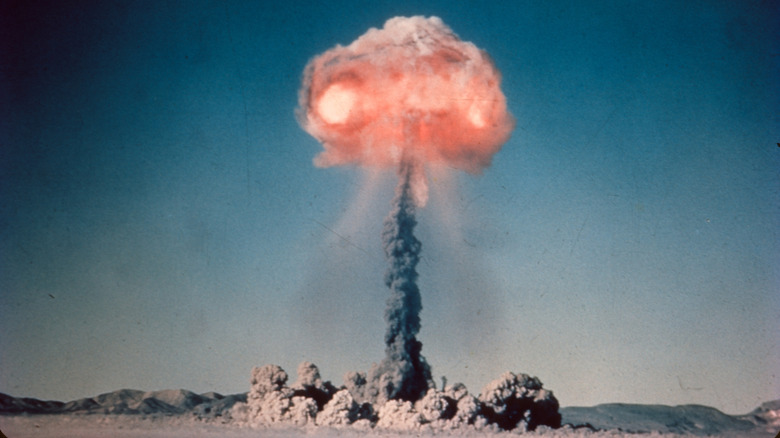
In Rees' book, he pointed to several threats to humanity related to human technological advancement. Through the 20th century, the greatest catastrophes were not caused by nature but induced by human technology such as automated weapons and the hydrogen bomb. Through the 21st century, potentially apocalyptic destruction is more accessible than ever. The first nuclear bomb was detonated in the 1940s. Now, nine countries currently hold nuclear weapons. On the threat, Rees wrote, "Nuclear weapons can be dismantled, but they cannot be un-invented. The threat is ineradicable, and could be resurgent in the twenty-first century."
Rees identified genetic engineering and biological experimentation as even greater potential threats to humanity than nuclear weapons. He wrote, "The 'downside' from twenty-first-century technology could be graver and more intractable than the threat of nuclear devastation that we have faced for decades." An example could be a mass eradication of crops that leads to millions of people starving to death. He warned of the difficulty of tracking potential biological weapons as well as a significant risk of laboratory accidents involving genetically modified germs that could result in millions of deaths.
Experiments involving colliding atoms (like at the Large Hadron Collider in Switzerland) could have devastating consequences, even potentially starting a chain reaction that could destroy the planet. Although it seems unlikely, a mistake could result in the production of theoretical molecules called strangelets that could engulf the Earth. When it comes to running experiments with these types of "doomsday downsides", Rees wrote that they should only go ahead with public approval.
Other people who echo Rees' sentiment
Rees isn't the first person to raise alarms in recent years about rapid technological changes that could have massive repercussions for society. Many other leaders in their fields have also warned that unchecked technological advancement could be an existential threat. For example, in a 2014 interview, Stephen Hawking warned, "The development of full artificial intelligence could spell the end of the human race." A lead researcher at the technology company Anthropic, Evan Hubinger, said in 2026 that there's more than a 10% chance that AI could kill all humans within a decade.
In his 2018 book On the Future: Prospects for Humanity, Rees revisits some of the predictions he made in 2003 and reiterates some of the potential existential threats humans could face. Whether you choose to believe humanity's final hours might be getting closer, Rees' message for increased regulation is important. Advancing technology without putting checks and balances in place has the potential to do irreversible harm, even if it's accidental. It would be foolish to not at least consider the opinion of some of the leading scientists in their fields when the stakes are so high.