

Scientists Looked For Blood In A 5,300-Year-Old Mummy. They Didn't Expect What Happened Next

Since the most historically common mummification method involved drying the bodies of decedents, bacteria can't flourish and the mummies don't decompose. The same can happen with ice mummies because the bodies lose fluid (essentially dehydrating) when they lay in snow and ice over a long period. In 1976, researchers published the story of the discovery of intact peripheral blood elements in a 2,200-year-old Egyptian mummy. That's not the oldest specimen of human blood that scientists have ever found, though. From the 5,300-year-old remains of Ötzi the Iceman, they were able to recover specimens containing red blood cells, which is surprising considering how quickly blood cells degrade.
In a paper published in 2012, researchers at the European Academy of Bozen-Bolzano (EURAC) explain how they used an atomic force microscope (AFM) to identify the presence of blood in Ötzi's right hand. The microscope used a fine probe to scan the surface tissue of the laceration, measuring every tiny deflection with sensors to build a 3D image. The resulting image resembled that of red blood cells (doughnut-shaped cells). To be sure, the scientists used Raman spectroscopy, an analysis technique that uses scattered light to measure vibrational energy and distinguish various molecules. Those results confirmed what the AFM image saw, resulting in the oldest human blood ever collected and tested.
This discovery is so significant because scientists weren't sure that blood could even survive that long. Since they didn't previously find blood elsewhere in Ötzi's body, they thought that all of it had disintegrated through autolysis, a postmortem process whereby enzymes destroy cells and tissues. Additionally, the technology used could lead to breakthroughs in forensic criminology, helping determine how long blood has been at a crime scene.
The contents of Ötzi's blood add weight to analyses of how he died
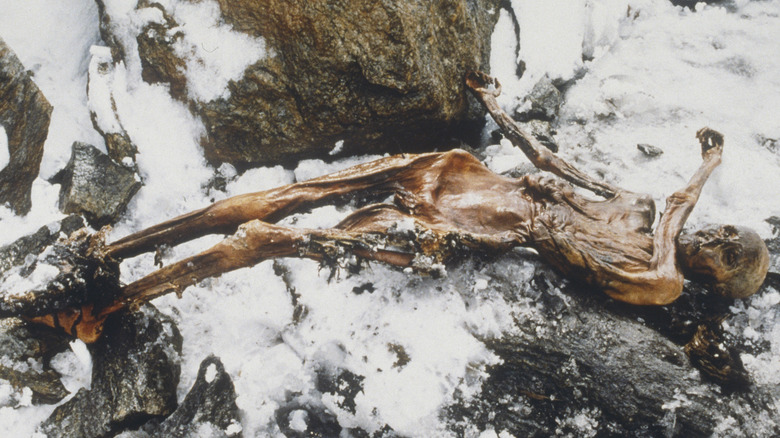
Ötzi the Iceman has been the basis of much mystery and scientific investigation since his remains were recovered near the Italian–Austrian border in 1991. Shortly before the discovery of the red blood cells was published, researchers published in Nature Communications that he had the blood type that could put you at greater risk of a painful death: type O. Researchers have made substantial headway learning everything they can about the circumstances of his death as well.
When Ötzi was first found, scientists thought he froze to death in a winter storm on the mountainside near where he was found. They determined in 2001 that he was murdered with an arrowhead in the back left shoulder. In 2003, the cut in his hand was reported, with scientists noting that it happened days before he died and postulating that he was pursued before being shot. It wasn't until four years later that they published radiological proof the arrow severed his subclavian artery, killing him within minutes. With the blood recently found in his wounds, more weight has been added to the finding that he died quickly.
While the blood retrieved from that arrow wound didn't have red blood cells in it based on the Raman spectroscopy results, the results did indicate the presence of fibrin. This protein is involved in wound healing and the formation of blood clots. EURAC's head of the Institute for Mummies and the Iceman Albert Zink explained in a statement, "Because fibrin is present in fresh wounds and then degrades, the theory that Ötzi died some days after he had been injured by the arrow, as had once been mooted, can no longer be upheld."