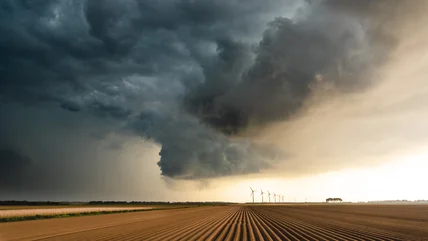
Rain Clouds Vs. Snow Clouds
Not all clouds are made equal, and each kind can indicate something different about the weather to come, telling you when rain or snow might be on the way.
Read More

The unique content on Sciencing is a result of skilled collaboration between writers and editors with broad journalistic, academic, and practical expertise across the wide variety of scientific fields we cover.
In pursuit of our mission to provide accurate and ethical coverage, the Sciencing editorial team consistently fact-checks and reviews site content to provide readers with an informative, entertaining, and engaging experience. Click here for more information on our editorial process.
Not all clouds are made equal, and each kind can indicate something different about the weather to come, telling you when rain or snow might be on the way.
Read More
Trees are critical to environmental health. They absorb carbon dioxide from the atmosphere, provide habitat for wildlife and anchor topsoil to the ground. Trees are cut down to clear land for agricultural and commercial development or to harvest timber. The effects of this deforestation are far-reaching and affect more than just the forested communities that lose tree cover.
Read More
With their round, flat bodies and undulating wings and their close relationship to sharks, which are some of the sea's greatest predators, stingrays may fit some people's definition of “exotic.” Yet stingrays exist worldwide, from freshwater rivers to the open oceans. No matter what habitat they occupy, an analysis of the creatures that they eat and the organisms that eat them suggests the importance of the roles they play in the ecosystems they inhabit.
Read More
An indicator species is a species whose presence, absence or abundance, and changes therein, can indicate certain environmental conditions. Changes in indicator species's populations are used to monitor changes in particular ecosystems and sometimes trends affecting the environment as a whole. They can also be used to identify specific habitats.
Read More
Ecosystems are important to all living things on the planet, including people. All plants and animals rely on their ecosystems to give them what they need to live. Without your ecosystem, you would not be able to survive on this planet.
Read More
Adult stingrays provide protection for their offspring until the young reach a certain level of physical maturity, somewhere around the age of 3. From birth, however, the young stingrays find their own food, a task made much easier by the fact that they are born naturally good swimmers. Ovoviviparous, stingray give birth to fully-proportioned young, an evolutionary advantage that provides the young stingrays with a better chance at finding nourishment while getting some protection from their adult counterparts.
Read More
Making a living ecosystem inside a bottle with fish, plants and all other forms of life necessary to maintain a healthy ecosystem is a great way to help form an understanding of the necessities of life. Whether for a school project, or just for fun, building yourself a working example of a contained ecosystem can be done with some commonly found supplies and a trip to your local pet store.
Read More
The open ocean contains the largest ecosystem on Earth. The demersal zone delineates the seafloor, extending from the deep ocean to the coast, while the open ocean, or pelagic zone, encompasses all other regions in the sea. The pelagic zone is divided into four subzones, each containing unique communities of organisms.
Read MoreThe genetic code allows the transfer of information from one generation to the next and is encoded within deoxyribonucleic acid (DNA). A gene is a functional unit of heredity and normally codes for the production of a specific protein. An allele is specific form of a gene and can be dominant or recessive. For example, there are different alleles for blood type. Allele frequency is a measure of the relative frequency of different alleles within a population and can be calculated with ease.
Read More
A closed circulatory system consists of a heart that pumps blood through blood vessels, distributing nutrients and oxygen, and retrieving waste products discarded from the tissues. Many invertebrates have open circulatory systems; however, the earthworm has the more efficient closed circulatory system.
Read More
Recombinant offspring are those children whose genes contain a non-parental allele combination. If one parent with the allele combination Aa Bb mated with a parent with the allele combination aa bb, for instance, then a child with the allele combination AA bb would be recombinant because neither allele group is directly inherited from either parent. This anomaly results when genes on the same chromosome are so far apart from one another that their alleles get crossed over during meiosis. Thus, the key to finding recombinant offspring lies in looking for allele pairs that aren't directly inherited. Once you've done that, you can calculate recombination offspring frequency.
Read MoreA microscope is any device that allows you to see objects too small to view with the unaided eye. An optical microscope consists of a series of magnifying glasses and is commonly used for viewing bacteria. These types of microscopes require specific adjustments to bring the bacteria into clear focus.
Read More
Regions characterized by mountains and ice are known as the "biome," or Alpine tundra. Examples of Alpine tundra can be found in the Andes Mountains, Rocky Mountains and Himalayan Mountains.
Read More
The intertidal zone, also known as the littoral zone, is the land on a coastline that is above the water at low tide and underwater at high tide. Animals and organisms that live in the intertidal zone must be adaptable and able to live in a wide variety of temperature, light and tidal conditions. Each vertical zone within the intertidal zone is home to different types of animals.
Read More
Tropical rain forests are home to about half of the plant species in the world. Many of the plant species found in the Central American tropical rain forest can be found growing on tree trunks, since it is easier for the sun to reach them at these higher heights than if they grew on the forest floor.
Read More
Energy is captured from the sun by plants and is passed through ecosystems. Energy collected by the sun by plants is consumed by animals (which can be consumed by other animals) and used for metabolism, growth and reproduction. Plant and animal waste and biomass created from this energy is broken down by decomposers into constituent parts, which can be used by plants to create more tissues. In this manner, ecosystems are cycles and, aside from the addition of sunlight and water, can be self-sustaining.
Read More
Food chains show predators and consumers in a linear fashion. Food webs combine food chains and make a more realistic representation of an ecosystem. Food webs consist of producers such as plants and plankton, primary consumers which are herbivores, secondary consumers which are carnivores and omnivores, and tertiary consumers which are predators that prey on other predators. A little knowledge on how to follow a food web will help you learn more easily how an ecosystem functions.
Read More
Many interactions take place in an ecosystem, which is a network created by the relationships between various organisms in their environment. The types of interactions in an ecosystem depend on the ecosystem. In each ecosystem, whether as large as a desert or as small as a tree, there are organisms that are decomposers, consumers and producers. Abiotic and biotic components of an ecosystem help make it function.
Read More
Part of the order Squamata, lizards are reptiles found in many habitats, but especially in tropical and desert areas. Although sharing the same habitat, tropical lizards species can vary in size, habits and colors. Iguanas, chameleons, geckos, spectacled lizards, dragon lizards and the Komodo dragon are some types of tropical lizards.
Read More

Although different types of moths mate in different ways, the mating habits of moths and butterflies, which belong to the order of insects called Lepidoptera, are generally similar. In most moth species, the male seeks the female to mate with her and the female then lays fertilized eggs. In some species, however, reproduction is carried out without mating.
Read More
An ecosystem is a community of plants and animals associated with specific climatic conditions and abiotic (non-living) features. In the grand scheme of things, there are only two types of ecosystems: terrestrial (land) and aquatic (water) ecosystems. However, these ecosystems can be broken down into a variety of smaller, more regional and specialized ecosystems, which are sometimes referred to as biomes.
Read More
The fox is an omnivorous animal. In addition to plant matter, its diet may include several small mammals. Commercially available fox urine can be used to humanely deter or control these species.
Read More
The cycle of life consists of all types of plants and animals. Plants are producers, because they make their own food by absorbing energy. Animals are consumers whose food source consists of eating producers and/or other consumers. Within the world of consumers there are herbivores, carnivores and omnivores and they all fall into either a primary, secondary, tertiary or quaternary consumer category. When you look even closer at carnivores and omnivores, you can classify them as either predators or scavengers. Without all of the various types existing together, the cycle of life would not function as it does.
Read More
Salamanders and lizards often look similar, but in fact salamanders are amphibians and lizards are reptiles. A few traits should help you distinguish between these two groups of herpetiles.
Read More
