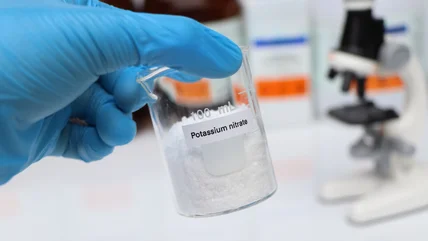
Potassium Nitrate Reaction Experiments
Potassium nitrate is an ionic salt that's rather versatile in the lab, able to be used in a number of different reactions. Here are a few of them
Read More

The unique content on Sciencing is a result of skilled collaboration between writers and editors with broad journalistic, academic, and practical expertise across the wide variety of scientific fields we cover.
In pursuit of our mission to provide accurate and ethical coverage, the Sciencing editorial team consistently fact-checks and reviews site content to provide readers with an informative, entertaining, and engaging experience. Click here for more information on our editorial process.
Potassium nitrate is an ionic salt that's rather versatile in the lab, able to be used in a number of different reactions. Here are a few of them
Read More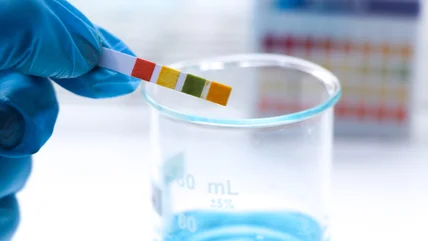
While pH testing strips can be used to determine the strength of NaOH, it's also possible to calculate that value using little more than a simple process.
Read More
Photosynthesis is the chemical process by which energy stored in light is converted into chemical energy stored in sugar. The prefix "photo" refers to the importance of light in the process. Photosynthesis is carried out by green plants using chlorophyll.
Read More
Moving charges create magnetic fields. Electrons have spin and hence act as magnetic dipoles. If all electrons in a molecule or atom are paired, these dipole moments cancel and there is no net magnetic field. In some materials, however, the atoms or molecules have unpaired electrons, so the atoms can be "lined up" by a magnetic field. These materials are either paramagnetic (if a magnetic field only reorients them temporarily) or ferromagnetic (if the reorientation is permanent) and are attracted to magnets. Many other substances, however, are not magnetic.
Read More
**The lateral area of an object refers to the surface area of its sides, but not the base**. In the instance of a square pyramid, this refers to the four triangles that make up the top and side portions of the figure around a square base. Like any three-dimensional object, the best approach is to break it down into individual, two-dimensional figures.
Read More
Hydraulic systems use pressurized fluid to accomplish work with only a small amount of force. Braking and steering systems, agricultural equipment and industrial machinery often employ hydraulic systems.
Read More
The oxidization or rusting of nails is an interesting topic for a science project. There are many different scientific experiments that can be done to further investigate the causes of rusting and the ways in which it can be prevented. Learning some basic information about a few different science projects involving nails that rust is a good way to decide which direction you want to take with your science project.
Read More
Plants need the sun because sunlight is made up of electromagnetic radiation which is given off as energy as the sun burns through its stores of hydrogen many millions of miles away from Earth. The electromagnetic radiation that plants receive from the sunlight that reaches Earth and penetrates its atmosphere is the key ingredient in a process that is called photosynthesis. Photosynthesis is important because it is the way in which plants derive their energy.
Read More
Titration is an analytical technique that allows you to determine the concentration of a substance based on its chemical reaction with another substance, called the titrant. You slowly add a standard solution of the titrant to the solution with the unknown concentration. Often you can tell the reaction is complete using a chemical indicator that changes color at the reaction endpoint. You measure the volume of the standard solution that you used for titration, and from there you can calculate the concentration of the other substance. As an example, the concentration of 10 ml of hydrochloric acid (HCl) solution can be calculated using a 0.15 molar standard solution of sodium hydroxide (NaOH).
Read More
A calorimeter is a container with two chambers. The first chamber holds the reaction you want to measure. The second chamber has a measured volume of water. These two chambers are separated by a metal wall that conducts the heat from the reaction to the water without letting the water mix in. They are both insulated so the heat stays inside the calorimeter as much as possible. A thermometer measures the temperature of the water. The calorimeter's sealed around the thermometer to prevent heat and water from escaping.
Read More
Math and the ability to tell time are essentials when it comes to cooking. In fact, all phases of cooking require some math, including meal planning, grocery shopping, food budgeting, baking, measuring ingredients, adjusting recipes, and storing and freezing food. Precision matters when it comes to adding and combining ingredients. While basic math comprehension may get you by in the kitchen, a thorough understanding of addition, subtraction, division, fractions, measurements and knowing how to make conversions are essentials for routine cooking and meal planning.
Read More
The most common examples of respiration occur in two places: in human lungs as part of breathing and in cells through a process called "cellular respiration." Humans breathe to oxygenate their blood, and cells breathe to acquire oxygen to be able to break down glucose for the energy that they need.
Read More
Life depends on nitrogen, which is a basic ingredient in amino acids that make up all proteins. While a substantial percentage of the atmosphere is comprised of nitrogen gas, it must be processed into a soluble form. This is done via a nitrogen cycle that occurs in the soil. Then plants and the animals that eat them can obtain dietary nitrogen.
Read More
Compounds and mixtures both consist of more than one constituent element, but they differ in their makeup and production. A compound is a chemically-combined substance that has a set recipe, while a mixture is a substance where the elements have simply been mixed together physically, and does not have any chemical bonds among its elements.
Read More
In some science projects, you're asked to include an applications section. This can be a confusing section of the project and also a difficult one to put together. Simply put, the application of a project means this is how the result of your experiment can benefit other people or apply to other sciences.
Read More
In grade school or middle school, your science teacher might present you with a project to keep ice from melting. Keeping ice from melting is also a common science fair project undertaken by children in these grade levels. The trick to keeping ice from melting is to insulate it, keeping the surrounding temperature low. Even the smallest amount of heat will expedite the rate at which ice will melt. You cannot keep ice from melting forever without a freezer, but you can postpone it for extended periods with the right method.
Read More
Cells in both plants and animals use cellular respiration as a means of converting stored energy into a chemical that individual cells consume. Adenosine triphosphate (ATP) is a chemical food that all cells use. Plants first create a simple sugar through photosynthesis. Individual cells then break down that sugar through cellular respiration.
Read More
Crystals are grown for both scientific purposes and for experimentation in labs or science fairs, to demonstrate the various properties of different kinds of crystal formation. In all kinds of formation, the constant temperature plays an important role in crystal development, affecting not only how fast the crystals develop but the ways in which they grow.
Read More
A cake can be one of many flavors and shapes, but all cake recipes have the same basic components: a base, such as wheat flour; a sweetener; a binding agent, such as eggs; a fat, such as butter; a liquid; and a leavening agent, such as yeast or baking powder.
Read More
Every high school science student has probably been faced with those little strips of paper and asked to tell if something is a base or an acid. Litmus paper comes in three kinds, though the most common are the red ones and the blue ones. Using them is very easy to do, and perfect for testing out the acidity/alkali nature of common chemicals such as lemon juice or bleach (a common school science experiment). For more complex studies, a Ph strip similar to litmus is often used.
Read More
Whenever a chemical reaction occurs, the changes that people observe are caused by the creation or loss of certain types of materials. For instance, temperature can generate a chemical reaction. An easy way to recognize a chemical change is to compare the color of the original item with the new one. A number of chemical reactions cause color changes.
Read More
Temperature regulation is important for the body to function properly. Sweating is the human body's natural way of cooling itself. Sweat happens for a variety of reasons, however commonly sweat happens when the body becomes too hot. Sweat evaporating from skin cools down the body through an endothermic process.
Read More
pH refers to the relative acidity or alkalinity of a substance. A 14-point scale measures pH, where 0 means complete acidity, 14 means complete alkalinity, and 7 means complete neutrality. Pure water is the only substance with a 7.0 pH. When you add water to a substance, you make it either less acidic or less alkaline. The neutral pH in the water dilutes the substance. Determining how much dilution is taking place requires some mathematical calculations.
Read More
Chemists use equilibrium constants, or Keq values, to express whether a reversible chemical reactions favors the formation of products or reactants. Acetic acid, or CH3COOH, for example, undergoes a partial reaction with water according to CH3COOH + H2O <---> CH3COO- + H3O+. An equilibrium constant greater than one would indicate that most of the acetic acid molecules convert to CH3COO-. An equilibrium constant less than one would indicate that most of the acetic acid molecules remain intact. When specifically applied to acids, chemists refer to equilibrium constants as acid-dissociation constants, or Ka values. These numbers are typically very small. The value for acetic acid, for example, is 0.000018, or 1.8 x 10^-5. Consequently, chemists sometimes express these quantities as pKa values, where pKa = -log Ka. In this case, the pKa of acetic acid becomes pKa = -log (0.000018) = 4.74.
Read More
Young students have to do a variety of math-conversion problems, including how to convert miles into tenths of a mile. One-tenth of a mile is precisely 528 feet -- about half the length of the world's largest cruise ship or slightly less than twice the height of the Statue of Liberty from its base to the tip of the torch. Fortunately, converting miles to tenths of a mile doesn't require a calculator, though using one will speed up your calculations.
Read More
You can conduct various experiments using bean seeds. They are useful to explore the effects of different conditions on germination times and plant growth. Beans sold for food may be subjected to treatments such as heating that kill the seeds. Unless you need a large volume of seeds, in which case dried beans are acceptable, it's a good idea to use bean seeds that are sold for gardens.
Read More
The term human biology indicates the biological systems which are present in the human body. In the study of human biology the various systems in the body are examined. Such systems include the circulatory, immune, skeletal and respiratory systems, among several others. Although it is easy to separate each of these systems for study purposes, it should be remembered that these systems are interrelated. For example, blood, a necessary part of the circulatory system is made in the bone marrow, which is part of the skeletal system.
Read More