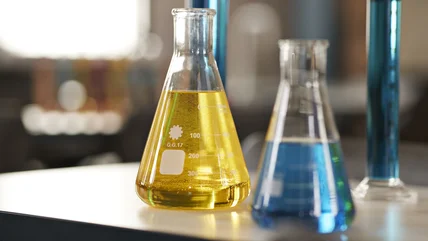
How To Neutralize Muriatic Acid
Muriatic acid is a dangerous substance that should be neutralized if accidentally spilled. Fortunately, there's a simple and safe way to do just that.
Read More

The unique content on Sciencing is a result of skilled collaboration between writers and editors with broad journalistic, academic, and practical expertise across the wide variety of scientific fields we cover.
In pursuit of our mission to provide accurate and ethical coverage, the Sciencing editorial team consistently fact-checks and reviews site content to provide readers with an informative, entertaining, and engaging experience. Click here for more information on our editorial process.
Muriatic acid is a dangerous substance that should be neutralized if accidentally spilled. Fortunately, there's a simple and safe way to do just that.
Read More
Weathering is a physical and chemical process that causes rocks and minerals on the Earth’s surface to break down and decompose. As rocks expand and contract, the heat creates a physical weathering process where the rock splits apart into fragments. It also contributes to chemical weathering when moisture or oxygen in the atmosphere alters the chemical composition of rock minerals.
Read More
Neptune is the solar system’s most distant planet from the sun. When Italian astronomer Galileo Galilei first observed Neptune through his telescope in 1612, he believed it was a fixed star. In 1846, German astronomer Johann Galle understood it was a planet. The Voyager 2 spacecraft flew by Neptune in August 1989, and the Hubble Space Telescope has been taking images of Neptune since 1994.
Read More

The Paleozoic era began around 542 million years ago with a massive explosion of life forms. It ended 291 million years later with the extinction of between 90 and 95 percent of life on the planet. Its climate was marked by massive temperature fluctuations as continental masses shifted around the Earth’s surface. Continents broke apart, fracturing the Earth’s crust, and crashed together again, closing off seas and creating mountains. Volcanic activity changed the chemistry of the atmosphere. The Paleozoic is divided into six periods: Cambrian, Ordovician, Silurian, Devonian, Carboniferous and Permian.
Read More
A tsunami is a wave, or series of waves, caused by the vertical displacement of a column of water. This can be generated by earthquakes below the sea floor and violent volcanic eruptions above it, landslides above or below water or meteorite impacts into the sea. Tsunamis scrape seafloor sediments and invertebrates, crash through coral reefs and destroy coastal vegetation. While ecosystems can recover, human interference may interfere.
Read More
From staggering out of bed in the morning to driving a car, the three laws of motion govern every aspect of our daily life. Compiled in 1687 by English mathematician Isaac Newton, the laws describe how forces act on objects on Earth and throughout the universe. The laws would become the foundation of classical physics.
Read More
Weathering Process of Granite. Granite is an igneous rock that injects, or intrudes, as magma into Earth's crust and then cools. It consists of four main mineral compounds. Two of these are types of feldspar, a group of silica compounds that constitute the most abundant mineral group on Earth. Plagioclase feldspar is a compound of sodium and silica; potassic feldspar is a compound of potassium and silica. Granite also contains quartz, the second most abundant rock-forming mineral after feldspar. The fourth main mineral compound is mica, which in granite is a silica compound with a crystalline appearance resembling sheets of paper. Muscovite is mica with a high concentration of potassium. Biotite is mica with iron and magnesium. Each of these mineral groups weathers according to its own chemical properties.
Read More
Gold is an almost non-reactive metal, but halogens — chlorine, bromine, fluorine and iodine — can dissolve it. Chlorine is the cheapest and lightest product that can achieve this. Bleach is the chemical compound sodium hypochlorite. When combined with hydrochloric acid, the mixture produces chlorine that dissolves gold from gold ore. This was the first commercial method used for gold extraction.
Read More
The Uses of Hydrocarbon Gas. Hydrocarbons are molecules of carbon hydrogen and oxygen that have different chemical and physical properties depending on the structure of their bonding. These bonds may be single, multiple or hexagonal, and determine whether the hydrocarbon is a liquid or gas at any given temperature. Hydrocarbon gas is also known as natural gas and forms in the Earth's crust from decomposing organic matter. It is a mixture of different hydrocarbons that condense into liquids at different temperatures.
Read More
Canals and levees formed the basis of land irrigation and flood control in ancient Sumer. Located in the lower reaches of the Tigris and Euphrates Rivers in southern Mesopotamia, today’s southern Iraq, this is an area of scarce rainfall but major flooding in late winter and spring. From around 3500 B.C. and over the next two millennia, Sumerians pioneered control of the water flow and the development of agriculture whose produce would feed the populations of over 20 city states. However, this process was hampered by increasing salt concentrations in the soil.
Read More
Why Is the Water Cycle Important to an Ecosystem?
Read More
Unloading is the removal of great weights of rock or ice that lie on the surface. This may happen through rising temperatures that melt ice sheets; erosion by wind, water or ice; or tectonic uplift. The process releases pressure on underlying rocks and causes them to expand upward and crack at the surface. As a result, greater areas of rock are exposed to mechanical and chemical weathering.
Read More
The Mechanical Properties of JIS SCM 420H Steel. Steels are ferrous alloys that contain iron, carbon and other trace elements. SCM 420H steel is an alloy containing chromium and molybdenum. Its symbol is SCM and its specifications comply with Japanese Industrial Standards (JIS) that govern all industrial activities in Japan. The American Iron and Steel Institute (AISI), the United States’ equivalent to the JIS, has not graded this steel type. But the Society of Automotive Engineers (SAE) grades it as SAE 4130. Its British Standards (BS) equivalent grade is 708H20. All steels have different strengths and mechanical properties depending on the heat treatment used during their production.
Read More
What Are the Different Ways That Minerals Can Be Mined?. Mining is the process of mineral extraction from an ore or rock seam. The minerals can range from precious metals and iron to gemstones and quartz. In ancient times, miners recognized a mineral rock formation from its outcrop at the surface. Modern mining technology uses geophysical techniques that involve measuring the magnetic, gravity and sonic responses of rocks above and around a prospective mineral ore body.
Read More
Dynamite was invented by Swedish chemist and engineer Alfred Nobel in the late 19th century as a safe way of using nitroglycerin as a demolition agent. Nobel stabilized nitroglycerin by mixing it with diatomaceous earth, the fossilized shells of diatoms. Dynamite has to be detonated using a blasting cap. Used as a military explosive at the turn 20th century, today, it is used widely in industrial blasting operations.
Read More
The River Nile was vital to life in ancient Egypt. Agriculture depended on its summer floods, which fertilized land along the river banks by depositing silt. The population of Egypt grew from nomads who settled along the fertile Nile banks and transformed Egypt into a sedentary, agricultural society by 4795 B.C. Farmers sowed and harvested crops during seasons around the flooding. However, during the inundation, they worked to pay off their taxes.
Read More
How Do Volcanoes Cause Erosion?. Erosion is the wearing down of soil or rock by the action of wind, rain, rivers, ice and gravity. A volcanic eruption produces lava, ash and gases. This debris creates new sediments, igneous rock formations and landforms. Volcanoes cause limited erosion directly; the underside of a new lava flow scours topsoil or loosely consolidated sediments. Volcanic eruptions are the indirect causes of substantial erosion through the action of volcanic debris on the atmosphere, land and water.
Read More
Dust storms occur when winds pick up tiny particles of rocky debris from the ground. Such particles may be just a few micrometers in diameter and remain suspended in the atmosphere over periods ranging between a few hours and several months. When they fall back to the ground, their impact loosens more particles from the surface. Scientists have observed dust storms only on Earth and Mars.
Read More
The solar system's most distant planet, Neptune is really one large, stormy atmosphere composed mostly of ices surrounding a rocky core. Astronomers classify it as both a gas giant and an ice giant. Although it rotates around its own axis in 16 Earth hours, Neptune takes 165 Earth years to complete one orbit around the sun.
Read More
The Disadvantages of Wetland Nature Reserves. Wetlands are nature's system of flood control and water cleaning. They store excess water from a river flood or during a storm and allow it to flow slowly back to the river as a storm abates. Wetlands filter out excess nutrients and pollutants and provide habitats for a wide variety of wildlife. In nature, wetlands can be swamps, bogs and marshes along a coastline, such as the Florida Everglades, or an inland system, such as the Okavango Delta in Botswana. The past two decades have witnessed extensive wetland nature reserve restoration and construction. Newly constructed wetland nature reserves provide wastewater treatment facilities as well as wildlife habitats
Read More
What Happens to the Earth's Crust After an Earthquake?. Earthquakes occur when two sections of rock within the Earth's crust move against each other. The Earth's crust and upper mantle, known collectively as the lithosphere, consists of a number of separate sections, or tectonic plates, in constant movement relative to each other. The forces propelling these plates are convection currents that rise from the Earth's hot, molten core, through the plastic mantle and towards the lithosphere where they cool and fall back to the core. Earthquakes occur both around the boundaries of these plates and within them.
Read More
Importance of the Electrical Properties of Gypsum. Gypsum is the chemical compound calcium sulfate dihydrate. It occurs naturally in crystalline form in marine salt deposits where its geological name is anhydrite. It mixes readily with water to form a plaster-like material that sets rapidly in any desired form. Gypsum has been a decorative and building material since ancient times. Any material’s principle electrical properties are its conductivity and resistivity. Conductivity is a measure of the material’s ability to permit the movement of an electric current and resistivity is a measure of the material’s opposition to electric current flow. Gypsum’s electrical properties are important in their application to a variety of tasks.
Read More
The Paleolithic Age was the earliest part of the Stone Age. The name derives from the Greek words “paleos” meaning “old” and “lithos” for “stone.” This era began about 2.5 million years ago in Africa and lasted up to 10,000 years ago at the end of the last Ice Age. The beginning of the Paleolithic era is marked by early human ancestors that archeologists call hominins developing simple tools. It drew to a close as modern humans began producing works of art and discovering America.
Read More
The presence of chemicals, particulates or biological compounds in the atmosphere can harm human and animal health and damage the environment. Factories and other industrial installations have caused such pollution since the dawn of the industrial age nearly two centuries ago. Air pollution can be controlled through the installation of filters and scrubbers to clean exhaust fumes from factory processes.
Read More
The Effects of Silica on Steam Turbines. Steam turbines are machines that convert the heat energy of steam from a water boiler into rotary motion. Their interior consists of a series of blades that capture the steam and provide a rotational force. As it rotates within a magnetic field, the turbine generates electric power. This principle constitutes 80 percent of the means of electric power generation worldwide. The purity of steam that passes through the turbine is crucial to its function and efficiency. Mineral and organic contaminants are present in the reservoir and river water that provides the steam source. These can be silica, detergents from urban waste or salts such as sodium chloride and sodium sulfate.
Read More
Polystyrene is a hard, stiff and transparent thermoplastic -- a plastic that softens on heating -- produced by the polymerization of the petrochemical styrene. It is a common plastic used in everyday life for packaging, insulation, toys, housings of electrical appliances and construction. This plastic is straightforward to process and easy to recycle.
Read More