

This 1970s Invention Was One Of The Greatest Medical Discoveries Of All Time
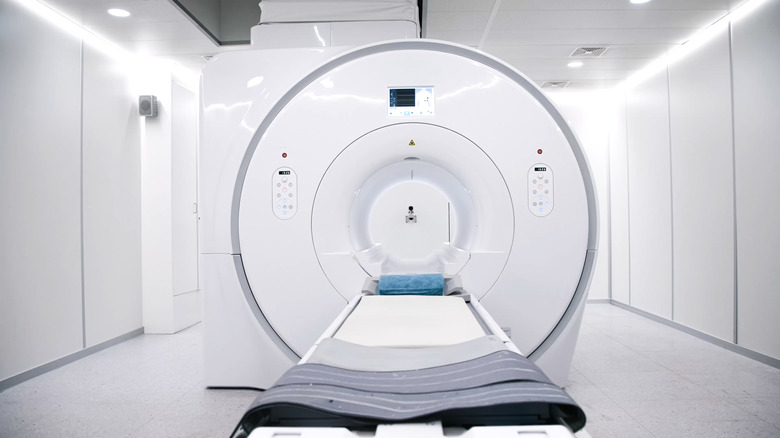
Cancer, heart disease, brain injuries, bone infections ... all are frightening health concerns that affect the body in dramatically different ways, yet there's one medical technology that doctors look to for all of them: magnetic resonance imaging, better known as MRI. Every year, over 100 million MRI scans are performed around the world, making it one of the most widely used diagnostic practices in modern medicine, and yet, the first full-body MRI scan was only accomplished fewer than 50 years ago.
The groundwork for MRIs came a few decades before the first machines were introduced. In 1952, physicists Felix Bloch and Edward Purcell won the Nobel Prize in Physics for discovering nuclear magnetic resonance (NMR), which is the property of certain atomic nuclei to release forms of electromagnetic radiation when exposed to a magnetic field. By recording this radiation, scientists can identify the structure and interaction of molecules within a sample material. However, Bloch and Purcell didn't think to apply their discovery to imaging the human body. That idea came from Dr. Raymond Damadian, a professor at the State University of New York Health and Science Center.
In 1971, Damadian published a paper in the journal Science, demonstrating that NMR could detect a difference between healthy human cells and cancerous ones. Water molecules in cancerous tissue move more freely, creating a discrepancy in radiation. It was a major breakthrough, but it would take until the end of the decade to turn this discovery into a functional medical technology for everyday use.
The early pioneers of MRI technology

When Damadian published his findings on NMR in 1971, he hadn't figured out how to convert the electromagnetic radiation it produced into an actual image. He could detect cancers within samples of cells, but couldn't pinpoint them within the broader scope of the human body. It would take most of the rest of the decade to bridge that gap.
At this time, two other influential scientists began working with NMR scanning. The first was American Paul Lauterbur, who was the first to create two-dimensional images using NMR radiation. He created an electromagnet with two coils and used it to generate pulses of magnetism with different strengths. By doing so, he was able to generate magnetic field gradients that varied across the scanned space, creating a series of unique data points that allowed individual regions of the body to be identified amidst the whole.
The second scientist to get involved in the process was Englishman Peter Mansfield, who in 1974 invented a much faster imaging method by greatly increasing the frequency of electromagnetic pulses over what Lauterbur had done. In 1977, things came back around to Damadian, who created the first full-body MRI image by scanning his assistant. Controversy would arise decades later when, in 2004, Lauterbur and Mansfield were awarded a Nobel Prize in medicine for their work, but Damadian was excluded on the premise that, while his research set the stage for MRIs, he had less of a hand in the actual technology.
MRI technology today
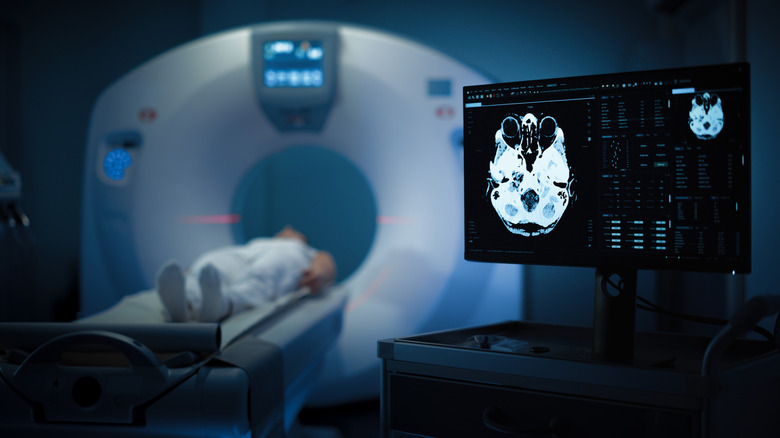
Following the pioneering work of the 1970s, major tech companies like Siemens and GE began producing MRI machines commercially, and they swiftly became a mainstay in hospitals. Today, MRIs are a go-to method of diagnosing and monitoring internal conditions and injuries, and they still use the same fundamental technology developed by the early pioneers. In fact, those electromagnetic coils devised by Lauterbur and the rapid-pulsing technology pioneered by Mansfield can actually be heard in every MRI scan. Anyone who has ever laid in an MRI machine knows the deafening clunking sound they make, which comes from the coils vibrating as they rapidly switch on-and-off.
You might wonder why MRI technology was so necessary, considering the fact that internal imaging was already possible through X-rays and CT scans before. However, X-rays are one of the most penetrating types of radiation, and repeated exposure to them can be dangerous. Patients who need frequent imaging to monitor long-term conditions can avoid the risk of radiation exposure by having MRIs instead. In fact, the MRI's only major risk is that the magnetic field can pull on metals, which is dangerous for people with certain medical implants or shrapnel from injuries under their skin. Fortunately, there are some MRI-safe metals, and most medical implants use them, making MRIs a very safe procedure for most patients.