

The Cool Science Behind Fluffy Snow
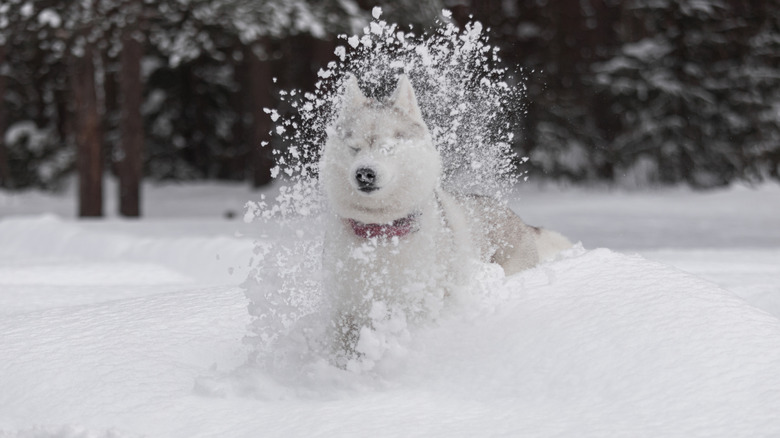
As the deep days of winter set in, millions across the country will have to contend with snow, but they won't all face the same conditions. Some will ski over fluffy snowbanks, while others will find themselves slipping on dense hardpack. Whether you get powder or slush all depends on local climate conditions during snow formation, and in order to get the kind of bright, fluffy snow worthy of a holiday movie, a lot of factors have to align just so.
You won't be surprised to hear that temperature is the chief factor in determining what kind of snow, if any, falls where you live, but the temperature you see on the weather forecast doesn't tell the whole story. Most meteorology reports show surface air temperature, which is measured by a thermometer 2 meters above ground level. Snow-forming clouds, however, are found thousands of feet up in the atmosphere, and there can be a great deal of temperature variance in between.
The fluffiest snow only forms when all of the air space between the cloud and the ground is below freezing. What your weather app won't show you is that there can sometimes be a warm layer of air between the surface air and the clouds above. If this happens, snow can still form, but as it passes through the warm air layer, it will start to melt. When it then falls into the freezing surface air, the precipitation refreezes, but this time, it will be in the form of sleet.
There's a way to measure the fluffiness of snow
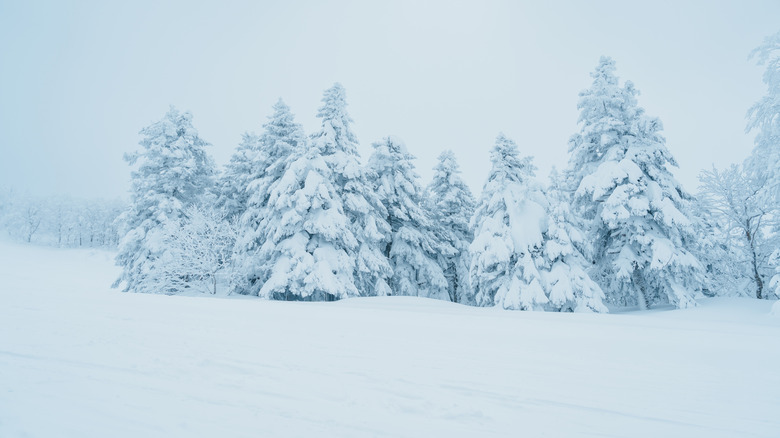
Weather forecasts often make note of whether the snow falling is expected to be powder or slush, but if you really want a detailed measurement, you can look up the snow ratio. Snow ratio is a measurement comparing the volume of snowfall to the amount of water it contains. A long-held standard says that the average snow ratio is 10:1, meaning that 10 inches of snowfall contain 1 inch of liquid water (the rest of the volume being mostly air).
Fluffy snow gets its texture from having a lot of air trapped between the snowflakes, much like how a meringue gains body by whipping air into egg whites. Therefore, fluffy snow is said to have a high snow ratio, often in the range of 20:1, which is double the conventional average. Wet, slushy snow has a much lower snow ratio, often around 5:1.
For the highest snow ratio, there needs to be a uniform column of sub-freezing air between the clouds and the ground, as previously mentioned. There also needs to be a high amount of ice crystals within the snow cloud to begin with (more on this in a moment). Lastly, winds cannot be too intense. Especially strong winds can cause snowflakes to break apart as they fall. The fractured flakes leave less airspace between them than fully snowflakes, making the snow ratio lower, and the resulting snowfall much slushier.
Fluffy snow is deceptively dangerous
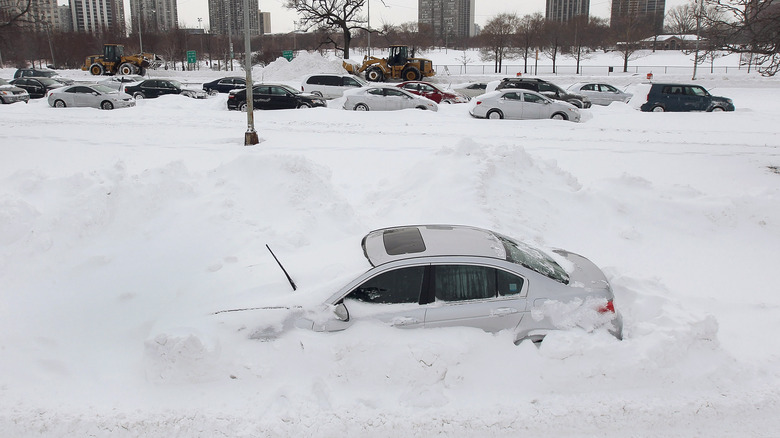
Powdery snow is often depicted as idyllic, perfect for skiing and snowball fights. However, there is a sneaky danger to fluffy snow, which will be especially familiar to residents of the Great Lakes Region. Cities like Buffalo, Cleveland, and Chicago are prone to a phenomenon called lake-effect snow. Surface air temperatures in that area are notoriously cold, staying near or below the freezing point for multiple months. However, the Great Lakes themselves stay warmer because water holds heat better than air. When the frigid air passes over the warmer lake, some of the lake water evaporates and rises to create heavily saturated clouds. Then, the clouds move away from the lake, and all of that water freezes into ice crystals. As mentioned in the last section, a high number of ice crystals in the clouds is required to produce fluffy snow.
When lake-effect snow is finally unleashed over the land, it falls in extremely high volumes, and because the air in the Great Lakes region is so cold, the snow ratio can be as high as 40:1. When snow ratios climb too high, dangerous conditions can develop because fluffy snow piles much higher than slushy snow. That's how cars, and even homes, can get buried under snow. Fluffy snowfall also requires constant cleanup to keep roads and paths navigable, and all that snow-shoveling can take a toll on the cardiovascular system. Slushy snow brings its own dangers, though, being slippery and more arduous to shovel.