

The World's Biggest Spider Web Is More Crowded Than You Think
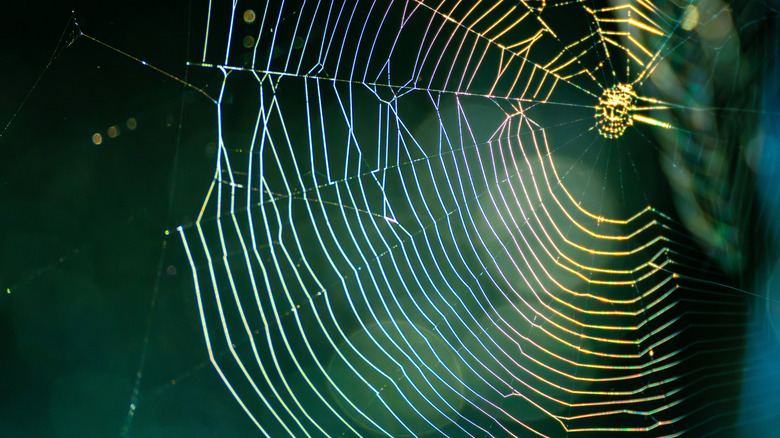
Scientists may have just determined the worst place in the world for arachnophobes. In a network of caverns below the Greek-Albanian border known simply as Sulfur Cave (already sounds like a charming place, doesn't it?), a team of cavers discovered a spiderweb that stretches across 1,140 square feet. It's been declared the largest spiderweb known to exist, and researchers estimate that there are around 111,000 spiders living in it. That's roughly the population of Peoria, Illinois, a metropolitan scale of life unlike anything ever seen before.
The cavern containing the remarkable web was first discovered in 2022, and over the next three years, an international cooperative of scientists made repeated trips back into the cave to collect data and samples. Their findings were finally published in October, 2025, in the journal Subterranean Biology, revealing not just the unprecedented scale of the spider colony, but also new revelations about their ecosystem.
Sulfur Cave is a unique habitat. A network of limestone tunnels carved by the Sarantaporos River, it has natural springs and the temperature hangs around a balmy 80 degrees at all times. It sounds like the perfect place for life, except for the fact that the air is full of hydrogen sulfide gas in concentrations high enough to suffocate most animals. The result is an ecosystem almost entirely contained within itself, and it turns out that the spiders living there behave in a way that no scientist ever expected they would.
Scientists found something surprising in the massive web
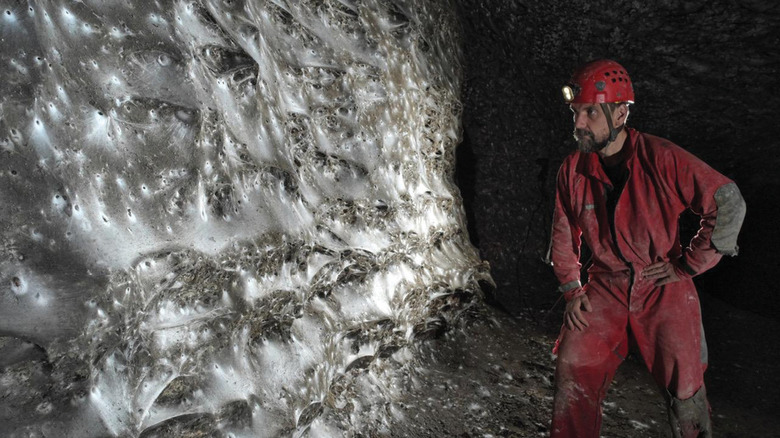
The record-breaking web is not a single unit, but rather a network of independently-built webs that have merged into one giant mass. These webs were actually made by two different spider species: Tegenaria domestica and Prenerigone vagans. The former is commonly known as the "house spider" in Europe because it often settles in buildings; they are not dangerous spiders, with a bite too weak to even break through human skin. The latter is even smaller than the house spider, and favors wet environments like the moist interior of Sulfur Cave.
T. domestica is a funnel web spider and P. vagans is a sheet web spider, meaning they spin two different patterns of spider webs. What really shocked scientists about this find, however, is that T. domestica traditionally preys on P. vagans, yet in Sulfur Cave they live side-by-side in peace.
Researchers attribute this unexpected peace to the fact that the cave contains millions of midges, which get trapped in the massive web network. This provides a constant and reliable food source for both species, eliminating competition. The midges themselves are native to the cave, and feed on sulfur-oxidizing microbes within its depths, creating a truly unique self-contained ecosystem. This fact was made even more extraordinary when gene analysis revealed that the cave spiders are genetically distinct from outside members of their species. Sulfur Cave could help us better understand how species evolve differently in different climates, a treasure trove for biologists present and future.