

The Deadly Spider Scientists Don't Want You To Squish
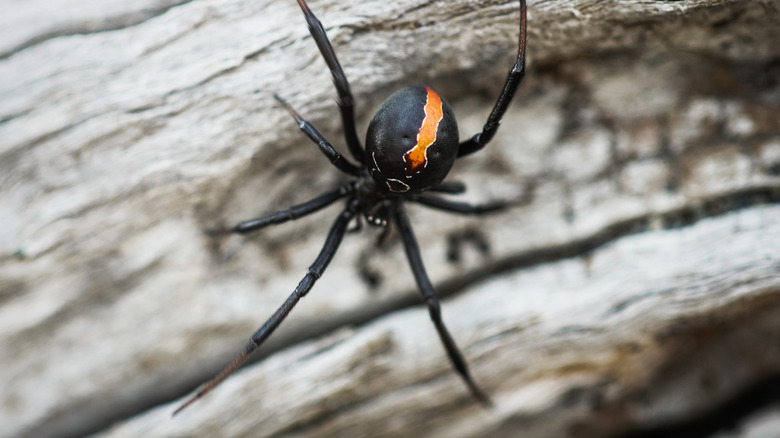
In many cultures, killing a spider brings on bad luck. The Irish and Scottish even have a little proverb to remember the tradition: "If you wish to live and thrive, let a spider run alive." But when a potentially deadly spider crosses your path, it's hard to resist the squish. Spotting a black widow spider, in particular, is especially terrifying, owing to its famous red and orange markings. In fact, the black widow spider can be found on every permanently-inhabited continent because the name refers to an entire genus, Latrodectus, containing 31 distinct species. And, regrettably for some of the Kiwis who encounter it, one species of black widow is protected by law.
Latrodectus katipo is a black widow spider found only in New Zealand. Its venomous nature gives it a place of importance in traditional Māori culture, since the island nation has very few dangerous native creatures. Thus, the Māori bestowed the small black-and-orange spider with the name "katipō," meaning "night-stinger." Folktales involving the katipō spider sometimes honor it as a skilled force of creation, while others describe it as malevolent. In any case, the spider has held a role in the culture of the Māori for centuries.
This cultural importance is one reason the New Zealand government eventually included the katipō in its Wildlife Act. The 1954 legislation famously protected most vertebrate species on the island nation from hunting and trapping in a sweeping conservation effort. But to ensure that culturally valuable invertebrates were also protected, a seventh section titled "Terrestrial and freshwater invertebrates declared to be animals" was added to the act in 1980. The list of protected invertebrates includes snails, insects, and two arachnid species: the Nelson cave spider and the katipō.
The legal repercussions of killing a katipō black widow spider

According to the New Zealand Department of Conservation, the katipō's official conservation status is "At Risk – Declining." This places it right on the cusp of being considered an endangered species. In recent decades, scientists have observed a decline in its population and range, and reports specify that "Climate Impact" is likely a cause. Indeed, climate change is a major factor in the human-caused habitat destruction of New Zealand.
Still, the katipō was already a protected species before fears of its extinction arose, and the legal repercussions for killing one can be severe. Under section 67F of the Wildlife Act, the penalty for killing or possessing a katipō can lead to "imprisonment for a term not exceeding 1 year or a fine not exceeding $100,000, or both." It's a harsh penalty, though there's no official data to suggest anyone has ever been convicted of violating the act by killing a katipō specifically. Obviously, it's hard to track down and prosecute someone who squashed a spider, yet the inadequacy of enforcement also speaks to a broader crisis in New Zealand's conservation efforts.
New Zealand is considered the country with the highest proportion of species at risk of extinction in the world, with over 4,000 species at risk. Legislation like the Wildlife Act has been criticized for being too short-sighted. Critics argue that targeting individual cases of hunting, killing, or trapping protected species overlooks wider, more robust opportunities for conservation, like habitat protection.
Why you shouldn't fear the katipō black widow spider
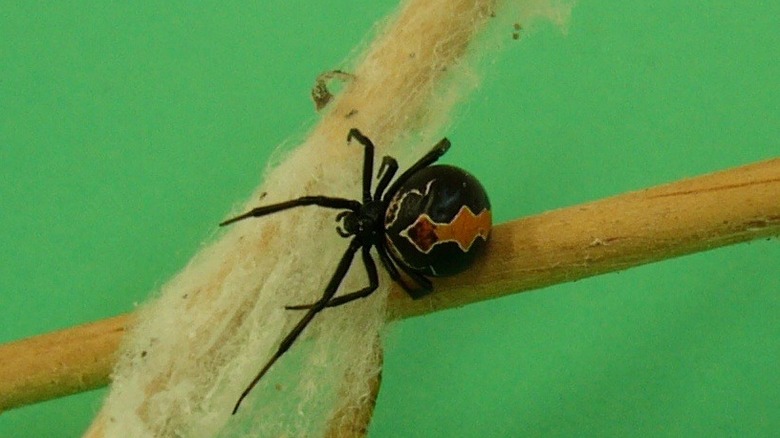
Fears of black widows are as widespread as the spider's range, but they're not really as deadly as most people are led to believe. In fact, there are only a couple of verified deaths from black widow bites, even with thousands of confirmed bites occurring around the world every year. And in the case of the katipō species specifically, there are no confirmed fatalities from the spider on record. Indeed, spiders in general get a bad rap. For instance, the fastest-acting venomous spider bite, from the Australian funnel-web, only has about 13 recorded deaths in the past century, while the most-venomous spider in the world, the banana spider, only has about 10 to 15 recorded fatalities.
The rarity of deadly reactions to katipō spider bites is largely due to the nature of the spider itself. Katipō spiders are reluctant to bite, often preferring to play dead, flee, or even shoot a warning shot of silk at threats. Furthermore, many bites are "dry" bites, with little to no envenomation. And when their bites do inject venom into the victim, severe reactions are rare.
This isn't to say that you want to get bit. A venomous black widow bite starts with pain at the bite site, which intensifies over several hours and spreads to other parts of the body. Victims can also have trouble breathing, experience intense cramps, vomit, and may break into a sweat. It's an unpleasant experience, and it's important to get medical attention as soon as possible, even in the absence of severe symptoms. Hospitals can provide antivenom and treatment for the symptoms. So if you encounter a katipō spider in the wild, let it live. It's best not to test your luck.