

What A Trip To Mars Might Actually Look Like For Humans
Bold promises by tech billionaires to establish a colony on Mars usually revolve around surviving on the planet itself. Yet, the trip between Earth and Mars is often taken for granted, leading many people to assume that its many challenges have already been entirely solved. They have not. The technology and logistics of a crewed voyage to Mars involve numerous hazards for its human cargo, many of which are still in the conceptual phase.
For one, space travel to Mars requires perfect timing to minimize the amount of time the astronauts spend in transit. As Mars and Earth orbit the sun, their distances to one another are constantly changing. At their closest, the two planets are around 33 million miles apart, while at their farthest, they're around 249 million miles apart (Mars is actually further away from us than Venus). To time it right, scientists have to take into consideration vehicle velocities, the movements of the two planets, and the amount of fuel they're willing to burn. The logistics of such an endeavor have been likened to hitting a bullseye on a moving dartboard from a moving car.
Considering this carefully calculated trajectory and the current capabilities of rocket technology, experts have estimated that a one-way crewed trip to Mars would take between six and nine months. That means the astronauts would have to spend at least half a year in cramped, zero-gravity conditions. And with a communication delay of up to 20 minutes, their main priority would be to stay healthy and manage any emergencies on their own. In fact, NASA has repeatedly stated that, "self-sufficiency will be essential to successful missions to Mars." That means the astronauts destined for Mars will largely be on their own for the whole six months.
The body takes a beating after months in space
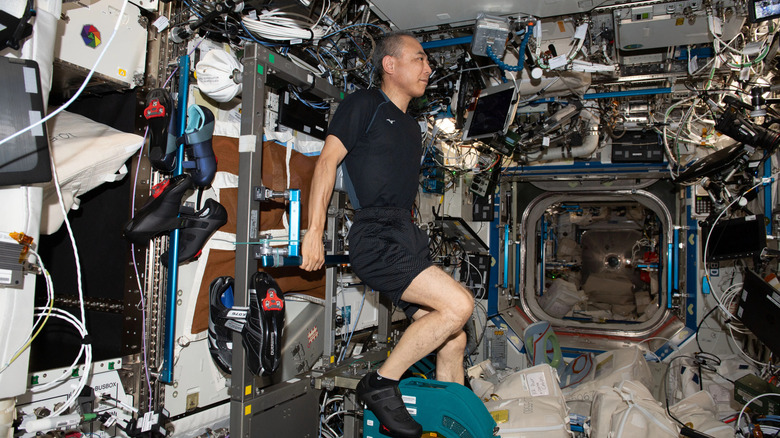
According to NASA, there are five main hazards facing astronauts headed to Mars: space radiation, travel time, changes in gravity, altered immune systems, and the psychological effects of extended isolation. The first two hazards are largely out of the astronauts' hands. Engineers will be responsible for minimizing their exposure to space radiation by shielding the walls of their craft, even in the case of a radiation storm. The time-and-distance question will also be a problem for the terrestrial crew to solve. But once the astronauts are on their way to Mars, the responsibility for their well-being mostly falls on their own shoulders.
Managing the physical effects of space travel are surprisingly straightforward. Nonetheless, living in zero gravity will take a heavy toll on their bodies. Zero gravity can cause problems with spatial orientation, balance, hand-eye coordination, and locomotion. After several months in zero gravity, the astronauts will lose bone density, their muscles will atrophy, and their cardiovascular system will weaken. To counter these effects, the astronauts will have to follow strict dietary protocols and exercise constantly. Once they return home, they'll still have done irreparable damage to their bodies.
Mars-bound astronauts will also face an invisible threat to their health: microbes. Micro-organisms start behaving differently in zero gravity, leading to changes in the gut. These changes, in part, cause alterations to the immune system, increasing the risk of diseases, allergies, and other illnesses. To make matters worse, the close quarters makes germ transfer even easier. Astronauts travelling to Mars will thus spend much of their time monitoring their health and taking supplements and medications. Testing their vitals, fluid levels, and blood will become a daily ritual.
The psychological toll of half a year in a tight tube
Despite lofty promises, a crewed mission to Mars is still quite a ways off. For example, SpaceX has continuously postponed its target launch date, which was most recently pushed from 2028 to 2031. Nonetheless, SpaceX's Starship is currently the most viable spacecraft design. Its Super Heavy booster, which uses a liquid-methane propellant, has had some successful initial tests, while NASA's proposed nuclear-propelled crafts remain entirely conceptual. If the first trip to Mars does take place in a SpaceX Starship, then it will be able to carry 100 to 150 tons of payload.
How much of that payload will be allotted to living space is yet to be seen. Should a sizable crew embark on the first manned mission to Mars, the quarters will be cramped. Each crew member will require space for sleep, exercise, food, drinks, and personal belongings to keep them sane. The psychological toll of such confinement is hard to imagine. Even on the International Space Station, only six sleeping quarters are allotted to up to seven people at a time. On a spaceship to Mars, the conditions could be even more claustrophobic.
As a result of the confinement, crew members would have to be carefully selected to ensure the risk of interpersonal "behavioral issues" is minimized. Regardless of the mental fortitude of the astronaut, the risks of long-term confinement include declines in cognition, mood, sleep quality, and morale. The remedy, according to NASA's research, focuses on three main factors: lighting schedules, sleep, and exercise. Experts will also encourage astronauts to keep journals to vent frustrations. The psychological toll is perhaps the greatest challenge for Mars-bound astronauts, and that's not to mention the challenges that await them once they arrive to the hostile red planet.