

12 Signs Your Partner Might Be Cheating, According To Psychology
Science is present in all aspects of life, including our romantic behavior. There's the science of heartbreak and deep dives into what happens to your brain when you're in love. We've even looked at the worst first date mistakes according to science, and taken a long, hard look at the mathematics of love that might just help determine which one is "the one".
However, there's more to romantic and sexual interactions than forming exclusive relationships. Since humans are animals that mate for pleasure, wandering eyes and hands can sometimes lead to cheating. Science has also taken several extensive looks at this unfortunate aspect of human relationships ... and interestingly enough, psychology has discovered several ways to spot infidelity from surprising aspects of your partner's behavior. Let's take a look at the several strange ways you can tell if your partner is potentially cheating.
Search for signs of emotional withdrawal

In movies and TV shows, cheaters often get caught red-handed, either in the act or with tangible evidence. As is so often the case, reality can be more subtle. In fact, there's a chance that the first strong sign of cheating is simply a shift in your relationship's overall atmosphere. Your partner might not have as much time for you anymore, and they might not be as interested in your life as they used to be. It could seem that they don't care as much anymore — either about you or the life you're supposed to share. This emotional withdrawal is a potential sign of cheating ... and even if your partner is not actively cheating at the time, this increasing lack of emotional availability is a troubling sign that should be discussed.
Of course, there are many reasons why your partner might seem less committed than usual. For instance, stress can be a major factor. To make things even more complicated, their emotional withdrawal could even partially stem from your own behavior, since a relationship is a two-way street, and one person's behavior affects the other.
Because of the numerous factors involved, you shouldn't automatically assume that your partner is cheating if they seem to fit in this particular box — or many other ones, for that matter. Still, it's probably not ideal if they're suddenly not as interested in you as they used to be.
Look at their social group

In 1993, Oxford University anthropologist and social psychologist Robin Dunbar introduced the concept that a human being has an upper limit of 150 truly meaningful connections. The exact "Dunbar's Number" and the potential for variance among individuals has caused some debate in the scientific community, but the idea that a human brain has a hard limit of people it can care about is fascinating. From a cheating standpoint, it may also be concerning ... at least, if a significant number of meaningful people in your partner's life happen to be cheaters themselves.
Even if your partner seems like the most trustworthy person in the world, the people in their lives might negatively affect their ability to stay faithful. Research indicates that bad influence from our social circles can potentially impact our tendency to cheat. The way this works might seem surprising, but is ultimately pretty simple. When someone is surrounded by people who are either prone to cheating or simply think that infidelity isn't all that bad, it might normalize the idea that "everybody" is cheating in that person's head. After that thought takes hold, it's not a huge step for the person to join what they perceive to be this normal cheating behavior themselves.
Study your partner's face

Some clues about potential cheating are so hardwired into us that they can be read from a person's face ... literally. Amazingly enough, it seems that a person's potential for infidelity can be determined from their facial features. Women seem to be more adept at judging this from men's faces than vice versa, and it should be noted that this isn't a foolproof technique for anyone — so maybe don't study your partner's face too carefully in order to determine whether they can be trusted.
Still, let's unpack how it works. In a 2019 study published in Royal Society Open Science, researchers had over 1,500 heterosexual subjects study a series of face photos, with hair and other distinguishing features around the face covered. Some of the faces belonged to people who the researchers knew to be cheaters ... and both men and women showed some ability in pinpointing these people, based on the images alone. Female participants showed a higher talent for judging the trustworthiness of the men. The pictures the women deemed less trustworthy tended to be rated conventionally masculine, which suggests that women may associate "manly" features with untrustworthiness.
As mentioned, this is obviously not a catch-all strategy, and the female subjects' ability to point out cheaters was closer to "above average" than "100% accurate." Still, it's interesting that the study suggests a possible correlation. After all, there is some evidence that masculine faces are a benefit when it comes to mating.
Look for signs of online infidelity
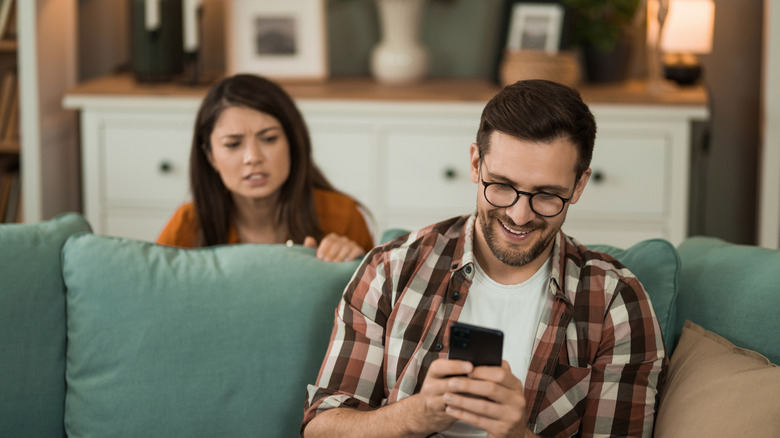
Have you noticed that your partner likes someone's posts on social media weirdly often? Perhaps they've started to disguise their communication with online contacts, or their open communication with someone has gotten strangely intimate? These could be signs of infidelity — specifically online infidelity. This is part of one of the more difficult grey areas of cheating out there, known as "micro-cheating."
Micro-cheating is effectively a form of potential infidelity. It's not necessarily as condemning as actual cheating, but it can demonstrate a willingness to cheat should the opportunity present itself. The problem with it is that the threshold and exact definition of micro-cheating can vary from person to person. Women often see micro-cheating as a more serious issue than men, and what some individuals see as harmless discussion can be highly trust-breaking to others.
Research has determined that there are certain forms of online infidelity that are larger breaches than others. For instance, late-night communication can be seen as more condemning than interacting with someone during daytime. On the other hand, it's also worth keeping in mind that suspecting someone of micro-cheating can open a whole different can of trust issues if the suspicious person finds themselves spying on their partner's online behavior and personal messages.
Find out if they've cheated before

Sometimes, clichés are clichés for a reason. For instance, have you ever heard the age-old adage, "Once a cheater, always a cheater?" Well, it turns out that the saying may have at least some meat around its bones ... even though the more scientifically accurate term might be "Once a cheater, always carries an elevated chance of repeat occurrences of cheating." (Admittedly, this version doesn't roll off the tongue quite the same way.)
According to research, cheating behavior is far more likely to occur in a relationship if the person has cheated in their previous relationship than it is if they have been faithful. In fact, a person who was willing to admit to cheating behavior in a former relationship for the study was no less than three times as likely to report cheating in the following relationship than someone who doesn't have a history of cheating.
This doesn't mean that every single person with a history of cheating is just waiting for a chance to cheat again, of course. In fact, most of the people who took part in this research reported no instances of cheating in their new relationship, even if they had cheated in a previous one.
Pay attention to certain aspects of your partner's mate value

Ideally, the person you're in a relationship with should be very important to you, and the relationship itself should be between two equals who both contribute the same amount. Of course, life is rarely perfect, and this isn't always the case.
From a scientific point of view, the potential inequality between partners can be determined with a concept known as mate value. It's essentially the combination of key traits that make a person a desirable partner in a relationship: Agreeableness and commitment, surgency (which is an umbrella term for a person's positivity, sociability, and responsiveness), emotional stability, and physical attractiveness.
Here's where things get interesting from a cheating standpoint. If the partners' mate values aren't close to each other, it may increase the risk of infidelity, specifically for men. Interestingly, certain mate value traits also seem to positively predict the possibility for cheating: High levels of surgency (for women) and agreeableness and commitment (for men) in a relationship seem to correlate with potential for being unfaithful.
Pay attention to your partner's self-confidence

Very few people feel confident all the time, and that's alright. However there is some evidence that low self-confidence might have a pretty nasty side effect — and you can probably guess what it is.
Yes, it turns out that self-confidence issues and cheating have a connection. While this obviously doesn't mean that every person with low self-esteem is a cheater, some people can try to improve their self image with infidelity. This, of course, is a badly thought-out self-improvement strategy that can easily make things worse for everyone involved.
Apart from the usual ways cheating can harm a relationship, a cheater who's motivated by self-image trouble can attempt to establish dominance in their own relationship as a substitute for their own self-esteem issues. This may also lead them to be extremely hypocritical in their behavior, blaming and criticizing their partner and situational circumstances without accepting or even fully understanding the true effects of their own behavior.
Look for signs that they're not seeing things from your perspective
Do you feel like you're on the same page with your partner? If they're able to step in your metaphorical shoes and see things from your point of view, congratulations — there's a noticeably lower chance that they'd cheat on you. However, if they can't see where you're coming from in the relationship, there's an elevated chance that their eye might be wandering.
From scientists finding ways to communicate their research to participants of a project calculating different communication channels, the ability to let other people know your viewpoint is essential. This applies to romantic relationships, as well — and it can even act as an important method of preventing infidelity.
A person who's unaware of their partner's perspective on things is far more liable to consider cheating. Fortunately, it also works the other way around. If partners do consider how the other person sees things, it not only decreases their potential for infidelity — it actually increases their devotion to the partner. As is so often the case, communication really is key.
Look for signs that they're normalizing dishonesty
Honesty is an important aspect of a healthy and functional relationship. However, things can become tricky if one of the people in said relationship starts losing track of what honesty means in the first place.
Unfortunately, this can happen — and it's not even all that difficult. According to research, the human brain has a heavy tendency to adapt to dishonesty. What may start out as small lies and deceits will soon seem normal to a person. When this level of dishonesty starts to seem normal, it becomes easier to commit slightly bigger misdeeds ... and when those seem normal, even bigger lies soon start to seem possible and even logical.
This normalization of dishonesty applies to all aspects of life, including fidelity. As such, this sort of downward spiral can potentially cause even an originally faithful person to slide toward cheating behavior ... and once that seems normal to them, it's entirely possible that they will cheat again.
Pay attention to how powerful they feel

As mentioned, differences in two partners' mate value can potentially increase the chance of infidelity in the relationship. However, there's another factor in the two peoples' "values" that can affect the potential for cheating: The power dynamics of the relationship.
In a nutshell, the more powerful a person is, the more likely they are to act in bold ways and put themselves first. This applies to many aspects of life, and in a relationship context, it doesn't even necessarily translate to tangible power in society. Simply the impression of being the more powerful partner might lead a person to start suspecting that they contribute more to the relationship than the other partner.
Naturally, this doesn't mean that being powerful equates to being an automatic cheater. Still, if the power dynamic within a relationship — be it real or perceived — is not balanced, there's an elevated chance that the partner who sees themselves as more powerful will not appreciate the relationship as much as they otherwise would. Instead, they may see their presumed superior value as a justification to explore the field as they wish.
Recognize your partner's dark triad personality traits

In psychology, the Dark Triad of personality traits covers Machiavellianism, psychopathy, and narcissism. As you might suspect, they're not necessarily ideal building blocks for a healthy relationship. When it comes to cheating, they're all very different, and the way people with these traits view cheating in the first place can be confusing. Recognizing Dark Triad personality traits in your partner can help you understand which version of infidelity might potentially be in store, though.
Psychopaths can appear normal and charismatic, but their defining psychological feature is their lack of conscience. For a person like this, being physically intimate or secretly emotionally attached to a partner outside their relationship may not count as cheating at all. However, open displays of emotion toward someone else or simple fantasies can be grievous transgressions to them. On the other hand, people with Machiavellianism – which is all about cynical manipulation — are completely fine with fantasies and displays of emotion toward other people.
Narcissists, of course, are self-centered by design and highly liable to cheat. Their infidelity comes in two distinct flavors. Narcissists who genuinely feel that they're better than others extend this view to their partners, and are constantly on the lookout for more interesting opportunities. Meanwhile, more insecure narcissists may cheat to satisfy their need for attention and validation. If you want to learn more of this particular personality trait, you can reference a handy list of 11 telltale signs that someone is a narcissist.
Pay attention to potential gaslighting
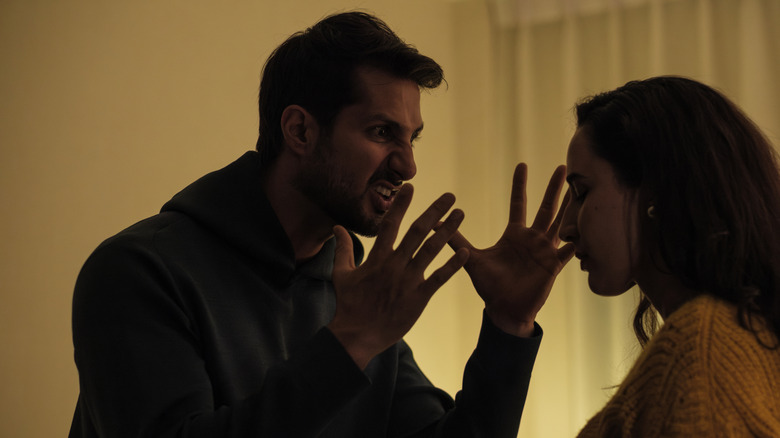
Gaslighting is an umbrella term for a wide array of manipulative techniques that a person can use to throw another person off balance and question themselves. It's an abusive way to control one's partner, and as such, a very potential tool for the kind of person who might cheat said partner in the first place.
Infidelity and gaslighting are so connected that if your partner has been sleeping around, it's more than likely that they've also attempted to gaslight you. This makes up all the stories that an unfaithful partner comes up with to cover their affairs and shift the blame, from outright lies to repeated insistence that they're not doing anything wrong — even in the face of evidence.
Believing your partner's gaslighting isn't something to be ashamed of. The way humans are psychologically hardwired to strong emotional connections is strange: When we feel that connection with someone, it allows us to actually shift our perception to better match theirs. This is why gaslighting from a loved one can be so effective ... and so deeply hurtful. If you suspect that it's happening to you, relationship expert Dr. Robert Weiss tells Psychology Today that it's better to trust your gut instinct and consult your friends than to blindly listen to your partner's words.