

Scientists Suggest Earth's Final Days Might Be Closer Than Ever Before
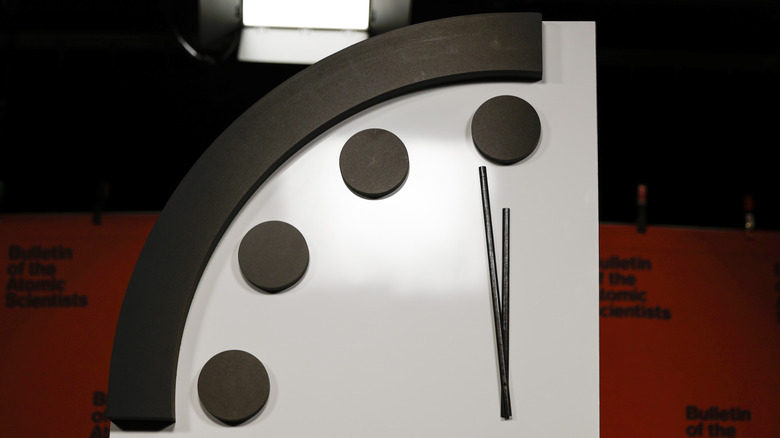
"It is 85 seconds to midnight," reads the ominous caption at the bottom of the Doomsday Clock. This is the metaphorical representation determined by a group of scientists, eight of whom have garnered Nobel Prizes, of how close the planet is to global catastrophe. Within the 79 years that this clock has been in operation, 2026 has reached the closest to midnight. These determinations are based on proximity to nuclear disaster, the climate crisis, and existential threats facing humanity. Essentially, the future is so bright, you're going to need to wear a hazmat suit.
In 1945, the nuclear attacks on Hiroshima and Nagasaki killed between 110,000 and 210,000 people. After the catastrophic bombings, several members of the Manhattan Project — the secret research group formed by the United States government to create the atomic bomb — formed the "Bulletin of Atomic Scientists," with the purpose of informing the public and policymakers about man-made threats to human existence. Members included Albert Einstein and J. Robert Oppenheimer.
The Doomsday Clock was created in 1947, when the Bulletin decided to begin releasing publications as magazine issues. Artist and member, Martyl Langsdorf, designed the iconic clock to provide a symbolic illustration of the threat that nuclear annihilation posed to humanity. That year, the image declared, "It is seven minutes to midnight." Since then, a board appointed by the Bulletin of Atomic Scientists, known as the Science and Security Board, continues to set the clock each year.
The best of times and the worst of times
Shifts in global events have been reflected in the clockface each year. As the Cold War raged, the hands crept closer to midnight. In 1949, when the Soviet Union performed a nuclear test, the clock displayed three minutes. But the Earth's journey to potential disaster has not been linear, according to this daunting timepiece. When the Soviet Union and the United States signed the Limited Nuclear Test Ban Treaty in 1963, the apocalypse was a whole 12 minutes away.
As global threats have shifted, so have the determinants of the Doomsday Clock. The Science and Securities Board introduced climate change into the equation in 2007, and in 2015, nuclear weapons advancement and the climate crisis ticked the clock back to three minutes until midnight. Interestingly, misinformation was introduced as a primary concern in 2017, when the clock displayed just two and a half minutes left.
Recent years have made this display incredibly dire as nations increased their nuclear arsenals and the climate crisis progressed. The experts have also pointed to unregulated artificial intelligence as an emerging risk. In a 2024 statement, the Bulletin emphasized the possibility of AI use in harmful biotechnology and military operations. The authors also state that disinformation spread could prevent properly addressing future pandemics and climate change.
Are we doomed?
The 2026 statement pointed to record-high sea levels in 2025, along with various natural disasters around the world. Also highlighted was the Trump administration's anti-renewable energy agenda, which could reverse progress and lead to worse climate outcomes. Moreover, experts noted increased nationalism among countries like the United States and Russia. This trend reduces opportunities for international cooperation, which is needed to effectively address global threats.
Of course, disinformation spread by AI exacerbates the issue of cooperative action as well. The Bulletin's 2026 statement quoted Nobel Peace Prize laureate, Maria Rissa, as saying, "We cannot solve problems we cannot agree exist. We cannot cooperate across borders when we cannot even share the same facts." Whether the world is the closest it's ever been to imminent doom is difficult to quantify, but one takeaway is to be cautious of where we receive our information and how critically we approach it.
The timeline displayed by the Doomsday Clock serves as a metaphor for genuine threats to humankind, determined by esteemed scientists with expertise in nuclear, climate, and technological risks. However, criticism has been levied, suggesting that this is overtly dramatic and non-transparent. While it is true that the exact calculation method is not known, some critics have stated that it is still a powerful tool to raise awareness.