

Scientists Can't Quite Believe What Was Found Under One Of The World's Oldest Trees
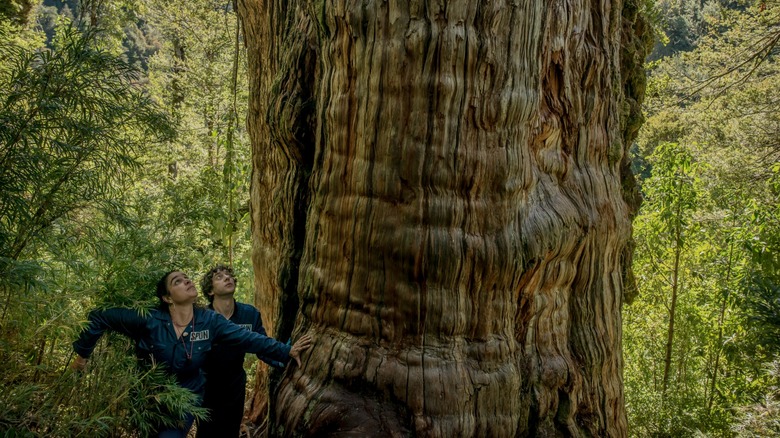
Rainforests are the most biodiverse ecosystems on the planet. Although they only account for 6% to 7% of Earth's land, they're home to 70% of the plants and animals in the world (per the World Rainforest Fund). However, scientists have only begun to identify the millions of species in these ecosystems — less than 10%, in fact. That's why it's not a total surprise when field researchers uncovered new species of fungi in the Alerce Costero National Park in Chile. What is surprising, though, is that the fungi were found in a hidden world underneath the park's massive trees.
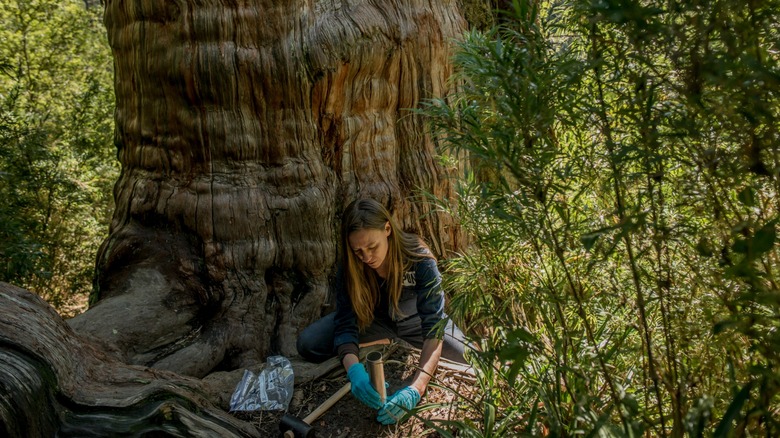
The study that led to this finding, which was published in Biodiversity and Conservation, actually started in 2022. With the aim of understanding the importance of the Chilean park's temperate rainforest biome and how to protect it, scientists from several collaborating institutions and organizations were mapping the mycorrhizal fungal networks and sampling the soil under its ancient conifers, which are called alerce trees.
As the second oldest tree species in the world, alerce trees have a low mortality and grow slowly, reaching up to 15.5 feet wide and 164 feet high. The field researchers found that they act as shelters for hundreds of organisms that live amongst their root systems — which provide the kind of environment fungi like. While analyzing DNA from the soil from individual trees that range in age from saplings to 2,400-plus years old, they discovered that the biggest, oldest tree was home to 2.25 times the fungal diversity. That tree's soil samples also had more than 300 unique fungi species.
Why discovering this hidden underground world is important
Along with finding this hidden underground world of fungi, the scientists were able to determine that the relationship between the alerce trees and fungi isn't one sided: The trees provide shelter while the fungi assist the trees' survival and adaptability.
Many fungi contribute to the ecosystem, and mycorrhizal fungi are one of the common types of fungi found in soil. In Chile's Alerce Costero National Park, these fungi are key to helping the forest function by channeling nutrients and water through the trees' root systems. This role supports the trees and other plants when they have to survive through environmental stressors like droughts and pathogens. On top of that, the fungi are the reason the national park is a huge carbon sink: They draw carbon to the soil, which is part of the planet's natural carbon cycle to make things grow and maintain a stable climate.
Because of these findings, the scientist concluded that conserving the alerce trees is essential for protecting the hundreds (possibly thousands) of fungal species under their trunks. The range of the alerce forest has already been reduced to nearly half due to deforestation over the centuries, and the oldest tree was felled in 1976 at 3,622 years old. If more millennial trees are lost, soil fungal diversity will also be lost, triggering negative consequences that could cause a ripple effect that leads to the destruction of an ecosystem that took millennia to build.