

How Uranium Enrichment Works And Why Iran's Program Has People Concerned
It's generally well known that uranium is used to make fuel for nuclear reactors. In its natural form, uranium contains more than 99.3% of the isotope uranium-238 (U-238), which takes billions of years to decay, and less than 0.01% U-234 (per the U.S. Nuclear Regulatory Commission). To sustain a nuclear chain reaction and release significant amounts of energy, though, it's the 0.7% U-235 in the natural uranium that holds the power. That's why countries around the world — including Iran — have enrichment facilities, but how does enrichment work and should countries like Iran have that power?
There are two main methods by which U-235 can be concentrated for use as nuclear fuel. Gaseous diffusion enrichment was the first method the U.S. used on a large scale. It involves combining the uranium with fluorine to create uranium hexafluoride gas, which is then passed through a gaseous diffusion unit. The lighter molecules in the gas carry the U-234 and U-235 atoms and travel faster than the heavier molecules that carry the U-238 atoms. After hundreds of stages, the gas contains enough U-235 and can be separated back into fluorine and U-235.
Today, the United States uses the gas centrifuge enrichment process. It involves creating uranium hexafluoride gas and putting it into a gas centrifuge of numerous cylinders. While spinning at high speeds, the heavier molecules carrying U-238 are pushed to the outer edge, separating them from the lighter molecules carrying U-235 in the center. The U-235–enriched gas is then chemically processed into uranium dioxide powder and compressed to form fuel pellets.
In addition, a new laser enrichment or separation process is under development. It delivers a monochromatic light to chemically change the U-238–carrying molecules in uranium hexafluoride, allowing the U-235 to be separated and captured.
Enriched uranium isn't used just for nuclear power
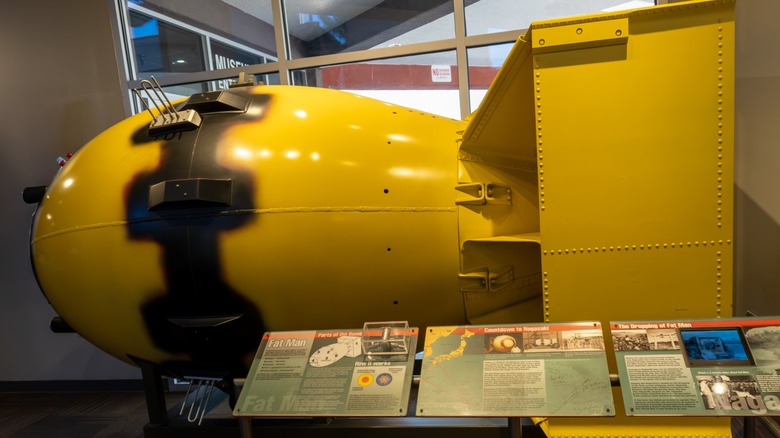
While uranium and nuclear power have been recurrent topics in the news since the 1940s, the U.S.-Israeli war against Iran has brought them to the front page in early 2026. The countries started launching attacks to eliminate what President Donald Trump called "imminent threats from the Iranian regime." That threat includes 400 kilograms of 60% U-235. Meanwhile, the International Atomic Energy Agency inspectors reported in 2023 that it found 83.7% U-235 particles in Iran. To understand why that's concerning, it's helpful to understand the various concentrations of enriched uranium and how they're used.
Nearly all uranium used to fuel nuclear reactors is low-enriched at between 3% and 5% U-235. Containing 5% to 10% U-235, "low-enriched uranium plus" is being developed to enhance light-water nuclear reactor performance so that reactors don't have to be refueled as often. Next, high-assay low-enriched uranium contains 5% to 19.75%. It's not widely available now, but it's intended for use in advanced reactors under development to improve nuclear power efficiency.
Finally, a U-235 concentration of 20% or more is highly enriched uranium used to power some research reactors. With a purity of 90%, it's used to power naval reactors, nuclear weapons, and bombs (one of the dangerous uses of radioactivity at this level). Iran having the capability of enriching uranium to 83.7% is concerning because it means the country isn't far off from accelerating its production to produce 90% U-235 to fuel nuclear weapons. Then, it could use those weapons to attack other countries that it deems enemies, such as Israel and the United States.