

Oprah Winfrey's 'Ozempic Feet' Rumor Is Actually Based In Science

It's no secret that American talk show host Oprah Winfrey has struggled with her weight. In an exclusive with People, she talked about those challenges and how her life has improved since she started taking a GLP-1 weight loss medication, one of the best peptides to improve your body. Fans have noticed one change other than her slimmer figure, though: excessive wrinkles on her feet. Unfortunately, what is being referred to as "Ozempic feet" is a side effect, and there's a science behind why it happens.
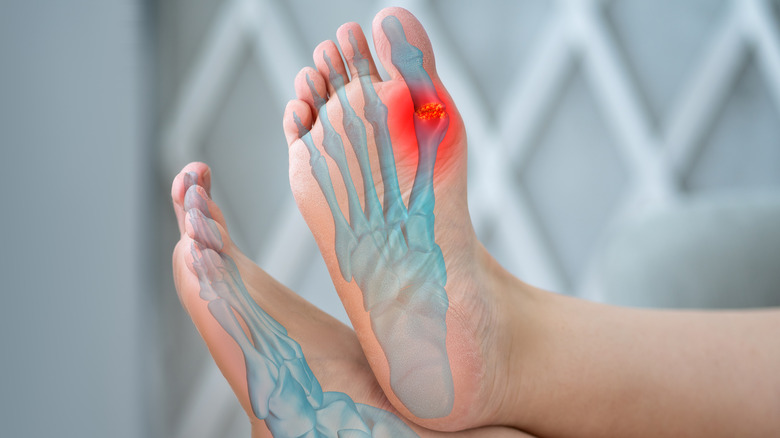
American Association of Clinical Endocrinology president Scott Isaacs, MD, tells Health that "sagging skin, reduced fat padding, and visible tendons or veins in the feet" are the characteristics of Ozempic feet. It's a form of fat pad atrophy, which happens naturally as you age. All of the walking, standing, running, and jumping that you do over the years wears down the fat deposits in the balls and heels of your feet, leaving the bones underneath vulnerable to impact.
With the rapid weight loss that occurs while taking GLP-1s, that natural process is accelerated. "The underlying mechanism is that when fat is lost quickly, the skin's natural elasticity may not be able to keep up," says Isaacs. The result is an undesirable side effect that not only doesn't look pretty but can also cause pain with every step. With low collagen and elastin levels — the primary types of fibers in connective tissue — depending on overweight duration, age, and genetics, the effects can be even more pronounced.
Ozempic feet isn't the only side effect of GLP-1s
The way that GLP-1s work, including the first oral GLP-1, which is one of the biggest scientific breakthroughs of 2025, means that so-called Ozempic feet (fat pad atrophy) isn't the only unsightly side effect. Along with slowing down how fast the stomach empties, these medications mimic the natural hormone GLP-1, which is produced in the gut and sends signals to the brain to tell the body that it's full. Together, these mechanisms make you feel fuller for longer.
The resulting rapid weight loss affects the entire body and can cause a noticeable reduction in subcutaneous fat in your face, hands, and even the gluteus maximus — leading to the nicknames Ozempic face, Ozempic hands, and Ozempic butt. As a result, sagging skin and wrinkles become more prominent. The face may present with sunken eyes and thinner lips, while the butt may appear deflated or flatter. Scott Isaacs explained to Health, "The mechanism is similar to that seen in other body areas: As fat is lost rapidly, the skin may not contract quickly enough, revealing underlying structures and contributing to an aged look."
It's possible to mitigate the severity of the side effect but not prevent it entirely. To do that, Isaacs recommends staying hydrated while taking a GLP-1 because it will help your skin maintain elasticity. You can also work with your healthcare provider to slow down how fast you lose weight, which will give your skin more time to adapt and reduce the loss of fat padding in the feet.