

The Surprising Way Scientists Used Condoms In A New Experiment

Condoms are widely known for their purpose of creating a barrier that protects individuals from sexually transmitted infections and unwanted or unplanned pregnancies. However, people have found many alternative uses for condoms, such as a makeshift ice pack, waterproof bag for a phone or matches, and wound dressing or tourniquet. Since latex condoms are made of substances that are impermeable to water, researchers have even found them useful in field research in the Amazon rainforest while investigating cicada towers.
Working as part of the Serrapilheira Institute's Training Program in Quantitative Ecology, more than a dozen young researchers studied something that they had never seen before: cicada towers, including the tallest ever recorded at 47 centimeters. The researchers became curious about the poorly understood purpose of these structures and aimed to test two hypotheses. In a paper published in Biotropica, they described how they used condoms in a sealing experiment to test one hypothesis and provided the results.
Testing the theory that the towers have a physiological regulatory function, lead author Marina Mega said in an article recounting the experience that "one of my colleagues joked, 'Look at their shape — what if we used condoms?'" to prevent air from getting in and out. That's when they slipped latex condoms over nine of them, wrapping them at the base with PVC film. After 18 hours, they checked the condoms for inflation and broke the towers at the base to record what happened next.
What the condom experiment revealed about cicada towers
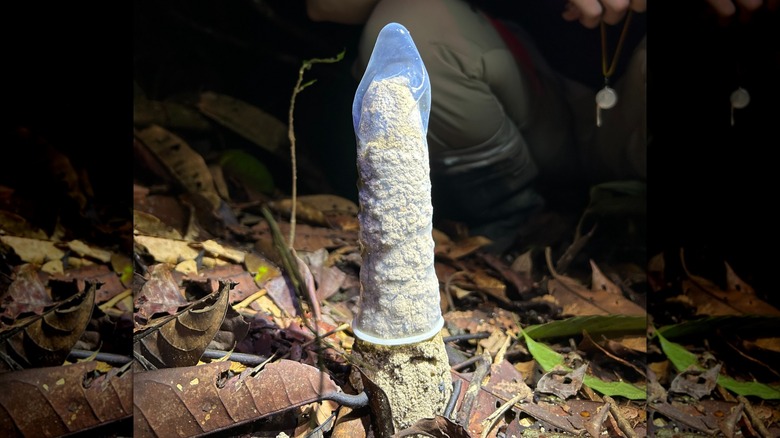
The cicada towers studied by the Serrapilheira Institute researchers in the Amazon were built by Guyalna chlorogena nymphs, which are among the rainforest animals that go through metamorphosis. As bugs that shed their skins and live underground, they feed on root sap before surfacing as adults. The insects neatly sculpt these cylindrical structures out of clay and urine, and one of the researchers' hypotheses was that they help regulate air flow.
After the nine towers were sealed with condoms for three-quarters of a day, the results were dependent on their size — likely because the seal limited gas exchange and caused respiratory stress. The latex covers on the taller structures were inflated. On the day after the structures were broken, those that were at least 19.6 centimeters exhibited better growth rates than the control structures left untouched. Towers that were shorter than that had lower growth rates than the controls.
Because of that, the researchers deduced that the G. chlorogena nymphs had flexible responses to carbon dioxide accumulation and respiratory stressors like heat and hypoxia. That's because, based on the results, the larger structures seemingly have more initial oxygen to delay the buildup of CO2. Also, it might indicate that the nymphs in larger towers have more energy reserves and better stress tolerance. The researchers note that these potential conclusions can only be confirmed with direct physiological measurements.
Cicada towers have more than a physiological regulatory function
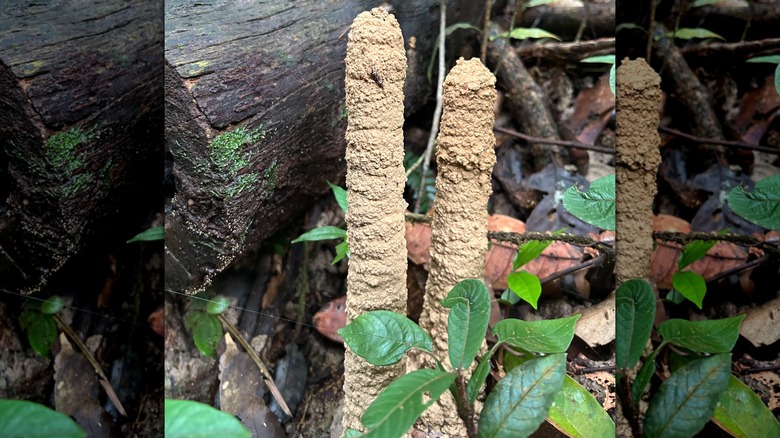
Along with the sealing experiment using condoms, the Serrapilheira Institute researchers performed a water addition experiment on nine of the G. chlorogena cicada towers. They poured water into a hole at the base and evenly around the exterior to simulate the effects of heavy rain, closing the opening at the top with clay as well. Compared to the untouched clay structures used as a control, there was no difference in growth rate.
On top of that, the researchers wondered whether cicada towers protect the nymphs from predators. That theory came to mind when they noticed how many ants were crawling around the towers, sometimes in huge colonies. To find out, they attracted the ants to specific points using pizza-like bait made of wheat, water, and sardines. The bait was placed on the tops of 30 towers across three sites to imitate where the cicadas would emerge during metamorphosis. Another 10 control baits were placed on the ground at least 2 meters apart. Just three hours later, there were about 8.5 times more ants on the ground baits than the tower baits; the towers themselves were apparently protecting cicadas from predators. The variations in height, however, didn't influence the probability of ant occurrence.
The combined results of these experiments indicate that cicada towers are an adaptive extended phenotype. Basically, they're the insect's strategy to cope with abiotic and biotic factors in the ecosystem (or the non-living and living elements, respectively). The protective function is particularly important when the nymphs are in their final stage of transformation. Still, the researchers have questions about how the height of the towers relates to the nymphs' reproductive success and survival.