

What Scientists Really Think About 'Project Hail Mary'

We may receive a commission on purchases made from links.
While many movies certainly have some educational merit, the majority are made with the primary intent of entertaining. This is not necessarily an issue, as suspension of disbelief is often a requirement when enjoying a good film. However, as mis- and disinformation become more pervasive, striking a balance that truly employs science in genres like science fiction is a worthy endeavor. This appears to be a concept that Andy Weir, the author of "Project Hail Mary," a sci-fi book that has recently been adapted for the screen, is particularly aware of.
With scientist parents, including a father who worked as a particle physicist and a mother who was an electrical engineer, Weir has expressed that he tries to maintain scientific accuracy in his work. Although he does achieve this in some respects, there are certainly elements of the book and film that rely more on movie magic than physics and biology. Interestingly, while there are aspects of the story that do not mirror scientifically verified reality, Weir does implement creative solutions that manage to introduce other science concepts.
The plot of "Project Hail Mary" involves the race to stop a fictional star-eating fungus, referred to in the film as "astropage," from destroying the sun, which would in turn save life on Earth. This microbial antagonist travels back and forth between the sun and the planet Venus to breed, and this presents the first scientific challenge.
The astrophage threat
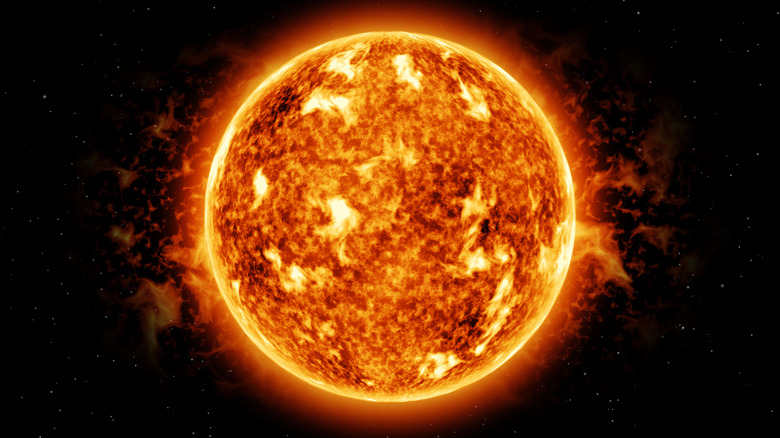
Theoretically, microbes could travel to the sun from Venus, or vice versa. However, these two trips are very different from each other in terms of the energy required. This is largely due to solar wind, which is the movement of particles from the sun throughout the rest of the solar system. Therefore, it would be easier for these fictional microbes to travel from the sun to Venus because it would essentially be riding the current of solar wind. To travel from Venus to the sun would be going against this current, and thus a more energy-draining feat.
To solve this challenge, Weir fictionalizes the particle science underlying neutrinos. Though they do have some mass, neutrinos are so light that they have yet to be weighed and are often referred to as "ghost particles." They are also neutral and abundant, constantly passing through matter, including your body, without interacting. And this is where Weir makes an exception for the plot. In "Project Hail Mary," the fictional astrophage can absorb neutrinos and convert their mass into energy, using these ghost particles to fuel the voyage back to the sun.
A final scientific discrepancy is that these astrophages have mitochondria, the organelle known as the "powerhouse of the cell." Since mitochondria are found on Earth, this is used to suggest that astrophages could be ancestral to life here. However, this does not account for cells that are without mitochondria, for instance, prokaryotes like bacteria, which evolved on Earth before eukaryotes.
The importance of habitat

The story also follows a friendship that develops between the main character, a human named Ryland Grace (Ryan Gosling), and the alien Rocky (James Ortiz). The area that they meet, Tau Ceti, is actually presumed to have an exoplanet, referred to as Tau Ceti e and described as "A potentially rocky world, larger than Earth" by NASA. Grace and Rocky's collaboration is fraught, but this plot device is based on some theoretical science.
Due to the extreme differences between their habitats, Rocky and Grace cannot be together under the same physical conditions. For the plot (and all life that we know of), the inhabitants of Rocky's planet, Erid, needed to rely on water. However, this planet is also close to its sun (40 Eridani), which means that any water would boil and become vapor. The boiling point of any given molecule increases under high atmospheric pressure, so Weir theorized that the aliens from 40 Eridani would have to thrive under incredibly high pressure and with very hot water. Additionally, Weir decided that Erid's atmosphere would be primarily composed of ammonia, which is particularly heavy, to weigh down the atmosphere and prevent it from being stripped away by its nearby star.
Overall, although there are a few holes in the science, "Project Hail Mary" incorporates some interesting concepts into its plot. If you see the film or read the book, pay attention to where scientific jargon is incorporated, and ask yourself if this lines up with what you know. Fiction can be entertaining and educational.