

The 'Grand Canyon Of The East' Is Home To A Peculiar Light Phenomenon
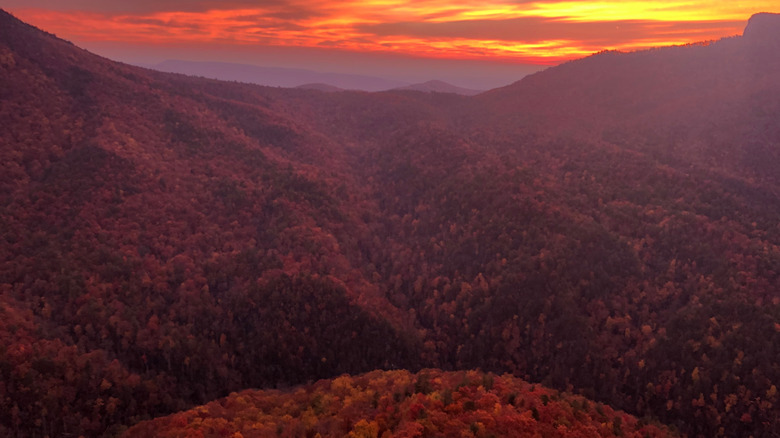
The world is full of amazing wonders, and the geological marvel that is the Grand Canyon in Arizona is one of them. Like the formation of all gorges, it was carved by a river (in this case the Colorado River) and tributary streams eroding the rock formation layer by layer over millions of years. It's counted among the greatest canyons in the world and holds numerous mysteries, such as why dinosaur fossils have never been found there. On the opposite side of the country, though, Linville Gorge — nicknamed the "Grand Canyon of the East" — and nearby Brown Mountain have a baffling mystery of their own: the Brown Mountain lights.
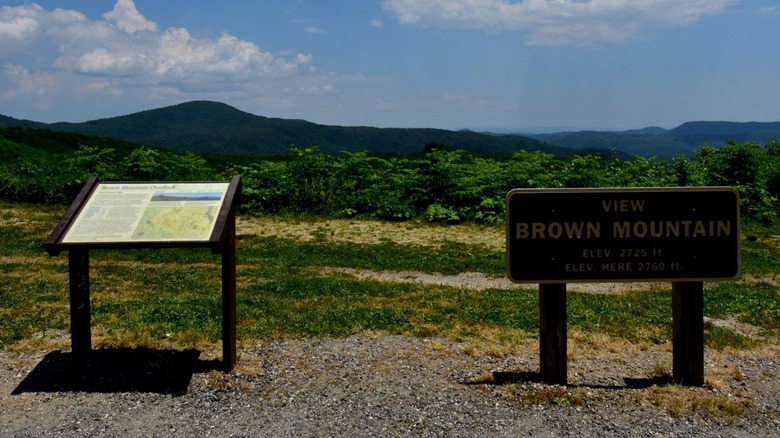
Basically, the Brown Mountain lights are the random appearance of dancing orbs or star-like dots in the sky, usually on clear, warm evenings during the summer. Mostly white, the lights sometimes look blue, red, or yellow in color. Thousands of people have reported seeing them above the mountain (hence the name) and from various viewpoints throughout the Linville Gorge Wilderness Area for hundreds of years. There are even legends about the Brown Mountain lights dating from 1200, according to the interpretive sign at Brown Mountain Overlook.
One Cherokee legend has it that the lights are the spirits of maidens searching for long-fallen warriors who died during a conflict with the Catawba Indians near the mountain. Another legend is that the lights are a woman looking for her fiancé who left her heartbroken on their wedding day. Researchers, however, are looking for a scientific explanation.
Scientific theories that may explain the Brown Mountain lights
Like the "Taos Hum" — the unusual humming noise in Taos, New Mexico — the Brown Mountain lights continue to baffle scientists. Some U.S. congressmen requested that the U.S. Geological Survey investigate the phenomenon after an article was published in the Charlotte Observer in 1913. From two studies in 1913 and 1922, the researchers attributed the lights to cars, fires, and trains. Others have proposed that the lights are the result of burning marsh gas, city lights, and radium rays.
Since none of these theories have been proven, Appalachian State University director of observatories, astronomer, and astrophysicist Daniel Caton and his colleagues have set up and monitored cameras to capture and try to determine the cause. He records hundreds of images every night. One hypothesis was that unstable air created a light refraction that made distant stars look like they were appearing below the horizon. However, that doesn't explain why the Brown Mountain lights can be seen during bad weather. He also ruled out meteors because those leave streaks of light behind them.
Instead, Caton believes that ball lightning is the culprit. This rare phenomenon, an illuminated mass of gas about the size of a sports ball, usually develops during thunderstorms and near the ground. It may or may not move and could be visible for several seconds. Unfortunately, scientists don't know how ball lightning occurs naturally. "We don't know how nature makes it, but it's been documented for more than a century," Caton told The Appalachian. Although he has only been able to capture and confirm the Brown Mountain lights on camera once, he's determined to discover whatever triggers it in the Linville Gorge area.