

Science Weighs In On The Toilet Myth You Always Thought Was True
When you flush a toilet, which way does the water swirl? People in the Northern Hemisphere might say water swirls down in a counterclockwise direction because of the Earth's rotation. But it turns out that the idea that Earth's rotation dictates how water swirls during a flush is a myth. It's the toilet's design and not its location that makes the water swirl to the left or to the right.
However, the notion that toilets swirl clockwise south of the equator and counterclockwise to the north lives on in conventional wisdom and popular culture. This common misunderstanding is understandable. It's well known that Earth's rotation affects the large-scale circulation of air and water through a phenomenon known as the Coriolis effect. The Coriolis effect is one of the forces that influences wind speed and direction and creates ocean currents. This is why winds and ocean currents in the Northern Hemisphere move in an opposite direction from those in the Southern Hemisphere. Experiments have also found a similar effect on small systems like sinks and toilets, however, the effects on small scale systems are weak and easily overpowered by other factors.
The reason why winds seem to curve
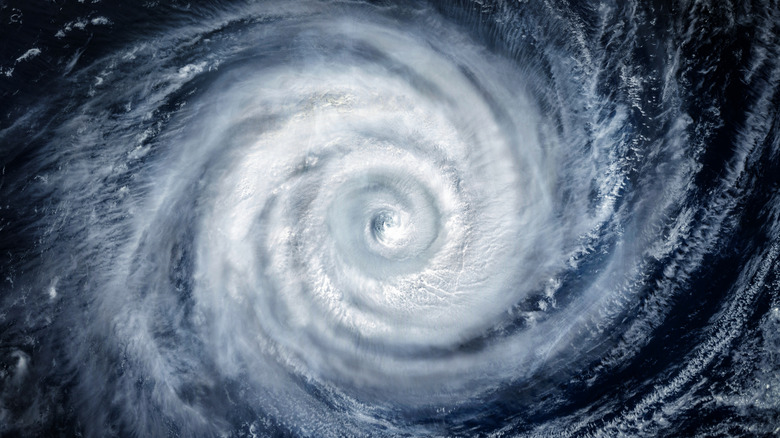
First described in 1835 by French mathematician Gustave-Gaspard de Coriolis, the Coriolis effect causes the path of an object traveling long distances to appear to curve. This effect arises because of differences in the linear velocity of Earth's surface at different latitudes. The entire planet has the same angular velocity, taking 24 hours to complete one turn; however, Earth's diameter varies widely from the equator to the poles. This translates to a linear velocity of a fraction of a mile per hour close to the poles and more than 1,000 miles per hour at the equator.
This difference in rotational speed causes a deflection in the path of anything moving in a straight line that's not due east or west. Straight paths deflect to the right in the Northern Hemisphere and to the left in the Southern Hemisphere. This is what gives hurricanes their characteristic counterclockwise or clockwise spin depending on the hemisphere. However, while this force has a profound effect on hurricanes, the Coriolis force is itself weak. Forces are higher at high latitudes and lower near the equator, but at mid-latitudes the Coriolis effect amounts to about one ten-millionth the force of gravity.
Design overpowers geography
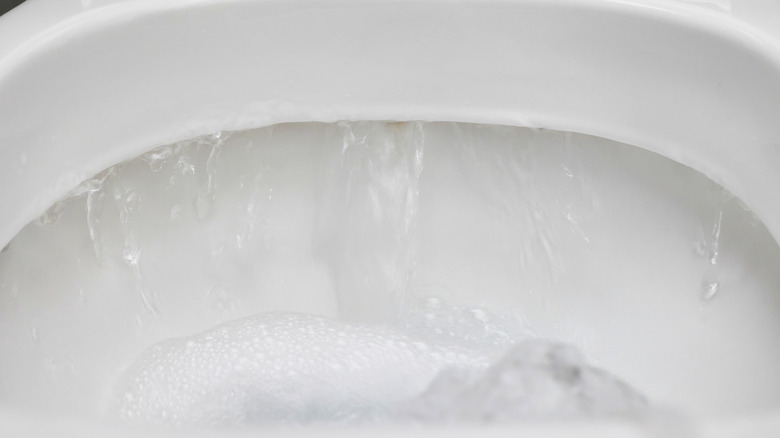
The strength of the Coriolis force means that it's most noticeable on large scales. However, that doesn't mean it has no effect on smaller systems like a sink, bathtub, or toilet. In 1962 a researcher at MIT named Ascher Shapiro carried out an experiment to see how the Coriolis force affected smaller systems. He filled a large shallow dish with water and gave it a clockwise swirl, which is the opposite of what would be expected in the Northern Hemisphere. He then let the dish rest for 24 hours to let movement slow and, after covering the dish with plastic to keep air currents from influencing the water's movement, unplugged a hole in the bottom of the dish. He found that the water drained with no rotation at first, but showed a tiny counterclockwise rotation over time. A repeat experiment in Australia found a similar, but opposite effect in the Southern Hemisphere.
So with such a small effect, what causes water to swirl the way it does? Toilets have small holes under the rim of the bowl known as rim jets. These holes are angled to cause the water to swirl around during the flush cycle to make the flush more effective. The water in the toilet will swirl in whichever direction the rim jets are pointed, regardless of where on Earth the toilet is. The Coriolis effect is a big name in weather and climate, but in the bathroom, it's design that reigns supreme.