

What It Means When Your Poop Floats Instead Of Sinks, According To Science

Humans and their ancestors have always had bowel movements as part of the body's digestion process to get rid of waste. With the help of science, the resulting poop can tell you a lot about your health. In fact, science can explain why shopping triggers the urge to poop, and even that 'poopy' Trump rumor is based in science. One of the biggest curiosities people have, though, is what it means when your poop floats. As it turns out, science has a simple, yet complicated, answer.
According to gastroenterologist Joseph Salhab, in an interview with GQ, "Sinking stool generally means things are working as they should. It indicates normal fat absorption, good digestive function, and appropriate water content. It's what I'd expect to see in someone with a well-functioning GI tract." However, he noted that healthy poop can also float.
Actually, researchers who investigated floating stools in the 1970s and published their findings in The New England Journal of Medicine concluded that floating stools from healthy subjects simply contained higher gas content than sinking stools. When the floating stools were degassed, they sank and had similar specific gravities as the sinking stools.
The extra gas is what makes poop less dense and float, and it can get there from eating a lot of foods that are high in fiber and create gas as they pass through your system. UnityPoint Health gastroenterologist Pavan Chepyala said in an article, "If your body struggles to break down lactose, a sugar found in dairy, then milk, yogurt or cheese might cause your poop to float as well."
The concerning reason poop floats and why
While an occasional floater isn't anything to worry about, bowel movements that consistently produce floating poop could be. That's because it indicates that your body is struggling to break down or absorb fat. Unlike flatulence (farting or passing gas), which is one of the gross adaptations humans evolved to keep the intestines safe and avoid exploding, regular floating stools are often a sign of an underlying problem.
Fat malabsorption, which is known as steatorrhea, is one cause and simply means that your body isn't absorbing fat as it should during the digestion process, resulting in poop with a high fat content. As Chepyala explains, "This can be caused by eating an extremely fatty meal, but it may also signal an underlying digestive issue." Some of these underlying conditions include gastrointestinal conditions such as celiac disease, Crohn's disease, and irritable bowel syndrome.
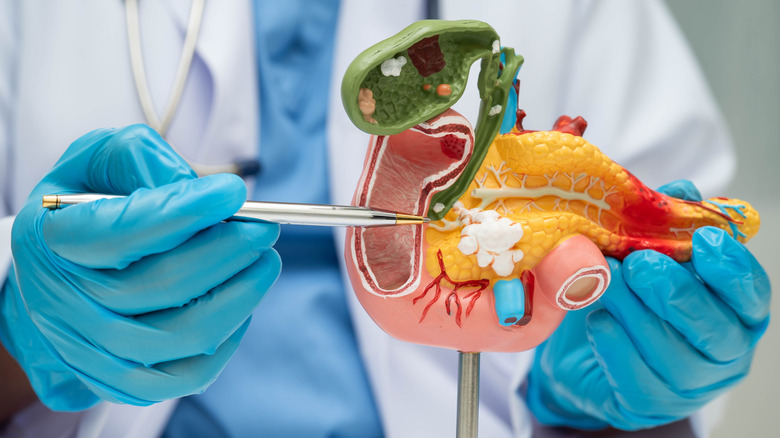
"Your liver releases bile and your pancreas secretes lipase. These two substances work together to help break down fats. If there's an issue with either organ, or if their flow is blocked by something, like gallstones, it can lead to excess fat in your stool," Chepyala noted. Chronic pancreatitis and pancreatic cancer are examples of such illnesses.
If you have consistent floating stools, though, it's important not to jump to conclusions right away. Instead, Salhab tells GQ that you should see a health care provider when it's accompanied by other symptoms like abdominal pain, blood, weight loss, and changes in stool appearance — such as pencil-thin, pale, or clay-colored poop.