

The Shady '50s Government Experiment That Changed The US Forever
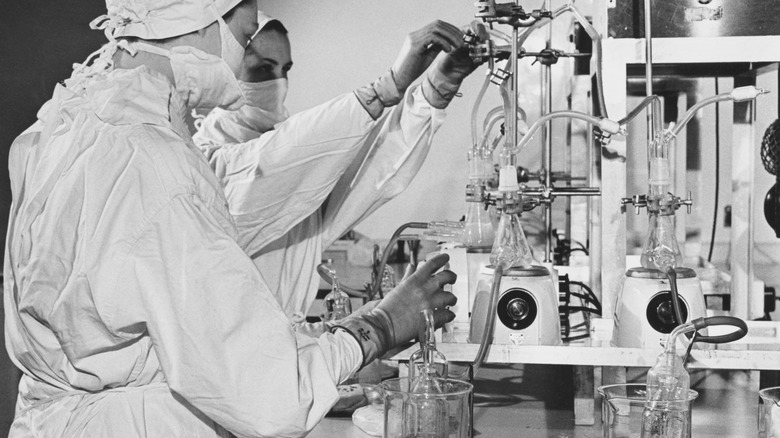
Former residents of the Pruitt-Igoe housing development recall a mist being sprayed from rooftops and vehicles in their neighborhood as they slept with their windows open in the heat of the St. Louis summer of 1953. The past tenants of the now-demolished building report not knowing the purpose of these chemical mists, with some assuming they must have been chemical pesticides. In fact, very few people seemed to truly know what was happening in St. Louis. The few city officials made aware of an ongoing study appear to have been told only that research was being conducted on the formation of smoke screens.
Following World War II, the United States and the Soviet Union battled for territory that was left vulnerable in the wreckage. During this time, the U.S. government exaggerated Soviet access to weapons and nuclear testing, generating a sense of urgency in developing defense tactics. The initial premise under which this experiment was reportedly conducted was to study how a smoke screen might be used to confuse Soviet forces if they were deployed into a city in the United States. However, the cities that were chosen for this study (Minneapolis and St. Louis) were picked due to their geographical similarity to Moscow and St. Petersburg, according to a later report, indicating that these tests were meant to inform tactics that could be used offensively against the Soviet Union. Later, an Army official would tell a Minneapolis news station that they "didn't really lie. They just didn't tell the whole truth."
The experiments in St. Louis

The substance misted over residential areas contained zinc cadmium sulfide, which glows under ultraviolet light, allowing it to be easily detected. It appears that the dispersal of this substance was intended to provide insight into how biological weapons could spread over an area, with zinc cadmium sulfide acting as a supposedly harmless tracer. While thought to be non-toxic at the tested concentration, later reports would demonstrate that swaths of data were missing. Without exactly knowing what occurred over those missing data points, and without performing any investigation into previous residents' health, the National Research Council concluded that there was no harmful exposure.
Officials had initially decided to begin testing in Minneapolis. While researchers supposedly canvassed the area to alert residents to the ongoing project, the local police received many phone calls from concerned individuals who did not appear to have a clue why this mysterious mist was being sprayed near their houses. In the end, these trials did not go well. Residents protested, and some testing equipment strangely went missing. So, when it came time to look at St. Louis, the experimenters switched tactics.
It appears that, to avoid local pushback, researchers decided to target a low-income, predominantly Black area in St. Louis (a city that still enforced segregated housing at the time) and increased police presence in the area, which could intimidate residents. In other words, the researchers explicitly sought to perform experiments on a population made vulnerable by racialized policies without consent or transparency.
The enduring legacy of racism in scientific experimentation
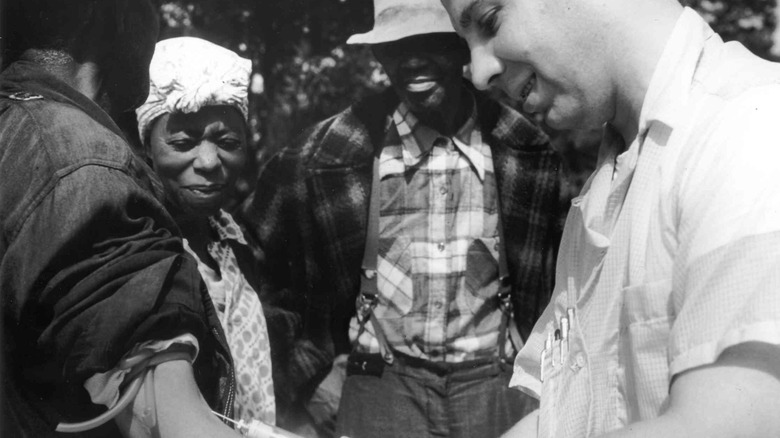
The exploitation of Black people in medical research was not a new or unique phenomenon. Famously, the Tuskegee Study of Untreated Syphilis intentionally withheld diagnostic information from Black men with syphilis, who were told instead that they were receiving a treatment for "bad blood." These experiments took place over the course of 40 years, from 1932 to 1972, and prevented the subjects from accessing penicillin, which became the standard cure in 1947.
In the 1840s, Black women and girls endured forced, painful experimentation from a man who would go on to be called the "Father of Gynecology." In 1951, cells from Henrietta Lacks were used for research without her consent. Her stolen cell line is still utilized in biomedical research to this day. From 1951 to 1974, many inmates at the Holmesburg Prison, most of whom were Black, were paid to participate in experiments without knowledge of what was being tested. Some prisoners were injected with asbestos, and others were exposed to a poison that is present in Agent Orange.
Issues with the experiments in St. Louis were brought to light in 2012 when Dr. Lisa Martino Taylor published research that included previously classified documents. Although legal action was pursued by past residents, the case was dismissed by a federal judge who stated that the Army and other actors were indemnified by the U.S. government. Due to missing data and incomplete testing, we cannot know the damage from these experiments.