

The Artemis II Toilet Debacle Meant One Gross Thing For Astronauts

On April 1, 2026, a team of astronauts were launched into space on the Artemis II mission. This second test flight in NASA's big plans to return humans to the moon started off with successful perigee and apogee raise maneuvers. While doing checks to prepare the Orion spacecraft — named after one of the most common constellations in the sky — in between those burns, the crew reported a blinking fault light to the ground team in Houston. A problem with the fan on the deep-space toilet was eventually detected, causing a gross problem: The astronauts could poop but not pee in it.
Modeled after one on the International Space Station, the toilet on Orion is an innovative part of the spacecraft and called the Universal Waste Management System (UWMS). It's designed to give the crew and those in the future a more dignified way to relieve themselves than waste collection bags taped to their rears. While a broken fan doesn't sound like a big deal, it meant that the crew couldn't pee in the toilet because it does more than ventilate the small space. The airflow that it provides actually pulls urine down so that it's not floating around the cabin in zero gravity. But, that same airflow isn't necessary for poop (that's explained later).
A few hours after reporting the issue, Houston was able to advise specialist Christina Koch on what to do while monitoring and performing their own troubleshooting tasks on the ground. When the UWMS fan was fixed, mission control recommended that the crew wait a little while to urinate in it.
How using the bathroom works on the Orion spacecraft
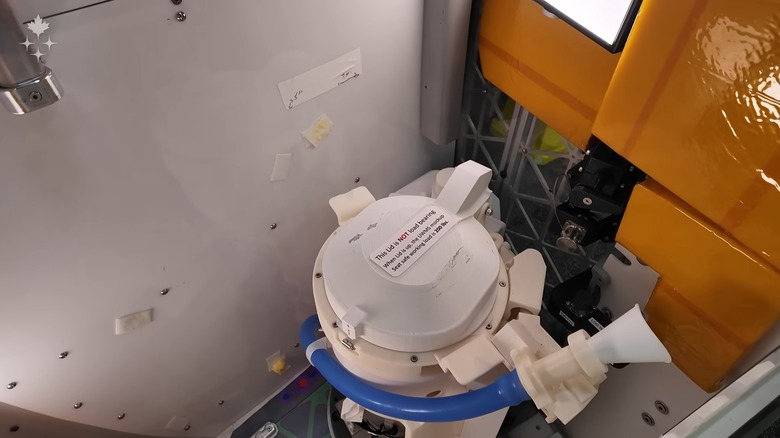
Since there's no gravity on the Orion as it travels toward the moon, using the bathroom in space is more complicated than you think. For starters, the zero gravity is why the UWMS relies on airflow instead of water to pull poop and urine into their respective receptacles. The toilet features automatically starting airflow as soon as the lid opens.
Also, because of the zero gravity and the fact that the bathroom is located on the floor, the first thing the astronauts have to do is strap themselves down. That's why there are foot restraints in the bathroom, another update from the thigh straps that the astronauts consistently referred to as a hassle. With these and handrails, the crew can keep themselves from floating away while they're trying to do their business.
After strapping in, the astronauts use the seat for pooping and a specially shaped personal funnel attached to a hose for peeing — or both simultaneously. The seat is small because, in microgravity, precision is important to ensure that everything flows down. For the 10-day mission, feces or solid waste will be collected in bags, which are then put into a canister the crew will bring back to Earth. The urine is collected in a Collapsible Contingency Urinal that's emptied into space a few times a day via Orion's venting system.
While the astronauts are fortunate to have a door for privacy, there are some additional quirks. Its entrance is underneath where the crew uses the collapsible space-rowing machine, so they can't use the rower and toilet at the same time. On top of that, they have to wear ear protection while using the toilet because the fans are so loud.