

The 'Useless' Facial Muscles Some People Still Have Once Served A Furry Purpose
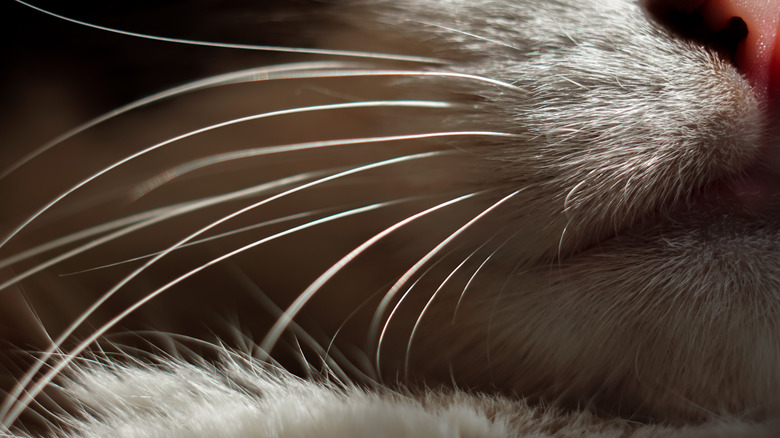
When we talk about mammalian characteristics, live birth and milk production tend to stand out, but hair is just as unique and important to the mammal identity. Every mammal grows hair at some point in their lifespan, but compared to other species, humans are unusually bare. Instead of thick fur coats, we have only a coating of fine fuzz known as vellus hair, and even those who grow beards and mustaches don't really have whiskers. True whiskers, like those on cats and dogs, are technically called vibrissae, and with their unique tactile capabilities, they serve an important role in the lives of almost every mammal species, save for ourselves. However, it may not have always been this way, as one scientific study suggests that not only did our ancient ancestors have whiskers, but they left evidence of them in our facial muscles to this day.
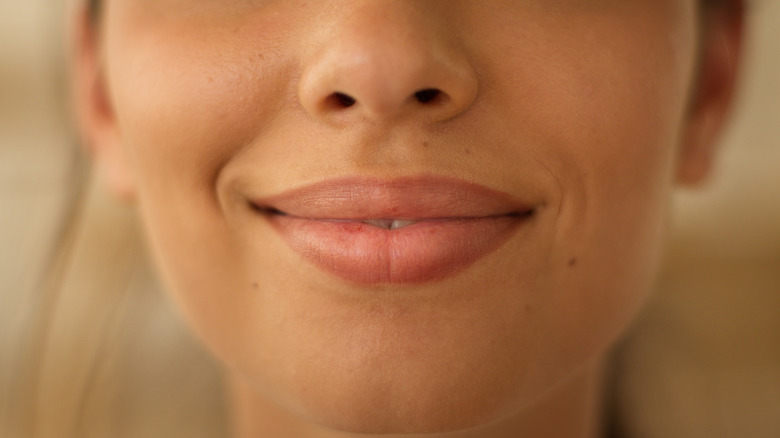
Your lips are surrounded by a ring of muscle called the orbicularis oris, affectionately known as the kissing muscle for its role in puckering the lips. In animals with vibrissae, the hairs are connected to the orbicularis oris, allowing voluntary movement of the whiskers. In a 2007 study published in the journal Clinical Anatomy, researchers inspected human cadavers, and found that 35% of them had muscle fibers connecting the orbicularis oris to the hair follicles above their lips, which would align with the presence of vibrissae. The researchers concluded that these muscle fibers were a remnant of prehistoric whiskers. The question is, why did we lose them?
Why humans lost their whiskers
The additional muscle fibers noted in some people's upper lips are an example of vestigial structures – a type of anatomical structure that doesn't perform a clear role in our bodies, but may have done so further back in our evolutionary history. Given the facts that whiskers are present in most mammals, and all mammals share a common ancestor, it's not a stretch to assume that the ancient predecessors to modern humans had some form of vibrissae themselves. However, at some point along the timeline of human evolution, these hairs vanished. It's not entirely clear why this happened, but evidence suggests a few possibilities.
Vibrissae are specially adapted for tactile use. When an animal's whiskers touch something, they send vibrations through nerves in the face, which help the animal feel its surroundings. One possible reason that humans lost vibrissae is that our forelimbs evolved into arms and hands with fingers that could do the same job as whiskers, but with an even greater range of mobility. We can also get clues from the small handful of other mammals that don't possess whiskers, which includes several other diurnal primates. Mammals active during the day can use sight more effectively than nocturnal mammals, meaning that the touch gained from vibrissae isn't as valuable. So while it's entertaining to imagine humans with a face of bristly whiskers, we don't really need them. Some vestigial features, like this "useless" organ, are actually important for your health, but extra strands of muscle fibers in some people's lips don't appear to be among them.