

What's Brewing Beneath Yellowstone National Park? Scientists Have A New Take
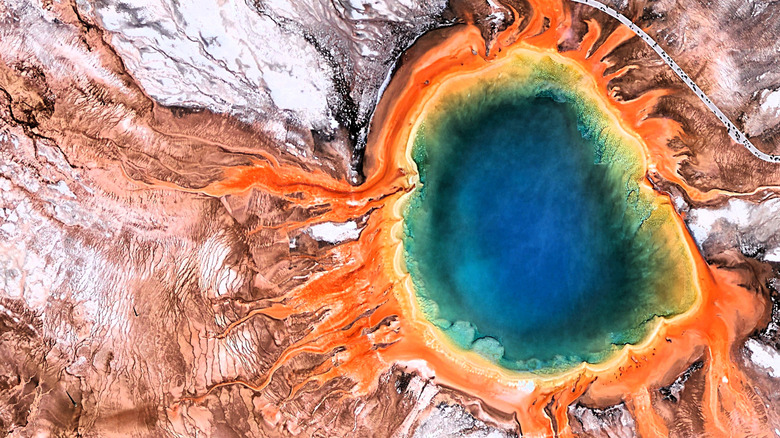
Yellowstone National Park is one of the most visited national parks in the United States, receiving more than 4.7 million visitors in 2025. However, there's a terrifying secret below Yellowstone: an active supervolcano that scientists don't fully understand. The U.S. Geological Survey emphasizes that a super eruption isn't overdue, but research has aimed to lay to rest the debate on exactly how magma moves under the Yellowstone's surface and the driving force behind its volcanism.
Based on new geodynamic modeling of western North America published in Science, researchers have determined that the Yellowstone supervolcano isn't fed by a single, deep mantle plume like was once believed. It's actually fed by hot material that flows eastward through the asthenosphere — the top-most layer of the Earth's mantle just beneath the rocky outer layer called the lithosphere. The flow is driven by a "mantle wind" or hot, slowly moving rock. When the material meets the lithosphere, some of it is pulled down causing a tear and melting in the lithosphere.
This partially melted rock becomes "magma mush." Rather than restricted to a magma chamber deep in the mantle, it's spread throughout the mantle, creating a tilted translithospheric magma plumbing system (TLMPS) that eventually feeds Yellowstone.
What controls the tilted TLMPS and why it matters
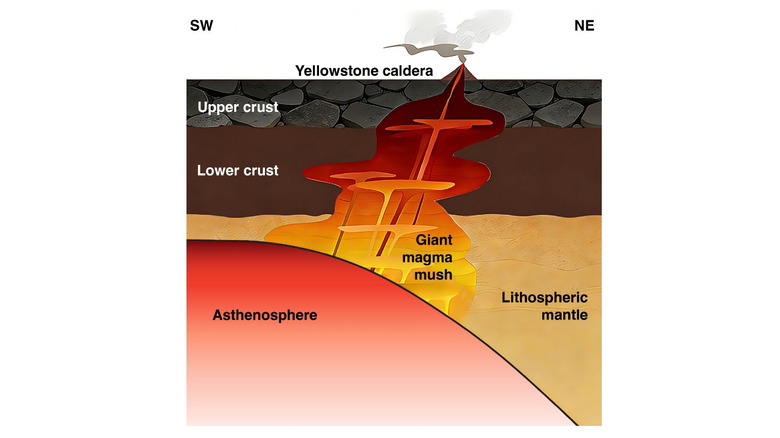
The same research and modeling published in Science also revealed what controls the shape of the magma flow through the tilted TLMPS. In the region around Yellowstone, one of the most dangerous supervolcanoes in the world, "a southwest-dipping extension zone" is the result of tectonic plate activity. The authors explain that it's the result of differences in rock density within the lithosphere and the hot, eastward-flowing magma in the asthenosphere pulling on the Earth's crust.
Combined with the mantle wind, these tectonic forces matter for eruptions. The stress of the eastward-flowing magma in the upper asthenosphere against the westward-directed force of the lithosphere creates deformation in the crust. Based on comparisons and geodynamic models of eruption locations, magma tends to burst from the areas in the upper crust that are actively deforming, such as at faults. Magma mush can accumulate without causing an eruption on the surface, however, where the crust remains strong.
These findings explain why some areas of the Yellowstone region have little to no eruptive activity. Also, it means that USGS scientists are already monitoring this area correctly — focusing their efforts on both upper-crust deformation in addition to deep-mantle activity. Additionally, the study weakens the likelihood of another super eruption being caused by an ever-rising plume of magma, although it's not an impossibility.