

The Frozen Ice Age Creature Scientists Brought Back To Life

Earth is full of creatures that never cease to amaze and seem to defy science, or at least the science that we understand. Bdelloid rotifers are among the strangest organisms you can only see with a microscope. Despite how small these multicellular animals are, they're also some of the most indestructible organisms of all time. Research published in Proceedings of the National Academy of Sciences in 2008 found that these creatures are unusually resistant to ionizing radiation. Years later, scientists discovered that bdelloid rotifers are unusually resistant to the cold, and can survive frozen for at least 24,000 years.
Researchers from the Soil Cryology Laboratory at the Institute of Physicochemical and Biological Problems in Soil Science in Pushchino, Russia, were working in Siberia when they isolated a microscopic bdelloid rotifer from ancient permafrost that was at least 24,000 years old. In Current Biology, the scientists reported that the organism was still alive after spending so long in cryptobiosis, a state of inactivity where all metabolic activity also stops, suspending development, repair, and reproduction. Previously, the organisms had only been confirmed to survive being frozen for up to 10 years.
Study co-author Stas Malavin said in a news release, "The takeaway is that a multicellular organism can be frozen and stored as such for thousands of years and then return back to life — a dream of many fiction writers." The U.S. National Science Foundation provided funding for the research, and its Division of Environmental Biology program director Dough Levey said, "This study shows that life exists practically everywhere on Earth, and that exciting discoveries about it are boundless."
Experimenting on the bdelloid rotifer and what the findings mean
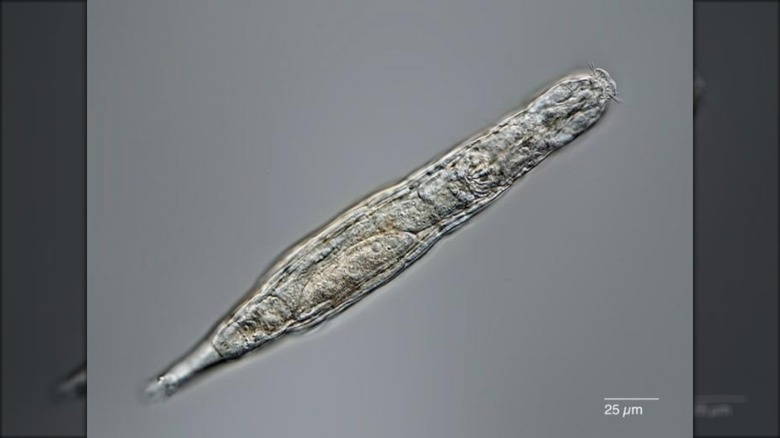
Along with being alive, the scientists reported that the bdelloid rotifer resumed metabolic activity, including reproduction, when thawed. They detailed the freezing and thawing experiments that they performed on the ice age rotifer, which belongs to the genus Adineta. While demonstrating that it could survive slow cooling and freezing for seven days, the scientists witnessed it reproduce through parthenogenesis, a type of asexual reproduction, when it was thawed.
Additionally, the researchers established numerous secondary cultures of a different strain, freezing them at negative 15 degrees Celsius for a week. Not all of them survived, and the ancient strain wasn't much more tolerant to the cold than other common Adineta species. However, the tests suggest that the ancient strain has biochemical mechanisms and cell shielding that allow it to survive such cold temperatures. Ultimately, the scientists aim to continue their Arctic research to learn more about those mechanisms to improve the cryo-preservation of other animal cells, organs, and tissues — eventually humans on Earth and beyond.
Malavin stated in the news release, "Of course, the more complex the organism, the trickier it is to preserve it alive frozen and, for mammals, it's not currently possible. Yet, moving from a single-celled organism to an organism with a gut and brain, though microscopic, is a big step forward." Harvard University molecular biologist Matthew Meselson told The New York Times, "They're probably the only animals we know that could do pretty well in outer space."