

The Real Difference Between Topsoil And Potting Soil, According To Science
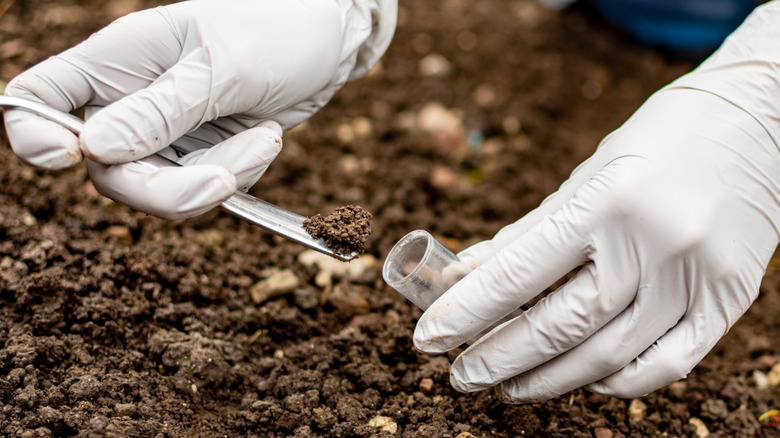
If you're preparing to do some gardening or lawn care, you might see a variety of soil bags at your local garden center. Although these bags look similar, they have different labels because they're each different on a scientific level. Topsoil and potting soil are two of the main types, and understanding what each soil is made of and how it's formed or produced is essential to choosing the right one to support a lush lawn and garden.
Topsoil is the natural uppermost layer of the ground. It forms over time from microbial activity, organic matter, and weathered minerals, reaching as far as 12 inches deep. On the other hand, potting soil isn't really a type of soil because it doesn't contain any. The word "soil" is used because it's used to grow plants, but it's actually an engineered mixture of organic materials, peat moss, and pine bark. Beyond these fundamental differences, the biological, chemical, and textural characteristics of topsoil and potting soil explain why one is better than the other for certain gardening purposes.
Topsoil explained
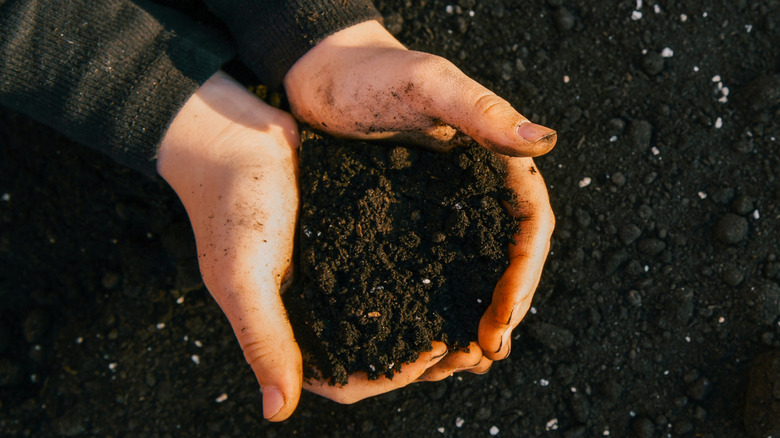
Developing from rock decomposition over millions of years, soil is a combination of organic matter and weathered minerals. It's also teeming with bacteria, earthworms, and fungi, which feed off of the organic matter in soil to cycle nutrients and carbon dioxide throughout the ground and build the soil's structure. Since the ratio of each of these can vary by region, the texture can range from clay to silt to very coarse sand. These factors are important because the amount of drainage and nutrients that topsoil has depends on its type. For instance, clay particles are the smallest and have a high cation exchange capacity (CEC), acting like magnets that hold nutrients such as calcium, magnesium, and potassium.
It's also important to note that topsoil naturally has pores made by insects and plant roots, and these pores are vital for airflow and drainage. That makes it ideal for in-ground planting, improving native garden soil so that roots can spread deeply. Gardeners also use it to fill raised beds and low spots in lawns. However, it must remain aerated with just the right amount of moisture. If it's too dry, it becomes hard; if it's too wet, it becomes easily compacted.
Bagged topsoil can contain different types of soil (sometimes mixed) and various amounts of nutrients that provide these same characteristics. However, you should never assume exactly what's inside, and read the label before buying.
Potting soil explained
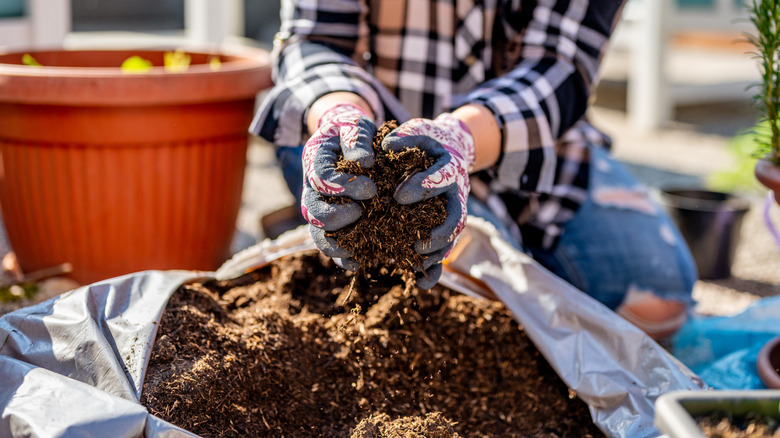
Since potting soil is manufactured from a wide array of materials, it doesn't have the same properties as topsoil. Most bagged mixes consist of bark and ground wood created from recycled forestry products (RFPs), but other additives (such as peat moss) may be included as well. There are also products that add various mineral particles and compost. Because of that, potting mixes can present problems such as nitrogen deficiency, poor water retention, and low CEC when used for in-ground soil.
The nitrogen deficiency occurs because the microorganisms that love to eat the RFPs reproduce rapidly, which depletes nitrogen and leads to poor plant growth. That issue can be rectified with fertilizer. However, poor water retention caused by RFPs being very porous allows the fertilizer to drain through, while low CEC (since it potting soil doesn't contain clay) is a contributor as well. Adding well-composted materials and organic matter to the mix — such as coconut coir, perlite (volcanic glass), and vermiculite (a raw mineral) — can improve nutrient and water retention.
Interestingly, the problems with bagged potting soil are actually beneficial for growing or at least starting plants in containers. It's specifically designed to have enough airflow and water retention for promoting plant growth in hanging baskets, houseplants, seed trays, and more. It doesn't become compacted easily like natural topsoil either, which prevents root rot. Additionally, most are pre-sterilized, so you don't have to worry about fungal diseases, pests, or weed seeds in fresh bags. With all of these factors, it's essential to read product labels so that you're certain about what you're getting.