

What Actually Causes Mushrooms To Grow In Your Yard?
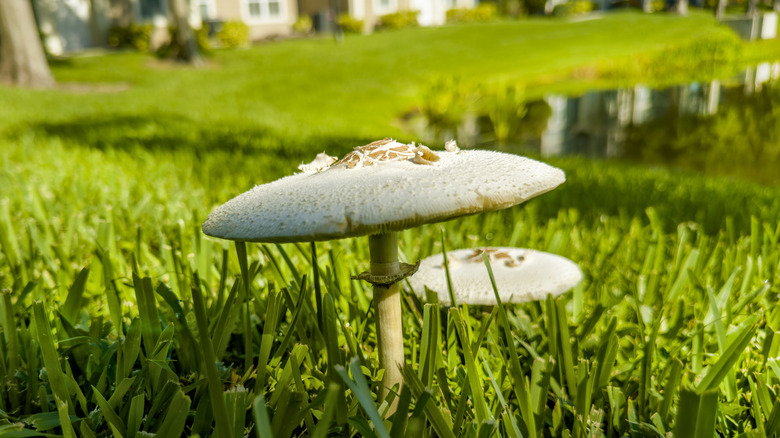
If you spend a lot of time in your yard or maintain your own garden, you might notice mushrooms growing even though you didn't plant them. The most common fruiting bodies (the above-ground part you see) you're likely to see in your yard are puffball, green-spored lepiota, and meadow mushrooms. In any case, all mushrooms are produced by different fungi, so they can pop up anywhere as long as the conditions are just right.
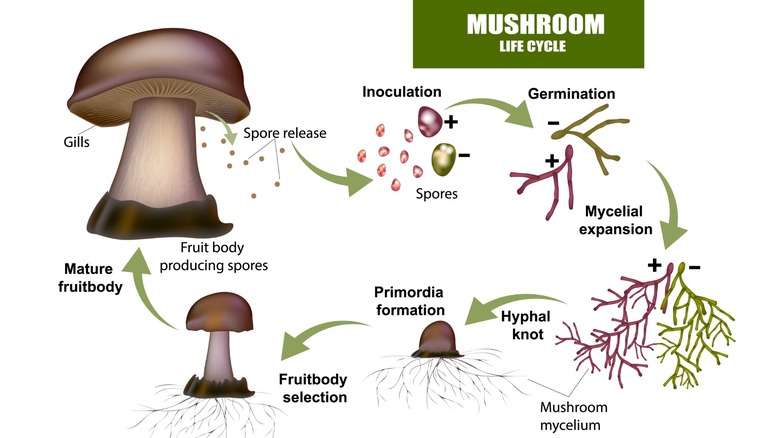
First, it's helpful to understand that mushrooms can end up anywhere fungi live underground. They get there because of how mushrooms reproduce, with the gills under the mushroom cap releasing tens of thousands to billions of spores that, like pollen, can travel long distances on wind currents. When they end up in warm, moist places, each spore can grow a network (called mycelium) of fine, root-like threads called hyphae. The hyphae release chemicals to dissolve decaying and dead organic matter — including leaves, old roots, and stumps — for nutrients that are absorbed so that the fungal flowers you see above ground can grow.
For this cycle to occur, though, there needs to be the perfect storm of weather, so to speak. That involves a prolonged period of higher-than-normal humidity and rain. However, the cycle can be interrupted before the gills release spores if the weather turns dry, at which point the fruitbodies will also dry up. The fungal mycelia will remain underground and continue growing, though, if there's still enough organic matter underground to feed it. When the conditions are right again, mushrooms can emerge.
Should you get rid of the mushrooms in your yard?
Whether or not you should get rid of the mushrooms that pop up in your yard or garden depends on if they're just a nuisance or actually causing damage. The underlying fungi are typically beneficial for lawns because they break down organic matter. In fact, fungi contribute to the ecosystem by recycling organic carbon, which is vital for all life.
Plus, the underground mycorrhizal networks that fungal spores create do more than feed the growth of the fungi into the fruitbodies that you see in your yard. They're communal networks that connect individual plants and trees. As a result, they can transport carbon, nitrogen, water, and other essential minerals and nutrients through the soil, giving the connected plants what they need to thrive. That's exactly what scientists found under one of the world's oldest trees. Additionally, plants struggling to survive can request aid from other plants through the mycelium.
Despite these benefits, some fungi and mushrooms pose a risk to your lawn and family. Lawn diseases are most commonly caused by fungi, resulting in severe, sudden, and/or widespread damage to grass and plants as they infect the blades, roots, and stems. However, like with the growth of mushrooms, there needs to be organic matter and favorable weather for it to spread and flourish. Additionally, there's a risk to family and pets if the mushrooms are poisonous and eaten. Simply not eating unidentified mushrooms is the best solution, but you can also pick and trash them.