

The Ocean Mystery That Left Scientists Stumped Over Great White Shark Deaths
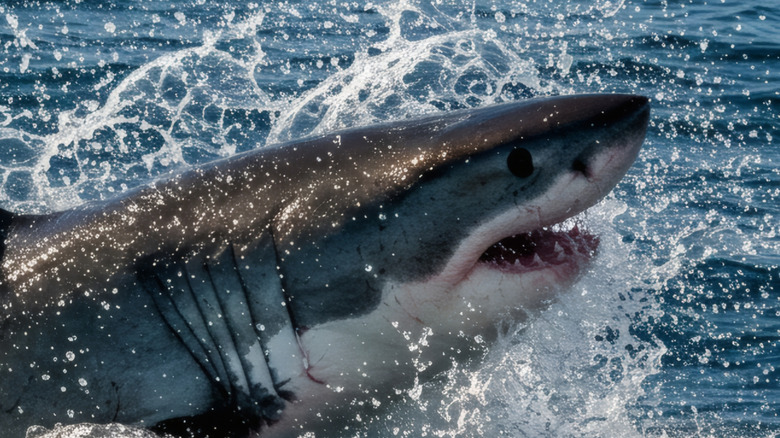
It's a widely known fact that great white sharks are apex predators in the food chain of saltwater fish. Because they're such powerful killers, scientists were scratching their heads in 2017 when their carcasses started washing ashore in South Africa. It took several years of study, but it turns out that orcas are actually the top of the food chain and the most ruthless of the saltwater hunters and the culprits behind this ocean mystery.
Although it varies by orca population, the whales' diet generally consists of fish, but sometimes dolphins, seals, and small sharks. The first verified documentation of killer whales hunting larger prey started in 2015 with sevengill sharks off the coast of South Africa. In this case, the culprits were orca duo Port and Starboard — named as such because of the direction their dorsal fins collapsed — with their brutal behavior recorded in Ecosphere Naturalist. Great white sharks started showing up dead on beaches just two years later, some of which were only missing their livers.
However, it wasn't until 2022 that evidence of Starboard and other orcas being responsible was published in The Scientific Naturalist. The study detailed how the killer whales bit into the shark near the liver, which they ate for its energetic value. In a statement, Simon's Town Boat Company whale-watching operator David Hurwitz said, "I first saw Starboard in 2015 when he and his close-associated 'Port' were linked to killing seven gill sharks in False Bay. We saw them kill a bronze whaler [copper shark] in 2019 – but this new observation is really something else."
The ecological consequences of orcas killing great white sharks
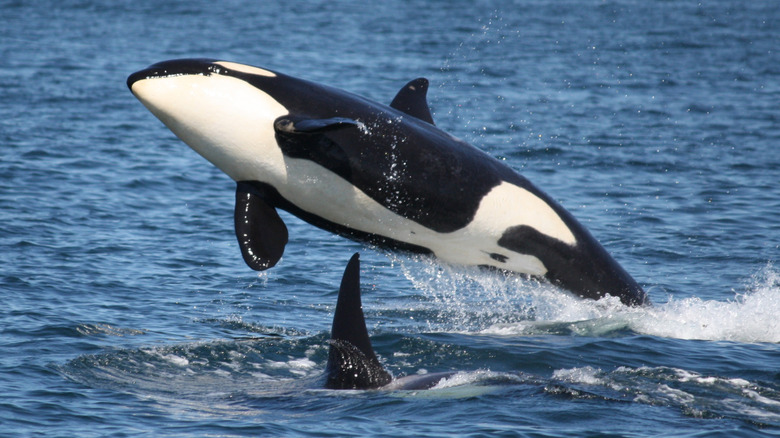
Although sightings of orcas killing great white sharks seemingly started off the coast of South Africa, they're happening in other regions as well. Footage and observations have since been recorded near Australia and in the Gulf of California, as noted in a Frontiers in Marine Science study. In a statement to Frontiers, lead author and marine biologist Erick Higuera Rivas said, "This behavior is a testament to orcas' advanced intelligence, strategic thinking, and sophisticated social learning, as the hunting techniques are passed down through generations within their pods."
Unfortunately, the killing of great white sharks by orcas is having a ripple effect. Researchers published in the African Journal of Marine Science that the sharks' "flight" sense means that they're fleeing from areas where killer whales are present — sometimes for months at a time. Another study published in Frontiers in Marine Science outlines the effects this has had in False Bay, South Africa. There has been an increase in the Cape fur seal and sevengill shark populations. As a result, their food supplies — fish and smaller sharks, respectively — are on the decline.
Another problem is that the Cape fur seal preys on the African penguin and its food. African Journal of Marine Science study lead author Alison Towner told The Natural History Museum, London, "With no great white sharks restricting cape fur seal behaviour, the seals can predate on Endangered African penguins or compete for the small pelagic fish they eat." She went on to explain, "There is only so much pressure an ecosystem can take, and the impacts of these orca removing sharks are likely far reaching."