

Science Explains The Rare Disease That Slowly Turns Its Victims To 'Stone'

There's quite a list of common genetic disorders, such as autism spectrum disorder, most cancers, diabetes, down syndrome, and spina bifida. Since there are (seemingly) fewer rare diseases, they aren't as well known. Some of them have never been heard of because they affect so few people. With a prevalence of less than one person out of 1 million in the United States (based on research published in Orphanet Journal of Rare Diseases), "stone man disease" is one example.
Medically referred to as fibrodysplasia ossificans progressiva (FOP), scientists have known since 2006 that this rare disease almost always involves a mutation in a gene called activin A receptor type 1 (ACVR1) and published their findings in Nature Genetics. This specific gene "encodes a type I bone morphogenic protein (BMP) receptor," as described in Biomedicines. In the classic presentation of FOP, the amino acid arginine is substituted for the amino acid histidine, which activates the mutated gene. That triggers a process called heterotopic ossification (HO), which involves bone growing in soft tissues — including muscles, ligaments, and tendons — where it normally wouldn't.
Although this extraskeletal bone growth can happen after any kind of injury and is usually so small that it doesn't cause symptoms, it's more of an ongoing process with FOP. Any kind of trauma, such as a fall or surgery, can stimulate a flare-up with inflammation and swelling that lasts for up to months at a time. Even the flu or other non-physically traumatic illness can cause a flare-up. Over time, the soft tissue turning into bone restricts range of motion and becomes debilitating.
Diagnosis and treatment of fibrodysplasia ossificans progressiva is difficult
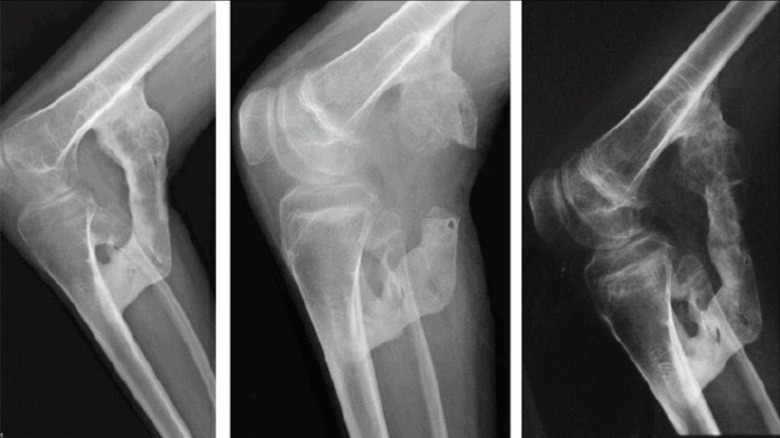
While the occurrence of FOP may be obvious in some individuals, that's not always the case. Having abnormally large big toes (hallux valgus) at birth can be a helpful indicator. Generally, though, the HO process starts during early childhood in the neck and shoulders and eventually moves to other areas of the body. The extraskeletal bone can grow rapidly or slowly, the latter of which might make it more difficult to diagnose. In fact, misdiagnosis is common because this disease is rare and shares some similarities with other health conditions.
Along with a physical examination (specifically looking at the toes) and imaging techniques like X-rays to assess the new bone growth, diagnosing FOP often includes identifying the symptoms and reviewing family medical history. Physicians won't perform a diagnostic biopsy if they suspect that the health problem is FOP because the invasive procedure can cause a flare-up. Instead, they typically order gene sequencing of ACVR1 to determine whether or not the disadvantageous mutation has occurred.
Since only about 800 people in the world are known to have FOP (per the Genetic and Rare Diseases Information Center), there are no solid treatments yet. Avoiding flare-ups with preventative antibiotic therapy and managing pain and swelling with medications are the main ways this disease is treated.
Regulatory agencies in Australia, Canada, and the United States have approved a selective retinoic acid receptor gamma (RARγ) agonist called Palovarotene to inhibit new HO formation (per a study published in Journal of Bone and Mineral Research Plus). However, it only partially reduces new HO formation, has potential toxicity, and is associated with substantial side effects. As scientists outlined in a study published in Biomedicines, research for other effective treatments is ongoing, and some are in clinical trials.