

Why Your Dog Might Eat Its Own Poop, According To Science
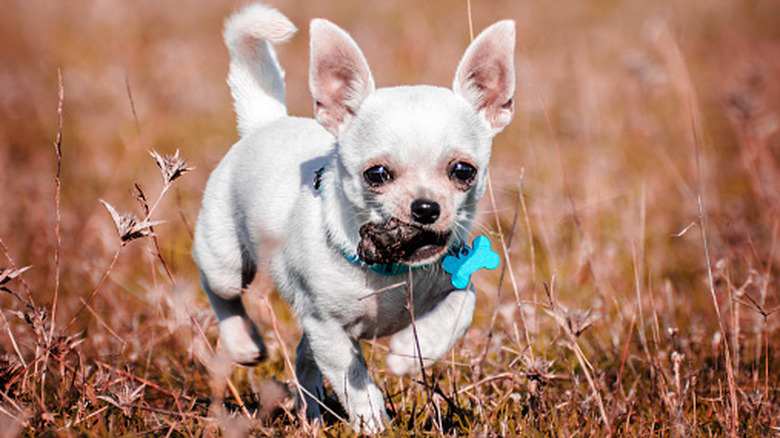
Considering that dogs are among the animals that are smarter than you think, they have some awfully quirky behaviors. They can suddenly zoom around a room and then walk in a circle before settling down, and they can have off-putting manners, like dragging and sniffing their butts. However, one of the most disgusting things you might see dogs doing is eating their own poop, which can be explained by science as an instinctual, evolutionary habit.
Scientifically known as canine conspecific coprophagy, dogs eating their own stools and those of other animals is common. The results of two web-based surveys conducted by veterinary researchers were published in Veterinary Medicine and Science in 2018. Of the more than 3,000 canine owners who responded, 23% reported that their pets ate poop at least once and 16% said their dogs did it at least six times. The scientists also found that 82% to 85% of feces-eating dogs preferred fresh stools up to two days old. In a preliminary report presented at an American Veterinary Society of Animal Behavior conference in 2012, the authors noted that 85% preferred other canines' poop over their own.
Lead author Dr. Benjamin Hart wrote in the preliminary report, "Our conclusion is that eating of fresh stools is a reflection of an innate predisposition of ancestral canids living in nature that protects pack members from intestinal parasites present in feces that could occasionally be dropped in the den/rest area." In a 2018 interview with The California Aggie, he explained that wolves would eat fresh poop in their dens as a way to avoid attracting parasites or to prevent infections, which is also one reason why animals lick their newborns. It seems that some dogs have retained this "sanitation instinct."
Dogs may also eat their own poop for other reasons
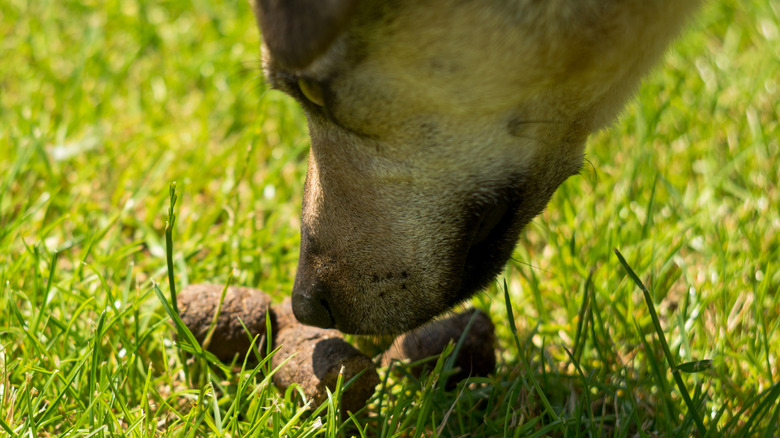
While canine conspecific coprophagy is normal for pups and mothers with the instinctual intent to keep clean, American Kennel Club chief veterinary officer Dr. Jerry Klein explains in a video interview that it's not the only explanation for why dogs have this habit. For example, it could be because of a nutrient deficiency in their diet or a health issue, such as diabetes. That's why it's important to consult a physician if you notice your canine frequently eating stools. Sometimes, dog food and feces smell similar, so they develop an inappropriate connection between the two.
Dr. Klein believes that the overall cause of this type of animal behavior is simply the development of bad habits. Studies have found that dogs who are confined to small spaces (such as kennels), left alone, and kept in close quarters eat feces more than others. In some cases, dogs develop anxiety from harsh punishments when they're being housetrained. They develop the bad habit of eating their own poop to eliminate the evidence to avoid the discipline, for which they're punished anyway, and the cycle continues. On the other hand, some pets who don't feel like their owners are paying enough attention to them could simply eat their own stool to get a reaction.
Fortunately, veterinarians and many canine owners have had success with various strategies to stop dogs from eating feces. Dr. Klein suggests practicing good hygiene by cleaning and picking up the stools as soon as possible. Since boredom and confinement are correlated with this behavior, Purina pet expert Dr. Annie Valuska suggests "adding some extra challenge to your dog's life in the form of environmental enrichment or physical activity."