

Scientists Finally Solved The Mystery Of The Golden Orb Discovered In Alaska's Ocean
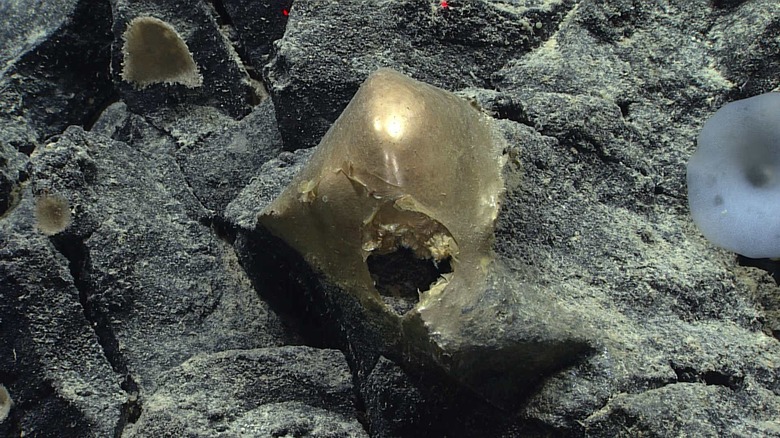
As scientists study Earth's oceans, they come across some intriguing mysteries. Among them are some of the strangest deep-sea discoveries, including a "golden orb" measuring about 4 inches in diameter in the Gulf of Alaska in 2023. Referred to as a "yellow hat" by one of the videographers at the time, researchers were stumped about what it could be; coral, an egg casing, or a dead sponge attachment were some of the initial guesses. Since then, they've been able to determine that it's dead cell remains from a huge deep-sea anemone.
The golden specimen was found about 2 miles beneath the water during the NOAA Ocean Exploration's Seascape Alaska 5 expedition. The researchers were able to retrieve the anemone remains using the Deep Discoverer, a remotely operated vehicle equipped with a suction sampler. Then, it was transported to the Smithsonian National Museum of Natural History for further study and identification. It took more than two years, but they determined that it's a relic of Relicanthus daphneae, and preprinted the finding in bioRxiv. One of the physical characteristics of sea anemones is that they can vary greatly in size, and the R. daphneae is a giant example commonly seen on the East Pacific Rise with diverse microscopic inhabitants.
NOAA Ocean Exploration acting director Capt. William Mowitt noted in a press release that they often find captivating mysteries like this one in the deep ocean. Being able to solve them "is why we keep exploring — to unlock the secrets of the deep and better understand how the ocean and its resources can drive economic growth, strengthen our national security, and sustain our planet."
How the scientists solved the golden orb mystery
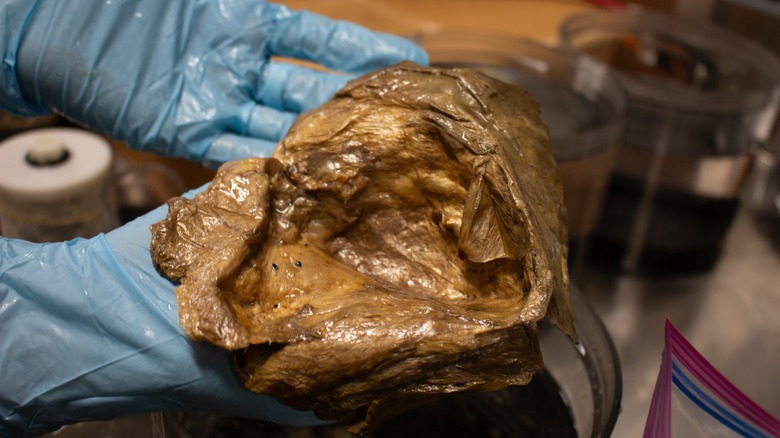
The golden orb specimen was found in August 2023, but it took until April 2026 for researchers to identify it. Because of the steps and procedures for conducting scientific research, it's normal for studies to take multiple years. This case was particularly complex, and involved a team of scientists from the NOAA Fisheries and the Smithsonian. NOAA Fisheries' National Systematics Laboratory director and zoologist Allen Collins explained that the researchers are used to working with hundreds of samples, "but this turned into a special case that required focused efforts and expertise of several different individuals. This was a complex mystery that required morphological, genetic, deep-sea and bioinformatics expertise to solve."
As outlined in the preprint, the now-identified R. daphneae remnant was preserved at room temperature in 95% ethanol, and the same was done for an extra tissue subsample stored in cryogenic tubes. The scientists used light microscopy, photography, and scanning electron microscopy to create a morphological characterization. Initial inspection didn't reveal the typical anatomy of an animal but, instead, a fibrous material loosely accumulated together and covered with a smooth surface full of cnidarian spirocysts, sticky organelles found on anemone tentacles. These characteristics are similar to specimens collected from the central Pacific in 2021 by the Schmidt Ocean Institute.
Additionally, the researchers used DNA barcoding that ended up being inconclusive. They were able to use whole-genome sequencing to get a better look, confirming that the sample had animal DNA and plenty of genetic material from the R. daphneae. By sequencing the mitochondrial genomes, the scientists determined that the 2021 and 2023 specimens were practically identical to the reference genome for the anemone, putting the mystery to rest.