

How Do You Die From Decompression Sickness? Maldives Rescue Diver's Death Explained
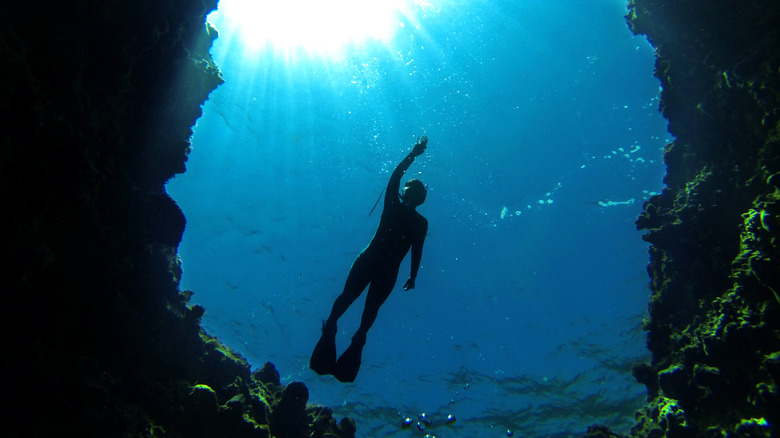
Cave diving is a sport reserved for the bravest of thrill-seekers, since even the most unassuming dives can be deadly, including this one in New Mexico. Most deaths, however, occur when divers push their limits far past the recommended depths. In May 2026, five Italian divers exploring a deep underwater cave in the Maldives disappeared, and it was soon after that they were pronounced dead. Rescue efforts turned into attempts to retrieve the tourists' bodies, and the Maldives government sent military divers into the deep waters for the search. Tragically, one of the divers, Mohamed Mahudhee, perished from the mission, bringing the death toll to six. But Mahudhee didn't die from drowning — he died in a hospital several hours after resurfacing from underwater decompression sickness.
Decompression sickness, better known colloquially as "the bends," can still kill up to 24 hours after a deep dive. It mostly occurs when a diver goes from the high-pressure depths of a body of water to the low-pressure surface too quickly. This rapid decrease in pressure can cause nitrogen dissolved in the body to form gas bubbles in the bloodstream and tissues. As small as the bubbles are, they can be deadly. Nitrogen bubbles in the body essentially act like blood clots, causing vascular obstruction and body-wide inflammation that can rupture nerves, tissues, and organ structures.
To reduce the frequency of decompression sickness, most governments set depth limits of around 100 feet for recreational diving. The cave in the Maldives' Vaavu Atoll that claimed the lives of the five Italians is at a depth of around 160 feet. After diving to the cave, Mohamed Mahudhee ascended too quickly. Why, exactly, has yet to be confirmed, but reports of rough weather likely made rescue efforts difficult. After resurfacing, Mahudhee was moved to a hospital where he died from decompression sickness.
Why there isn't a cure (only treatment) for decompression sickness
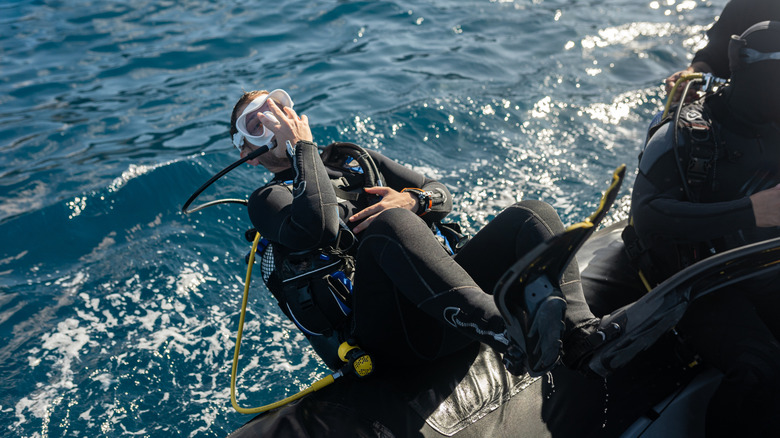
Decompression sickness symptoms only appear after nitrogen bubbles have already begun to form in the bloodstream, so any damage done to blood vessels, tissues, and organs can't be undone. Thus, the first step is to stop the bubbles from growing. Responders are urged to give someone experiencing the bends 100% oxygen in order to begin to flush out the nitrogen from their bloodstream. (Scuba tanks are filled with regular air from the atmosphere, so it's composed of 78% nitrogen, exactly like the air we breathe.) Simultaneously, all efforts should be to get the sick diver to a hospital, where they may even be placed in a recompression chamber.
If the response time isn't fast enough, the victim may succumb to a stroke, cardiac arrest, or even asphyxiation on their own blood due to the internal bleeding. The same is true when suddenly going from a pressurized environment to the zero-pressure of space, which demonstrates the power of pressure. Going from the high-pressure water of the ocean to the lower-pressure of the land too quickly can cause decompression sickness. And going from the low-pressure of the land to the zero-pressure of space too quickly would also cause gas bubbles to form in your bloodstream and tissues. The biggest difference between dying from the bends on land and in space is your chance of survival — surviving the vacuum of space is painfully unlikely if you were to get sucked into it.
Decompression sickness doesn't come from a pathogen or a genetic disease. Instead, it's the result of the very air we breathe suddenly becoming a gas while it's still in our blood. In the case of the Italian divers and noble Mohamed Mahudhee, "the bends" can also result in tragedy.