

Scientists Say This Is The Apex Predator Of The Ocean (And It's Not What You Think)
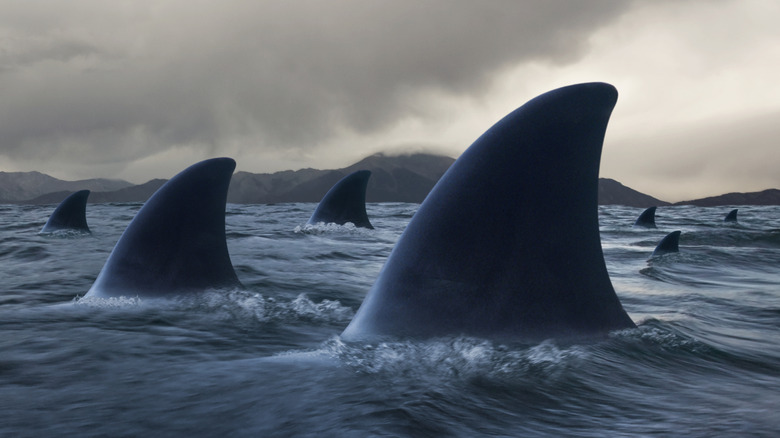
When it comes to the food chain of saltwater fish, you might think that sharks are the top predators. These powerful sea animals have hundreds of dagger-like teeth and several highly refined senses, including electromagnetism. Plus, thriller films from "Jaws" in 1975 to "Dangerous Animals" in 2025 are full of shocking scenes that depict sharks — especially great whites — as ocean terrorists. That might make it more horrifying to learn that orcas — which are one of the tough animal species that have no natural predators — are the true apex predators of the ocean.
Although they've earned themselves the nickname "killer whales," orcas are scientifically classified in the Delphinidae family, which makes them closer related to dolphins. Orcas were once considered all the same species, but a study published in Royal Society Open Science in 2024 found that there are actually multiple ecotypes or subspecies. In general, though, these marine mammals have distinct mostly black bodies with white undersides and can grow up to 32 feet long and weigh up to 11 tons.
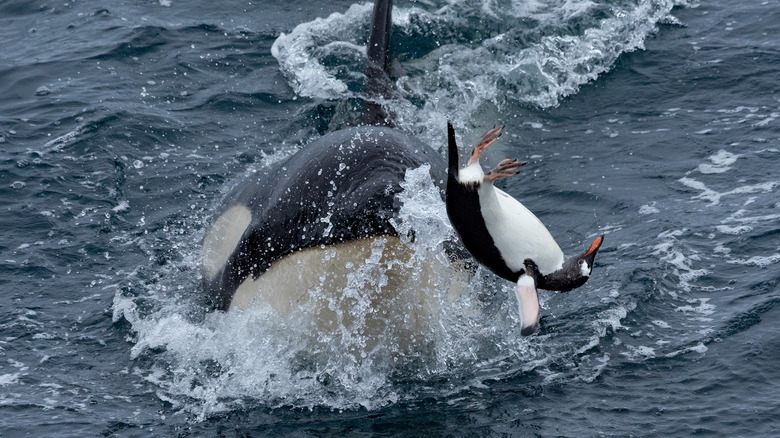
Living for 30 to 90 years, orcas spend most of their time in the cold waters of the north Atlantic and Pacific and around Antarctica. Along with the whales that eat penguins and a variety of fish, they're also one of the marine animals that eat seals, sea lions, dolphins, other whale species, and even sharks. Their diet and size — and the fact that killer whales have no natural predators — offer plenty of reasons that they're considered the ocean's absolute apex predator. However, those aren't the only reasons.
Why orcas are considered the apex predators of the ocean
Another reason orcas are the seas' apex predator is that orcas are incredibly smart because, according to a study published in Brain Structure and Function, their brains are among the largest of all animals and support cognitive, sensorimotor, and sensory functions. Like humans, neuroscientist Dr. Lori Marino explains in a lecture that they have highly developed cingulate sulcus and insula regions of the brain, which contribute to their empathy, self-awareness, and social cognition. Killer whale brains also have a paralimbic system with more intricate folding than human brains, which scientists believe allow them to process higher-level thinking alongside emotions. In other words, this uniquely elaborate area supports abstract thinking.
Because of this extremely high intelligence, orcas have the skills to develop hunting tactics, often working in pods (or social groups) similar to how wolves hunt in packs. Putting their classification as the apex predator of the ocean over the top, though, is their brutality. Killer whales have been known to hunt blue whales — the biggest animal on the planet, with the largest in the world weighing more than thousands of people combined. On top of that, researchers have observed and published in The Scientific Naturalist evidence of these animals ruthlessly killing great white sharks for their livers — an ocean mystery that left scientists stumped over great white shark deaths for a few years.
Generally, the carcasses of the great whites are left to scavengers or wash up on the nearest shore. Meanwhile, a paper published in the African Journal of Marine Science reports that other sharks flee from the area for fear of becoming the orcas' next meal. Who could blame them?