

What Happens To Your Body At Underwater Depths Of 160 Feet
Ocean diving can be a wondrous experience that gives people the chance to get close to marine wildlife and get away from the monotony of the everyday schedule. While exploring under the sea's surface provides a sense of freedom, not taking precautions can be a devastating endeavor. Diving up to 130 feet (40 meters) deep can generally be safe with standard scuba equipment and training, but going deeper to 160 feet (almost 50 meters) has devastating effects on the body.
Hydrostatic pressure or underwater pressure increases with depth by one atmosphere (101 kilopascals) for every 33 feet. By the time a diver reaches 160 feet, the pressure on the body has increased to almost 6 atmospheres. Since hydrostatic pressure pushes against you from all sides, the biggest concern is that the ocean's pressure can crush you by collapsing air-filled spaces in the human body, like the lungs. Deep-sea animals have adapted to that pressure and either don't have such air-filled pockets or have collapsible lungs and ribs, such as sperm whales.
Because of the difference in hydrostatic pressure compared to surface pressure, another effect is that soft tissues in the body's airspaces can become damaged — called barotrauma — without proper pressure equalization. Middle ear barotrauma, for instance, involves the tissues swelling and pushing against the eardrum. Although narrow, the connecting passageways in the sinuses can develop barotrauma as well.
Also, the pressure of nitrogen in breathing gas increases as divers swim deeper, and when it diffuses into the blood and tissues, it can cause narcosis at more than 100 feet. Since nitrogen narcosis impairs judgment, it can lead to death. Increasing hydrostatic pressure can raise oxygen levels in the blood, too, which can be toxic and cause altered consciousness, seizures, visual disturbances, and even death.
Why returning to the surface from 160 feet under can be just as dangerous
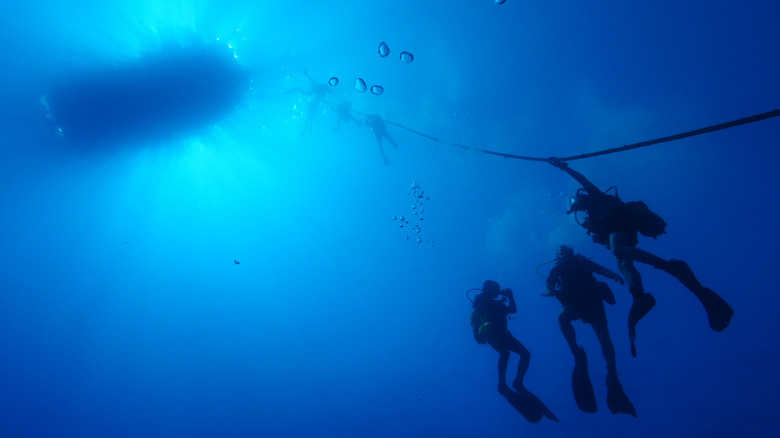
While diving and exploring the ocean at 160 feet under the surface can have some severe and even deadly effects on the human body, ascending to the surface from such a depth can be just as dangerous. The main effect it can have is decompression sickness, which caused the death of a Maldives rescue diver while searching for five missing Italian divers.
As divers make their way to the surface, the hydrostatic pressure on their bodies eases. The nitrogen in their blood from the compressed breathing gases is also released, but if it happens too quickly, it can create bubbles in the bloodstream, which is referred to as decompression sickness. Also called "the bends," this illness can cause severe pain in the lymphatic and musculoskeletal systems, injury to the brain or spine, and complications with the lungs that can be fatal.
Ascending too quickly can cause lung overinflation as the compressed gasses increase in volume and stretch the organs to their limits. As a result, lung tissue can become damaged, and gas bubbles can eventually escape into capillaries and veins. At that point, an arterial gas embolism (AGE) can occur whereby gas bubbles enter other body tissues, such as the brain and heart, damaging vessel walls and disrupting circulation. The most common initial signs of AGE are dizziness, confusion, and loss of consciousness. However, severe cases can cause chest pain, irregular heartbeat, rapid breathing, shortness of breath, and sudden blood pressure drops.
How special diving equipment and training protect the body at 160 feet underwater
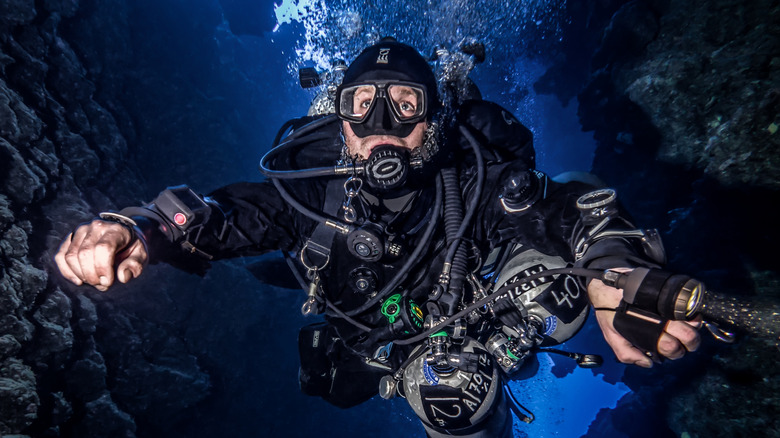
Because of all the risks involved with diving beyond 130 feet into the ocean, which is considered recreational diving, many divers don't venture deeper than that. In fact, going beyond that point is considered technical or decompression diving, which requires specialized equipment and training.
There are two types of technical diving. Open-circuit technical diving involves a regulator and a pair of cylinders of gases — concentrated nitrogen and oxygen, as well as helium to prevent nitrogen narcosis and oxygen toxicity at great depths. Also, the divers exhale into the sea. Closed-circuit decompression diving involves more complex equipment, including computers, multiple cylinders and hoses, and sensors. It involves a separate canister, too, for recycling, filtering, and mixing the breathing gases so that the divers always breathe the correct blend depending on their depth. In both cases, the combination of gases needs to be just right to avoid the effects of hydrostatic pressure on the air in the body.
Divers who descend to 160 feet must undergo additional training — which includes a handful of courses than what's required for recreational diving — to learn how to operate technical diving equipment. Also, the extra training teaches them about how nitrogen narcosis affects the body, alongside proper descension techniques and emergency procedures. Decompression stops are a vital part of the education as well to prevent decompression sickness as they ascend from the depths. During their ascent, divers stop multiple times for several minutes each time so that the nitrogen dissolved in their bodies has time to be released safely.