

That Stringy, White Goo On Egg Yolks Is Easily Explained By Science
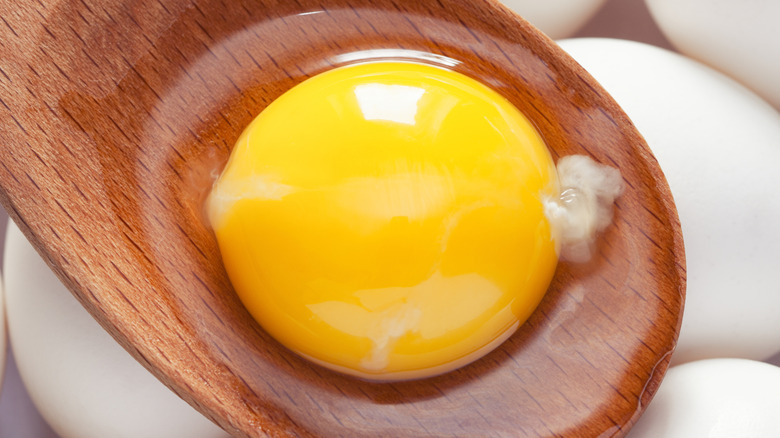
As you're cracking eggs for your morning breakfast or favorite baked goods, you might notice that they don't all look the same. For instance, the egg yolks can range from orange to yellow, which is easily explained by the carotenoid concentration of the hen's food. And while the difference between thick and thin eggshells depends on physiological and environmental factors, another characteristic of yolks is a white, stringy, goo-like substance. While some people are grossed out by it because they think it's the umbilical cord, it's easily explained by science as a normal part of the egg called the chalaza.
The chalaza in a chicken egg is a thick, inner layer of the yolk, and it's mainly made of protein like the egg white. In fact, this gel-like structure is the first to naturally form in the infundibulum (part of the hen's oviduct) from ovomucin (a glycoprotein in egg white), which contains the subunits mucin-5B and mucin-6. There's a much higher concentration of these subunits in chalaza, and their poor solubility is what makes the chalaza so visible in the yolk. Attached to the membranes of the shell and yolk on each end of the egg, the chalaza keeps the yolk anchored in the middle of the egg and is vital for the embryo's safety.
Why do some egg yolks have a chalaza but others don't, and is it safe to eat?
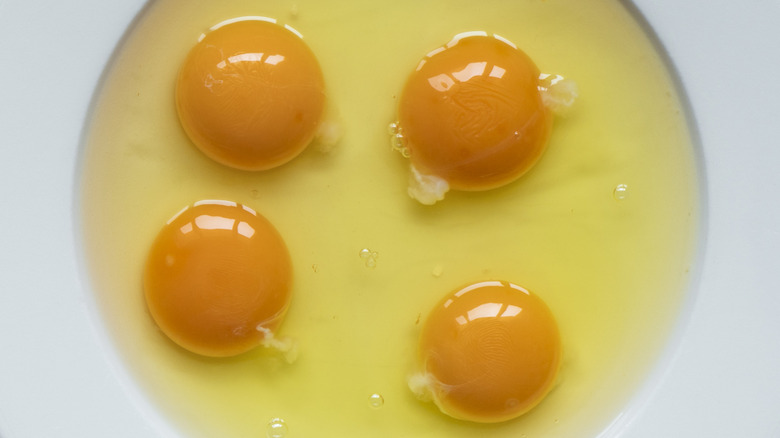
As science explains that the difference between brown and white eggs is simply the hen breed, there's also a simple reason why you can see one chalaza or both chalazae on the yolk when you break open an egg. Researchers explained in a paper published in Poultry Science that the carbohydrate chains in the gel-like ovomucin undergo depolymerization during storage. That's a fancy term to mean that they decrease in size on a macromolecular level, while the chemical composition and monomer unit structure remain. As a result, the white breaks down, making the chalaza more translucent the longer that the eggs are in storage.
That's not the only reason, though. The hen's age is another factor, with young hens producing bouncy, noticeable chalaza in the yolk. Generally, eggs from older chickens are waterier and weaker, so the chalaza are less visible. Because of these two factors, seeing a chalaza actually indicates that an egg is fresher than most and comes from a young hen. If it's a prominent feature, it also suggests that the egg is of Grade AA or A quality.
The appearance of the white stuff floating or stuck to the yolk might make you cringe, but it's totally edible. Most of the time, a chalaza visibly disappears when the egg is cooked anyway because the entire egg white becomes opaque. If it's too off-putting, though, you can use a kitchen tool to pinch it out or a fine-mesh sieve to strain it out.