

Gross Things That Happen If You Don't Poop For A Week
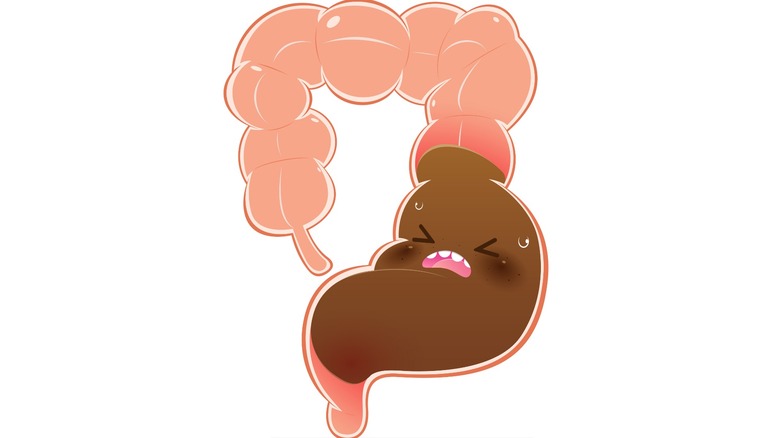
Bowel movements are something of a taboo subject in conversation, largely because feces is full of bacteria and stinky — both of which are simply gross. Understanding how bowel movements work, though, is an important part of comprehending overall wellness. And, like holding in urine is bad for your bladder and overall health, for instance, not pooping for a week — which is a strong indication of constipation — can have consequences for your intestines.
After the food you eat is broken down by many types of digestive enzymes in your stomach and small intestines, it passes into your large intestine and is broken down further for any remaining nutrients. Whatever is still too large or left over becomes waste, and the main job of the colon (the second part of the large intestine between the cecum and rectum) is to absorb water from that waste. Because of that, the waste becomes dryer, harder, and more compact the longer that it sits, making it more and more difficult to pass when you can eventually relieve yourself.
Meanwhile, the body begins to change by the third to fifth day as the hardened stool puts pressure on the inner walls of the intestines. The result is abdominal pain and significant bloating as gut bacteria continue fermenting despite the standstill, which traps the resulting excess gas. By the one-week point, the hard stool can become impacted, creating a blockage that's painful. Straining to empty the bowel can cause swollen, inflamed rectal veins or hemorrhoids, and eventually passing the hard mass may tear the lining of the rectum.
Normal bowel frequency and when to see a doctor

It's only natural to wonder what's normal for a bowel movement. You might question, for example, what it means when your poop floats instead of sinks — which could be healthy or indicate an underlying condition depending on the circumstances. Since not pooping for a week is clearly not normal, though, what is? A gastroenterologist evaluated the journals kept by 268 people between the ages of 18 and 70, and the results excluded those found to have an organic gastrointestinal disease, irritable bowel syndrome, or abnormality caused by medication. According to the findings published in Scandinavian Journal of Gastroenterology, pooping anywhere from three times a day to just three times a week is considered normal.
However, colorectal surgeon Massarat Zutshi, MD, explains in an interview with Cleveland Clinic Health Essentials that being constipated every once in a while is also normal. Some people are used to trying home remedies when they struggle to have a bowel movement — such as drinking more water, consuming more fiber or a supplement like Benefiber or Metamucil, and getting more exercise. In fact, apple cider is a heart-healthy juice science says can also help you poop because of its soluble-fiber content.
When these efforts fail or sudden constipation lasts longer than a week, it's time to see a doctor. You could even have an emergency on your hands if you suffer from fecal impaction that results in an obstruction or from protruding or thrombosed hemorrhoids. Although rare, ongoing constipation can create a tear in a weak spot in the intestinal wall, which is called a perforated colon. Dr. Zutshi recommends going to the emergency room if you have severe bloating and abdominal pain, see blood in your stool, experience weight loss, and are vomiting.