

The Fastest Bird In The World Is One Of The Apex Predators Of The Sky
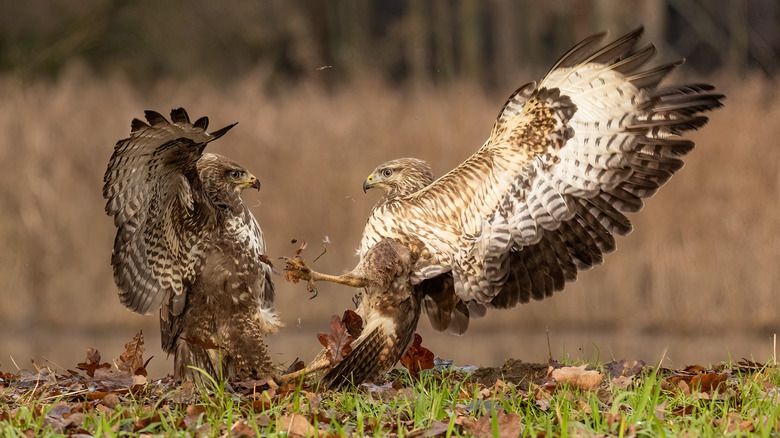
There are some truly amazing animal in the world. For instance, the African black-footed cat is considered one of the smallest but the deadliest wild cats in the world, while the apex predator of the ocean is the killer whale. When it comes to the skies, though, the fastest bird is also one of its top predators: the peregrine falcon.
As a medium-sized bird, the peregrine falcon has an interesting history. The pesticide DDT was widely used in the mid-20th century to limit insect infestations. Unfortunately, that contaminated the food supply for the small birds that peregrine falcons preyed upon. This domino effect led to reproductive issues that put the population at risk, but scientists collaborated to save this animal species from the brink of extinction with captive breeding.
Even more interesting, peregrine falcons are amazing fliers — comfortably cruising the skies at 24 to 33 mph on average. That's already slightly faster than the average 20- to 30-mph cruise speed that most birds achieve. However, what really makes the peregrine falcon stand out is its stoop (dive) speed, which can reach around 240 mph as it attacks prey. By comparison, the average dive for predatory birds tops out at around 100 mph. This high-speed maneuverability during flight is owed to its short tail and long, tapered wings, while specialized bony structures (tubercles) in its nose regulate the air pressure created by the speed so that the falcons can still breathe. Together, these characteristics make it rather challenging for its prey to escape.
Speed isn't the only characteristic that lands peregrine falcons among the sky's top predators
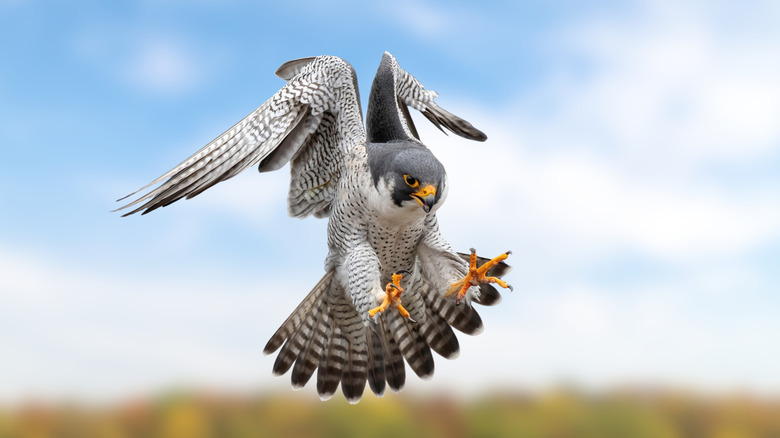
Since being saved from extinction, the peregrine falcon now comprises one of the biggest bird populations across the globe, living on several oceanic islands and every continent except Antarctica. Each of the 19 subspecies has a coloration that helps it stay concealed in its native environment. On top of that, the species has all of the characteristics of falcons and other raptors in addition to a remarkable ability to adapt and survive.
The peregrine falon's hunting behaviors are also why it's a top airborne predator. Generally, it perches as high as possible so that it can watch for its prey from above, although it sometimes hunts while cruising in the air. Most of its diet consists of smaller birds — from hummingbirds to sandhill cranes — but it may eat small mammals, insects, and lizards as well.
Once prey is within its incredible eye sight, the peregrine falcon takes to the air and begins a stoop, using its speed to keep the element of surprise. When it catches the animal, the bird's strong talons bend and lock around it. The predator may even use one talon like a fist to strike and stun its prey before latching on with the other talon — all happening in mid-air and requiring exceptional coordination. Then, it aims its sharp curved beak at the base of the prey's skull to sever the spinal column.
Despite the peregrine falcon being a force to be reckoned with in the sky, it's not a true apex predator, which is an animal that has no natural predators. Bigger predatory birds, like golden eagles, may prey on it.