

A Study Revealed This Apex Predator Can Swim Much Further Than Scientists Expected
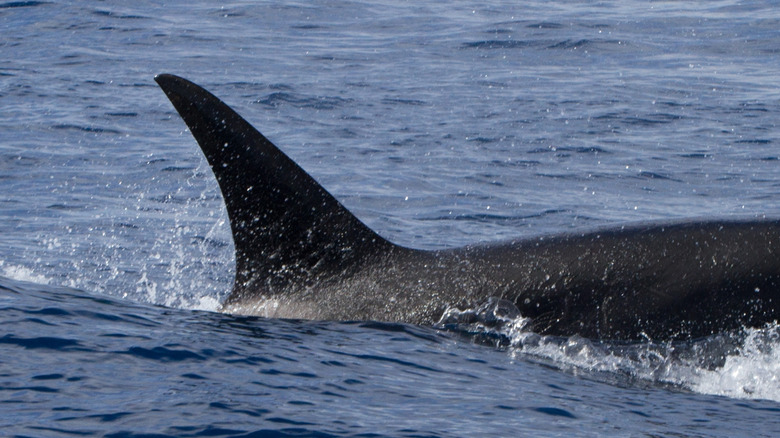
The ocean is full of complex and fascinating marine life, but some significant natural barriers make the research of these organisms incredibly difficult. Some portions of the ocean are especially inhospitable, invoking the sorts of old sailors' tales that spark dread at their power and expanse. Therefore, many marine species retain some mystery and evade the concerted efforts of many scientists to characterize their behaviors. But one study, recently published in the journal Marine Mammal Science, used 20 years' worth of photos collected from fisheries, research vessels, and tourist boats and found that we have been underestimating the apex predator of the ocean — the killer whale — and one type in particular that swam over 2,500 miles.
All killer whales belong to the species Orcinus orca, but they fall into five different ecotypes (although some researchers suggest each should actually be its own species). Each of these ecotypes exhibits regional and morphological variations, and some have been more elusive than others. The type D killer whale was characterized based on three mass strandings (occasions in which groups have become stuck on the beach or in shallow waters). One of those events occurred in 1955, and the other two did not happen until the 2020s. Type D killer whales are also referred to as Subantarctic killer whales. As you can imagine, this ecotype is difficult to study, based on its resident portions of the ocean. However, this recent paper has revealed that these creatures actually tend to travel.
The big swim
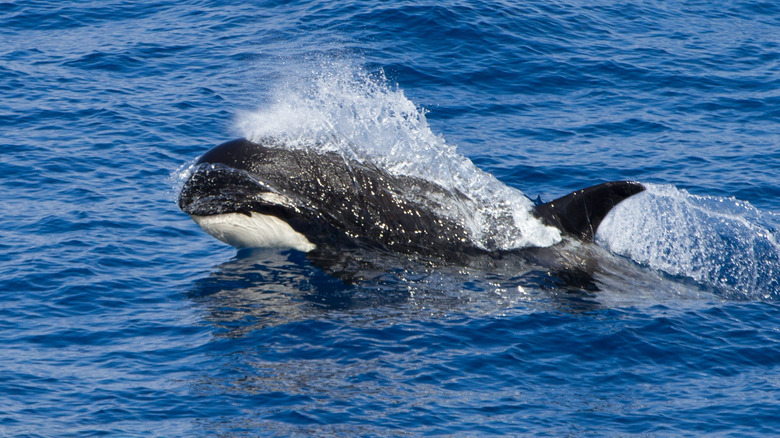
While it was previously thought that killer whales do not travel great distances over time, research over the past couple of decades has begun to contradict that notion. What is interesting about this most recent study is that, while most of the large movements of killer whales have been noted across latitudinal distances (north and south of the equator), the type D killer whales that were observed traveled a great distance longitudinally (movements west and east). Overall, 10 type D killer whales were spotted in both the South Atlantic and the southern Indian Ocean. These are 4,428 kilometers (about 2,571 miles) apart.
But not all type D killer whales seem to enjoy such a long commute. The researchers also observed two different large groups: 78 killer whales in the southern Indian Ocean and 29 near southern Chile. There seems to be a pretty clear reason why these particular killer whales remained in the same general area for years. Type D killer whales appear to love a diet of Patagonian toothfish, and these areas are populated with longline fisheries. Such fisheries work by extending a line through the ocean punctuated with baited hooks. Type D killer whales hang around these areas and are essentially provided with a toothfish buffet. The killer whales near Chile were spotted consistently in the area for seven years. So, while some type D killer whales like to go the distance, others are comfortably established and never leave their hometown.
There are more fish in the sea
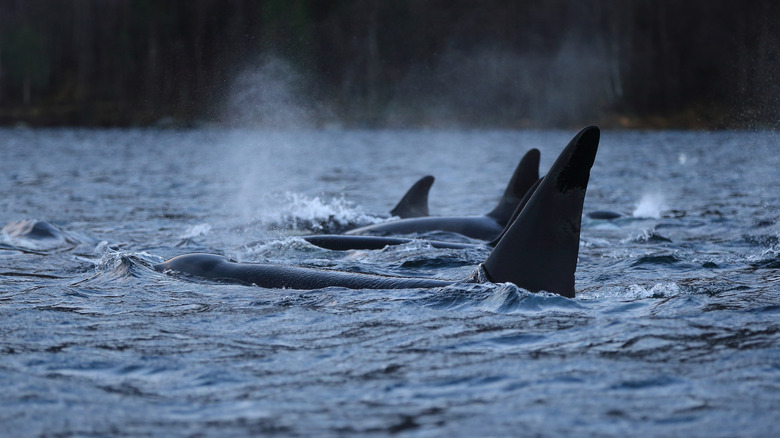
Some marine biologists have grown concerned for type D killer whales over the years. This ecotype is known as one of the most highly inbred mammals in the world. Type D killer whales are very insular, and although they regionally overlap with other killer whale ecotypes, they do not interbreed. Such behaviors have led to incredibly low genetic diversity and generated concerns of a genetic bottleneck. Some of these observations were based on the discovery that type D killer whales found near Chile and New Zealand both had incredibly similar genomes. But this more recent study of these elusive creatures might throw a wrench into some of those assumptions.
One of the other surprising findings was the sheer number of individuals identified during this study, which was 207. Such an observation actually suggests that there are more individuals within this ecotype than in some other killer whale ecotypes. What's more, although the killer whales from Chile and New Zealand that were previously genotyped were geographically far away and collected more than 60 years apart, they might have actually been direct kin, which would explain their nearly identical genomes. Based on this study, they could travel such a distance, and 60 years fits within their lifespan. So, there is still a lot to learn about these killer whales, and, while this study presented some groundbreaking findings, we might be left with more questions than answers.