

Scientists Found Something Unexpected Hidden Inside Squirrel Poop In Canada
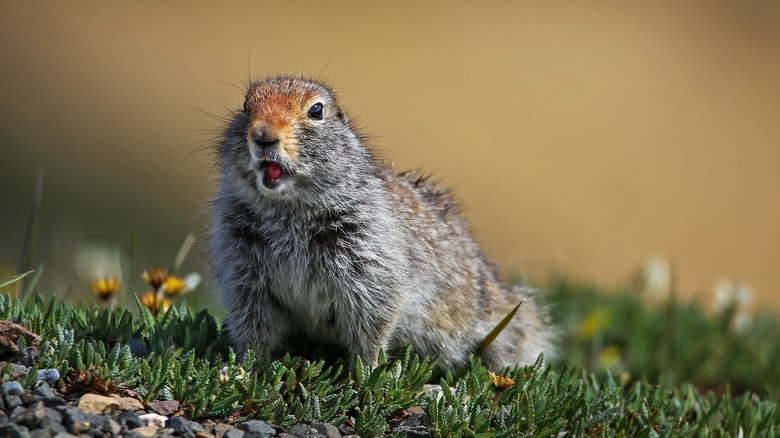
It may not be glamorous, but examining animal poop provides a wealth of information about the fauna, and the fecal samples don't have to be fresh. While digging in the unglaciated eastern Beringia — a region that spans parts of Alaska and Yukon, Canada — scientists discovered a mountain of ancient environmental DNA (aeDNA) from ground squirrel droppings that they didn't expect.
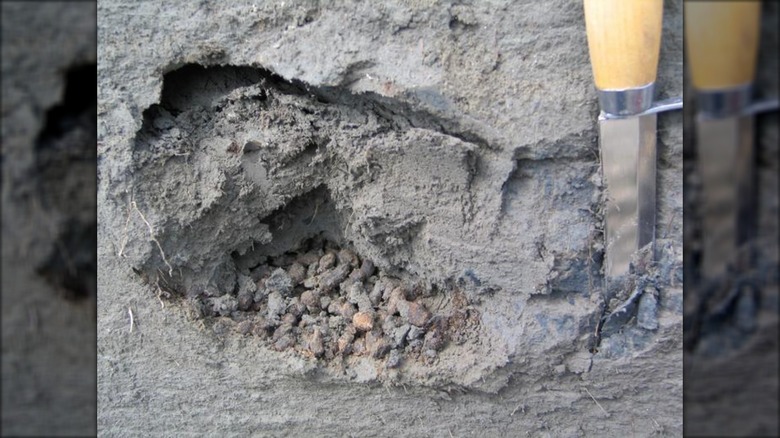
Researchers from several universities used climbing gear and pickaxes to excavate hundreds of ancient feces samples called coprolites, one of the different types of fossils, from the dens and tunnels that prehistoric ground squirrels called home in the now icy rock faces. At McMaster University's Ancient DNA Centre, they used chemicals to isolate the DNA in the frozen fossilized feces and analyzed it against control samples. The scientists reported in Nature Communications that all 13 of the analyzed coprolites — aged at between 30,000 and 700,000 years old (the oldest ever found and sequenced) — contained a diverse range of aeDNA signals. Along with known species of plants, insects, and small animals, the poop revealed a diet of caribou, steppe bison, wild horses, wolves, woolly mammoth, and other large animals.
The idea of a ground squirrel preying on much larger mammals may seem strange. As omnivores that live in the tundra, though, ground squirrels aren't finicky eaters. Study lead author and Hakai Institute paleogeneticist Tyler Murchie told The New York Times, "If there's a lot of seeds and nuts and other plant materials around, they'll eat that, but if there isn't that, or if there happens to be a carcass nearby, they'll definitely eat that carcass."
The significance of DNA hidden in frozen coprolites
Analyzing DNA from fossilized bone and feces is important for learning more about how animals live and evolve over time and even how to prevent them from going extinct. In fact, scientists are using poop to save the critically endangered Gilbert's potoroo in Australia. However, scientists face two uncontrollable challenges: the fossilization process itself and time.
The fossilization process can occur in different ways, but the organic matter in many bones, teeth, and other tissues can be replaced with minerals — a process called premineralization. Meanwhile, chemical reactions begin as soon as a living organism dies. Both of these processes result in degraded DNA, and then it's a race against the clock. However, a basic rate of degradation is difficult to pin down because so many other uncontrollable factors — such as oxygenation and temperatures — affect how long DNA lasts in fossils. What is certain, though, is that fossil DNA preserved in permafrost like the ground squirrel feces recovered from eastern Beringia lasts longer than non-frozen samples.
With the frozen poop from these types of squirrels, researchers can use the retained aeDNA to re-create ancient communities and trace ecological changes across climate and evolutionary cycles. Study senior author, McMaster Ancient DNA Centre director, and evolutionary geneticist Hendrik Poinar said in a press release, "We can look at genes under selection due to climate change in the past and that may help us think about how animals today may, or may not, adapt to our current warming climate." Additionally, scientists expect that the wealth of DNA they've extracted opens the door to future discoveries and will provide even more value as analysis methods and technology improve.