

The Halley's Comet Doomsday Prediction Of 1910 Never Happened – But What If It Had?
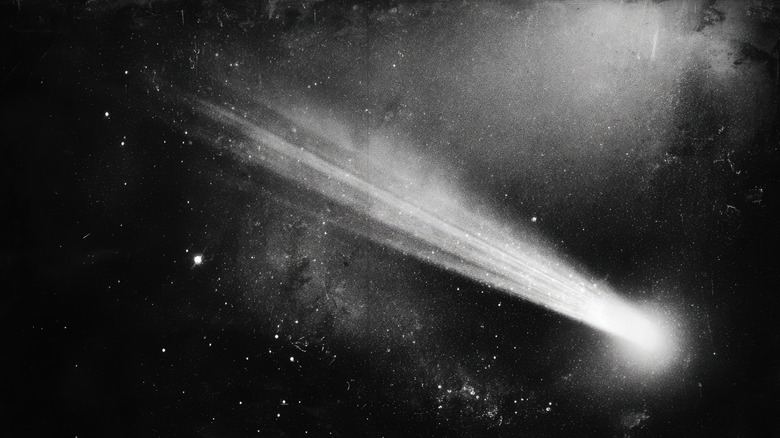
In 1910, people around the world watched the skies with anticipation, and no small amount of fear, as Halley's Comet made its way past Earth on its way around the sun. Returning every 76 years, Halley's Comet passed around 14 million miles away from Earth. Some feared an impact by the comet while others had concerns about what would happen if Earth passed through its tail, which measured some 15.5 million miles long. Like other doomsday scenarios, such as hit by a so-called lost asteroid in 2024, none of the doomsday scenarios of the day came to pass. But what if Halley's Comet had collided with Earth?
The exact effects would depend on several factors such as the angle at which it struck and whether the comet broke apart or stayed intact until impact. However, no matter what, the effects would have been devastating for life on Earth. Scientists have estimated that Halley's Comet has an effective diameter of around 6 miles and a mass of 150 billion to 300 billion tons. Scientists calculate that the impact thought to cause the Cretaceous-Paleogene extinction event 66 million years ago was caused by an asteroid less than a quarter mile across with a mass of 54 million tons. Additionally, that asteroid had an impact speed of 12 miles per second while Halley's Comet traveled at around 33 miles per second when it passed closest to the sun in 1986.
Fear of a long tail
While some feared an impact in 1910, the most common concern regarded what would happen when the planet passed through Halley's Comet's tail. The comet's passage in 1910 was the first time humans were able to take close observations of its structure and composition. Scientists also analyzed light reflected off of different parts of the comet, including its tail, to figure out what it was made of. Some newspapers hyped up fears with headlines like "Comet May Kill All Earth Life, Says Scientist" (via Britannica).
A main concern was the discovery of cyanogen gas in the comet's tail by astronomers at the Yerkes Observatory in Wisconsin in February of 1910. Cyanogen is similar to cyanide as it can keep cells from using oxygen. Others speculated that hydrogen from the comet's tail could combine with oxygen in the atmosphere and make Earth's air unbreathable; however, nobody could explain how that might happen. As it turns out, while the tail of Halley's Comet contained cyanogen, the gas was very widely dispersed and would have decomposed in Earth's upper atmosphere if Earth had passed through the comet's tail. Not that it ultimately mattered; it turned out that Earth missed the tail by roughly the distance between Earth and the moon.
A world-ending impact
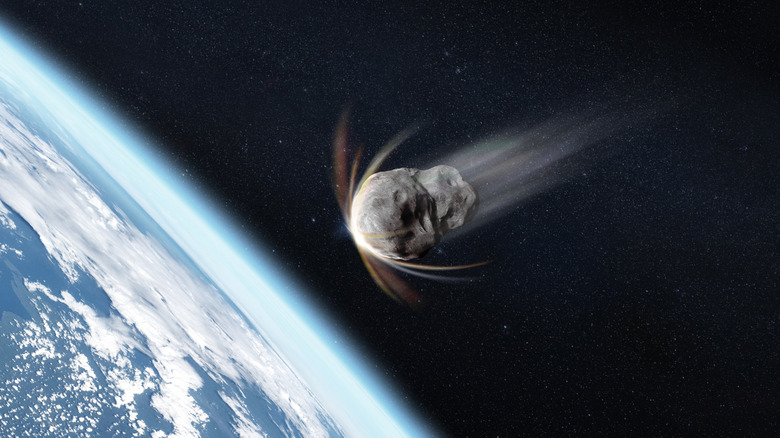
We now know that the gases in a comet's tail couldn't poison the atmosphere in the way people feared in 1910. Although passing through a comet's tail is nothing to worry about, an impact would be disastrous. A comet less than 100 yards across would explode high in the atmosphere, causing little to no harm. But an impact by one the size of Halley's Comet would release energy equivalent to 100 million megatons of TNT.
The impact would create a massive fireball. If the comet hit the ocean, it would cause a devastating tsunami. Hitting land would blast debris high into the atmosphere. Dust, debris, and smoke would cover most of the planet, blocking sunlight for more than a year. The resulting drop in sunlight and temperatures would cause many plants, including crops, to die off. Dust containing high levels of sulfur, either from the comet or from the ground, and nitrogen oxides generated by the heat of the impact would drive production of acid rain. This would kill remaining land plants and ocean life when acid rain enters the water cycle and drains into the sea. The dust and gases kicked into the atmosphere by the impact would also severely damage Earth's ozone layer.
Because of their higher relative speed and large size, a comet impact would be disastrous. Fortunately these bodies are also easier to keep track of, and humanity will watch the skies for Halley's Comet again in 2061.